

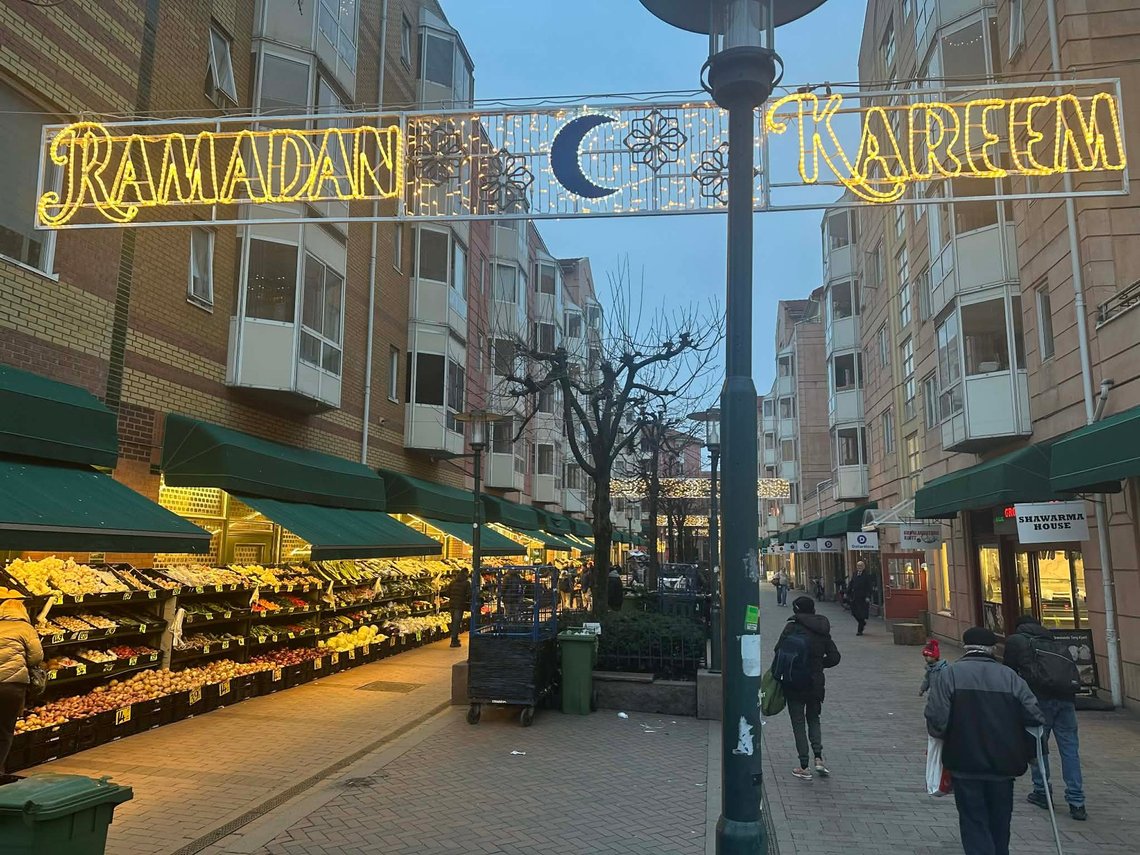
In 2005, it was prohibited to sing “O thou who feedest the little bird” in Norwegian schools. Twenty-one years later, school church services have been cancelled while Ramadan and Eid are celebrated throughout the entire system, including in kindergartens. A parent in Kristiansand believes the kindergarten has crossed the line when the child comes home wanting to “fast and celebrate Eid as an adult”. The local Pensioners’ Party also reacts strongly. “This is not about diversity – it is about us being in the process of losing our direction,” the party asserts.
Islam in the kindergarten
A parent in Kristiansand believes the kindergarten has crossed the line when the child comes home wanting to “fast and celebrate Eid as an adult”. The complainant is not opposed to diversity, but believes the public sector should not engage in religious influence over children, writes Avisen Kristiansand in a case concerning an angry parent.
The newspaper has also shared the case on Facebook, with the question: What do you think – is it possible to celebrate too much diversity in kindergarten?
The post has received an enormous number of comments, from across the spectrum, from those who find it cosy with Islamic celebration and diversity, to Mary-Ann, who is absolutely not enthusiastic. “This is indoctrination, and nothing else! Put an immediate stop to this! I would have reported the kindergarten if it had happened to my child,” she writes.
The Pensioners’ Party fears for Norwegian culture
The local Pensioners’ Party is also indignant, sharing the newspaper article on Facebook with unequivocal accompanying text. Under the heading “WHEN NORWAY FORGETS ITSELF – cultural heritage in retreat”, they write, among other things:
When a child comes home and says it wants to “celebrate Eid and fast”, without this being rooted in the home, it is no longer neutral knowledge. It is influence. And that is not the role of the kindergarten.
Kristiansand and our country are on the wrong course. Respect for diversity can never mean that we deprioritise our own culture, history, and value base. If we do not set boundaries now, we risk losing what actually binds us together as a society.
We in Kristiansand Pensioners’ Party – Children, Family and Pensioners are crystal clear – we shall build our work and our thinking on Norwegian cultural heritage. We care.
None of the comments disagreed.
“O thou who feedest the little bird” prohibited in 2005
In 2005, things were different. Then Minister of Education Øystein Djupedal from the Socialist Left Party (SV) demanded that teachers who sing grace with schoolchildren should cease doing so immediately. And they did, as far as we know. Even though the little grace is innocence itself, and has been sung at dinner tables and in Norwegian schools for generations.
O thou who feedest the little bird, bless our food, O God. Amen!
Thus, it became too much for Minister of Education Djupedal, and also for the Directorate for Education and Training. Djupedal referred to the provisions of the Education Act stating that the school shall be inclusive and unifying, and held that table grace, and naturally hymn singing as well, conflicts with this.
Table grace such as “O thou who feedest the little bird” may cause non-Christians to feel excluded, and thus the fundamental principle of an inclusive school is breached. The ban on grace will also affect the vast majority of after-school programmes (SFO), as long as they are part of the public school, reported VG in 2005.
Grace had to be agreed with parents
– Grace is not desirable in school. If a class nevertheless chooses to sing religious grace, it must be done in agreement with the parents. If parents do not wish their children to participate, the pupil must be given an adapted programme within the curriculum, said communications adviser Kristine Strømmen at the Directorate for Education and Training. She added that such confessional elements may have an excluding effect on pupils with a different religious affiliation, wrote VG at the time.
Celebrating holidays from a diversity perspective
Fast forward to 2026, and Kristiansand municipality and the kindergarten sector have created a dedicated online resource so that various holidays and commemorative days can be celebrated from a diversity perspective. The ideas are developed in collaboration with the University of Agder, and they have published pages on how Islam may be celebrated down to the smallest detail. Stories about Muhammad and such must, of course, be conveyed. Both song and dance from the Islamic world are proposed, which Muslim parents may perhaps contribute by teaching. Cards may be drawn, but one must ensure that the children do not draw any living beings, since this is prohibited in Islam, but “fortunately, a rich artistic expression has grown around this prohibition. Patterns, borders, geometric forms, and calligraphy abound in Islamic culture”, it states in the proposals to the kindergartens. Plus an encouragement that the children might write something on the cards, then place them in postboxes in the local community, or take them home.
And then there is the food. No fasting without food. “An Eid celebration in the kindergarten is an excellent opportunity for children to become acquainted with new and exciting tastes and aromas from different parts of the world. Let the children participate in making and eating the delicious food”, reads the proposals from Kristiansand municipality.
Christmas and Easter omitted
Those were from the proposals for Eid al-Fitr – the largest Muslim holiday. In addition, they have proposals such as “Vesak – Buddhist holiday”, “Diwali – a Hindu holiday”, and “Sámi National Day” – and there is also one called “Easter! – and Shrovetide. A Christian holiday.” The latter led to an empty link. It is otherwise somewhat curious that they do not also have an online resource regarding the celebration of both Christmas and Pentecost. Jewish holidays were otherwise not mentioned at all.
Inclusive pedagogy from OsloMet
It is not only Kristiansand that focuses on Islam and diversity for children. Scholar of religion Ragnhild Laird Iversen at OsloMet is concerned with religious diversity and inclusive pedagogy. Among other things, she has written the article “Islam in the kindergarten: Ramadan and Eid” (2020) for the website religionsundervisning.no, and there she essentially encourages more Islam in the kindergarten.
“Do you mark the Muslim holiday Eid in the kindergarten? Do you talk about Ramadan? Do you use stories, concrete materials, or practical and creative activities to make religious diversity visible with a focus on Islam? Based on the Framework Plan, we may hope that many will answer yes to this question.”
And further:
“It is better to begin on a small scale than to drop it entirely. Put up a poster wishing a happy Eid to all who celebrate. Write the date of Eid into the weekly or monthly plan so that you remember to give children who wish the opportunity to talk about how they celebrated when they come to kindergarten the following day. Borrow or purchase a book so that you can read about how Eid may be celebrated, for example ‘God id’ by Gudny Ingebjørg Hagen. You can also use the short story about the Fox Rafi and Ramadan.”
We do not know what Associate Professor Laird Iversen thinks about the table grace O thou who feedest the little bird, but perhaps she does not consider it as inclusive as Muhammad, Rafi, and Ramadan?


