

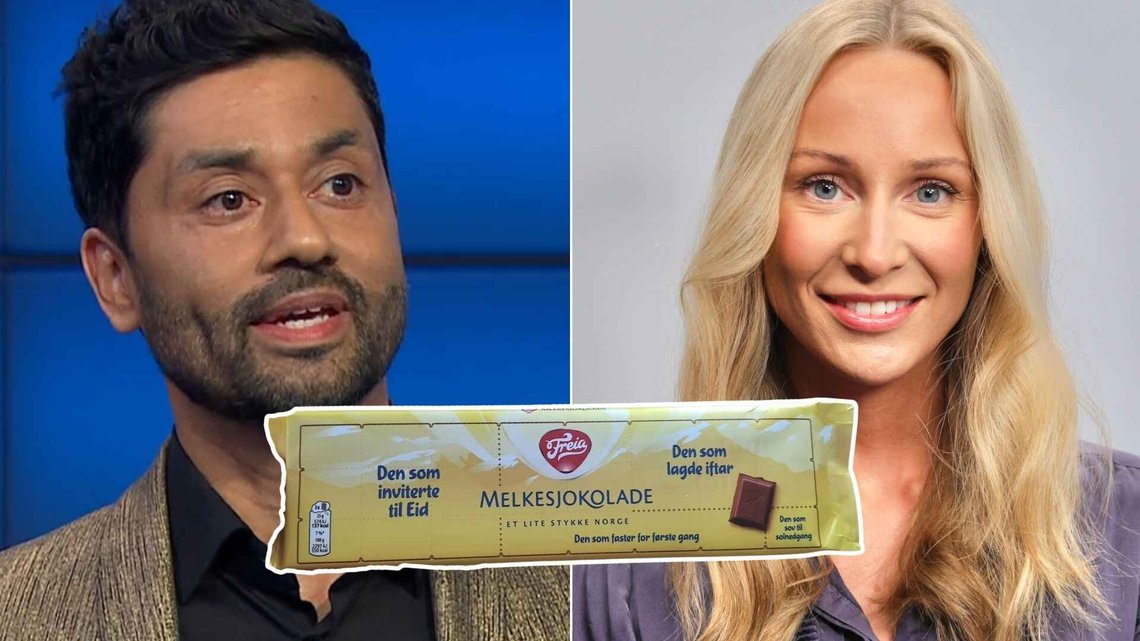
NRK-profile Noman Mubashir shared an image of Freia’s Ramadan chocolate and wrote that “Muslims are also a small piece of Norway”. We made a video in which we said we disagreed. The response was enormous. The vast majority agreed with us.
And then the real problem began. At least according to Norwegian media.
Several media outlets got in touch. Not to discuss the matter, but to hold me accountable for having expressed myself. The questions were strikingly similar: Why did you make the video? What do you think about the reactions? And most remarkably: What responsibility do you have for the reactions of others?
Let me take the last question first, because that reveals the whole problem.
If a journalist is responsible for what readers write in comment sections, public debate is impossible. In that case Mubashir is equally responsible for the messages I have received from his sympathisers. But of course I do not hold him responsible for that. Nor would it occur to him to think along those lines in the opposite direction.
The slogan that was redefined
Freia’s slogan “et lite stykke Norge” (“a small piece of Norway”) was launched in 1978. At that time Norway had 1,006 registered Muslims. The slogan played on Norwegian culture, Norwegian traditions and a brand closely tied to Norwegian identity. Freia, incidentally, is no longer Norwegian. The company is owned by the American corporation Mondelez International, which also owns Cadbury. The campaign with 26 different “sharing messages” is taken directly from the British Cadbury campaign “Made to Share”. It is therefore an international corporation that is using a Norwegian brand to redefine what “a small piece of Norway” means.
When Ramadan is suddenly presented as part of this, it is natural to react. Not because one hates Muslims. But because symbols matter.
The response we received shows that very many Norwegians are frustrated by the same pattern: prayer rooms in workplaces. NRK devoting airtime to Ramadan and Eid in the middle of the Christian fasting period. IKEA with a Ramadan collection. And now Freia. Individually these are small things. Taken together they form a picture that people recognise.
The media’s peculiar premise
What is interesting is not that reactions come from both sides, but how the media interpret them.
When Mubashir advances an identity-political message that Islam naturally belongs within Norway’s most iconic chocolate brand, it is described as inclusion. When someone says they disagree, it is called “division” and “polarisation”.
Consider that for a moment. Disagreement with an NRK-profile is not a deviation from democracy. It is how democracy is meant to function. But the concepts that are used reveal whom the media believe has the right to express themselves without being held accountable – and who does not.
“Division” and “polarisation” are used almost exclusively in one direction: when someone challenges what is increasingly presented as moral consensus. If you promote Islam in the public sphere, it is diversity. If you say you disagree, it is division.
The real debate
Mubashir says he has received hateful messages. That is regrettable. But it does not exempt him from criticism. Nor does it give him the right to redefine any disagreement as hatred.
This case is not about chocolate. It is about who gets to define what Norway is. About whether Norwegian symbols, Norwegian identity and Norwegian culture are gradually to be adapted, without anyone having asked for it, and without it being permitted to question it.
The response we have received shows one thing very clearly: most people want Norway to remain Norway. And more and more people dare to say so out loud.
That is not division. It is democracy.


