

The parliamentary parties (Stortingspartiene) have received close to 125 million kroner through the aid budget. But the Progress Party (Fremskrittspartiet) is not included in this select company. This “development aid” (“u-hjelp”) from the Ministry of Foreign Affairs (Utenriksdepartementet) began in 1999. The Christian Democratic Party (Kristelig Folkeparti) has received the most. It is followed by the Liberal Party (Venstre), the Labour Party (Arbeiderpartiet) and the Socialist Left Party (Sosialistisk Venstreparti), with the Centre Party (Senterpartiet) in a solid fifth place, ahead of the Conservative Party (Høyre).
In 2024, 599 million kroner in party support was distributed to the political parties in Norway. The more votes, the more party support. But that was not enough. In addition, the parties received funds through the aid budget. In 2024, this assistance amounted to 5.9 million kroner. Of this, 4.6 million went to the Christian Democratic Party, more specifically 2.9 million to the parent party and 1.7 million to the youth party. We are awaiting final figures for 2025.
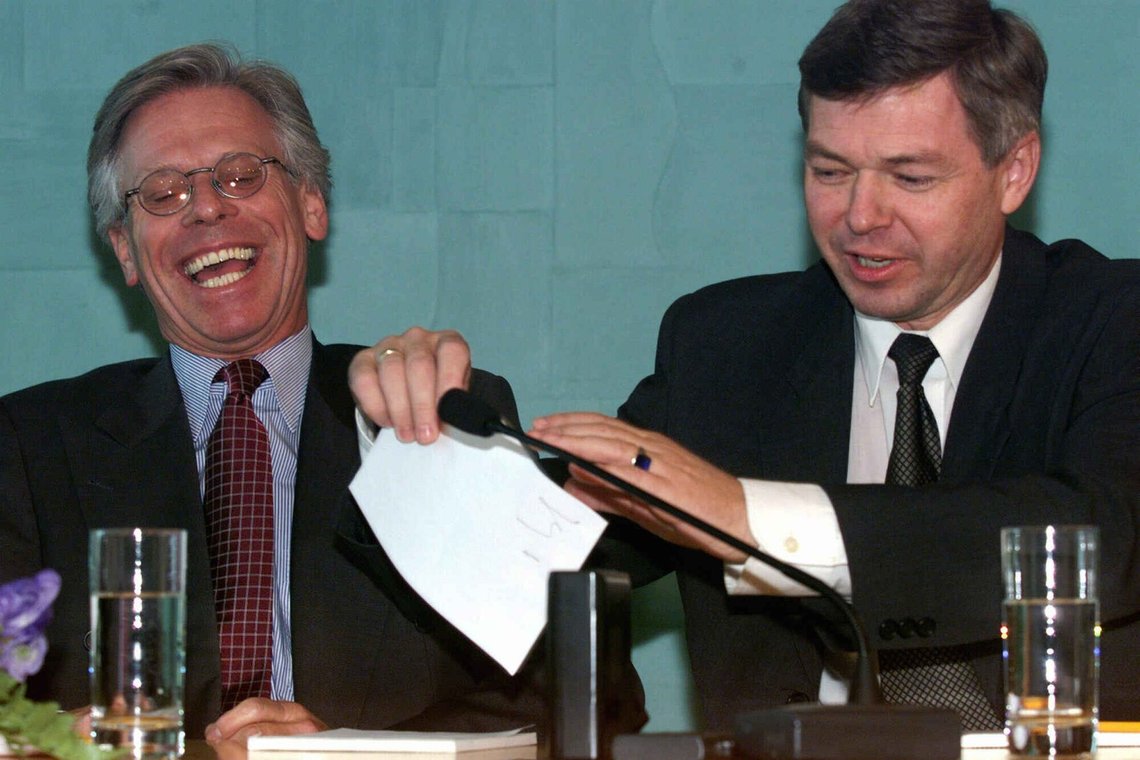
This “development aid” began in 1999, according to Norad. At the time, Kjell Magne Bondevik (KrF) was Prime Minister. Knut Vollebæk (KrF) was Minister of Foreign Affairs, and Hilde Frafjord Johnsen (KrF) was Minister for Development and Human Rights Affairs in the Ministry of Foreign Affairs, also referred to as the Minister for Development (bistandsminister). Since then, the Christian Democratic Party has walked away with something resembling a royal straight flush in aid. In total, 36.8 million kroner accrued to KrF in the period 1999–2024, according to Norad.
One party is not included in this select company: the Progress Party. At the same time, it is the only party that has argued for cuts to the aid budget.
In total, the parliamentary parties have received 119 million kroner through the aid budget in the period 1999–2024. If we add unrevised figures for 2025, the parties’ “development aid” comes to around 125 million kroner. Approximately 11–12 per cent of the funds go to administration in Norway.
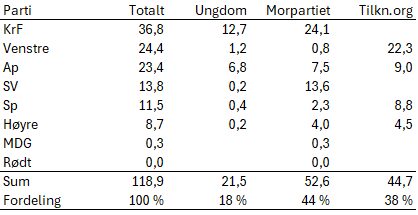 Parliamentary parties’ “development aid” in million kroner. Source: Norad.
Increased “development aid” with the Labour Party in government
The year after this “development aid” was put in place, the Bondevik I Government (Bondevik-1-regjeringen) resigned on a vote of confidence (kabinettspørsmål). Kjell Magne Bondevik set a condition that gas-fired power plants should not be included in the development of the Ormen Lange field. The majority in the Storting wanted otherwise. Bondevik resigned. Yet no gas-fired power plant was ever built. The Stoltenberg I Government (Stoltenberg-1-regjeringen) took office on 17 March 2000, in time before the revised budget for 2000 was presented in May.
There, the Labour Party and the Socialist Left Party received a substantial increase in aid. SV received more than one million kroner through the aid budget, up from just under 150,000 kroner in 1999, while the Labour Party received almost 2.5 million kroner, up from 1.4 million kroner.
After the parliamentary election in 2001, Kjell Magne Bondevik formed a government once again. This time the Conservative Party was included, and Jan Petersen became Minister of Foreign Affairs. Once again Hilde Frafjord Johnson (KrF) became Minister for Development. Under this regime, “party aid” increased significantly. It exceeded 5 million kroner annually and peaked at 6.8 million in 2004.
After a small “pause” down towards 4 million kroner in the election year 2005, a new aid record was set in 2006, with Jens Stoltenberg as Prime Minister. No less than 11.4 million kroner went to this purpose, a dramatic increase from only 4.3 million kroner in 2005. The one that walked away with most of it was the Liberal Party’s Educational Association (Venstres Opplysningsforbund), today called the Liberal Party’s Study Association (Venstres studieforbund), which is the party Venstre’s independent organisation for adult education and training of members and elected representatives. These received as much as 9.3 million kroner. The following year as well, the Liberal Party’s Study Association received a substantial 7.7 million kroner through the aid budget.
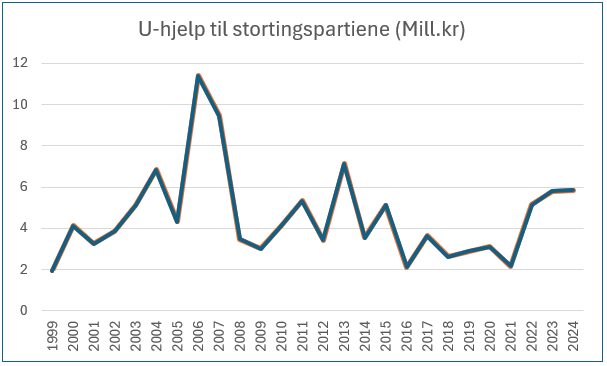 Allocations to the parties through the aid budget 1999–2024. Source: Norad
At this time, the leader of Venstre, Lars Sponheim, was a prominent opposition politician, and one may ask why Venstre was favoured with such a considerable amount of money by the red-green government (den rødgrønne regjeringen). As is well known, the official opposition from Sponheim culminated in the famous fishing trip with Jens Stoltenberg on Hardangervidda in 2008. The aid to Venstre continued after the fishing trip. With Stoltenberg as Prime Minister, the Liberal Party’s Study Association was by far the largest recipient of money through the aid budget, with more than 22 million kroner.
After a new upswing in the election year 2013, when the red-green government had to step down, a downward trend in this “development aid” to the parties followed. In the election year 2021, total aid had fallen to 2.2 million kroner, the lowest level since 1999. This changed after Jonas Gahr Støre formed a government. Today the aid to the parties amounts to close to 6 million kroner annually.
“Democracy promotion” and the UN Sustainable Development Goals
Document.no meets a helpful press officer at Norad who does not require that all questions be sent by e-mail, but responds to the best of his ability after making internal enquiries, and in fact calls back.
From this person we learn about the democracy promotion scheme, a scheme the youth parties can apply to. From the table above it emerges that since the parties began receiving funds through the aid budget, 18 per cent of the money has gone to the youth parties. A summary shows that 44 per cent goes to the parent parties and 38 per cent to party-affiliated organisations such as the Liberal Party’s Study Association, the Workers’ Educational Association (Arbeidernes Opplysningsforbund) (Ap), the Centre Party’s Study Association (Senterpartiets studieforbund) and the Conservative Party’s Study Association (Høyres studieforbund).
Document.no was referred to Norec: Norway’s competence centre for international cooperation (Norges kompetansesenter for internasjonalt samarbeid). The youth parties may apply here for funds through the aid budget, according to the helpful information adviser. On its website, Norec states: “Vi er ein etat under Utanriksdepartementet, og ein del av Noregs samla innsats for å nå FNs berekraftsmål”.
Document.no is still unaware of how the application for and allocation of aid funds to the parent parties and party-affiliated organisations takes place. But the conclusion is that in the period 1999–2024 the parties in the Storting, with the exception of FrP, have received 118.9 million kroner through the aid budget. The figure will likely be around 125 million kroner once revised figures for 2025 are available.
A cross-party aid effort without FrP
Although the Christian Democratic Party brings in the most aid money, the funds enable a cross-party aid effort (tverrpolitisk bistandsdugnad). However, with the exception of the Progress Party. The money makes it possible to conduct aid activities under the auspices of all the parties, their youth parties and affiliated educational and study associations.
Under the Støre Government (Støre-regjeringen), the largest recipients of development aid have been KrF, KrFU, AUF, Unge Venstre and MDG. The countries that have benefited most from aid projects under their auspices are Ethiopia, Kenya, Lebanon, Belarus and Palestine.
What the projects consist of and what results have been achieved, Document.no currently has no overview of.


