

It is not only the LO members who end up as sponsors of the election campaigns of the Labour Party (Arbeiderpartiet), the Socialist Left Party (Sosialistisk Venstreparti), the Centre Party (Senterpartiet) and Red Party (Rødt). All taxpayers are involved as well, through the aid budget (bistandsbudsjettet). Without funds from the aid budget, LO would have had to prioritise between support for red–green parties and international organisational building.
LO received 691 million kroner through the aid budget in the period 1999–2024. This emerges on the page Aid in Figures (Bistand i tall) on Norad’s website.
– I am sitting on the tram between two meetings, says Liv Tørres, head of the international department in LO, when Document calls.
We manage to learn that this is a long-term framework agreement and that the funds go to organisational building in a number of countries. Further questions would have to wait. Document was asked to send questions by e-mail, which we have done. The questions are listed at the end of the article.
In 2024, LO received 27.4 million kroner. On average, LO has received 26.6 million kroner annually since 1999. The annual amounts have varied between 20 million and 32 million. This means that, as of 2025, LO has received more than 700 million kroner through the aid budget, by a considerable margin.
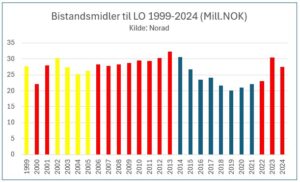
After eight years with a red–green government, the flow of funds to LO reached its historical peak in 2013, with a full 32 million kroner. This was followed by a decline under the Solberg government (Solberg-regjeringen), to 22 million kroner in 2021. After Støre formed a government, more money again went to LO through the aid budget, with a provisional peak in 2023, at 30 million kroner.
Would have had to choose
At the LO Congress (LO-kongressen) in May last year, LO decided to provide 29 million kroner in election campaign support to red–green parties. Of this, 20 million kroner went directly to the Labour Party (Arbeiderpartiet) – the largest single contribution from LO to Ap in recent times.
The other parties that received support were the Socialist Left Party (Sosialistisk Venstreparti), the Centre Party (Senterpartiet) and the Marxist–Leninist party Red (Rødt). These three shared the remaining nine million kroner from LO.
Those who in reality paid the bill for this election campaign financing were not only the LO members, but also the taxpayers.
Without the transfers from the aid budget, LO would have had to choose between party support to the red–green parties and its international work, or have had 26–27 million kroner less to give to any of them. If they were nevertheless to have financed both election campaigns and conducted aid activities on the same scale as they did, the bill would have had to be sent to the LO members.
Health and social sector or organisational building?
In the period 2021–2024, LO received almost 103 million kroner. According to Norad, this money went to the “Health and social sector”. But according to Liv Tørres, the money went to “organisational building in a number of countries”.
There is therefore reason to ask whether the money goes to health and social matters, as Norad writes, or to organisational building in a number of countries, as Tørres replies. And then whether LO conducts organisational building within the health and social sector in countries such as Ethiopia, Ghana, Colombia, the Philippines, Malawi, Eswatini, Cambodia, etc.
The following table shows how aid funds to LO are distributed across different countries.
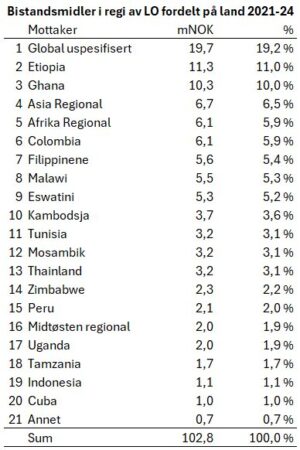 Aid funds via LO, 2021–2024. Source: Norad
Questions sent to LO
Document has sent the following questions to Liv Tørres at LO:
- According to Norad’s statistics, this flow of money began in 1999. Comment, and specify if necessary.
- What was the basis for LO receiving money through the aid budget?
- What can LO contribute to the field of aid that existing aid organisations could not handle?
- How much did LO receive in 2025?
- What is the budget for this year?
- Who are the recipients in these countries?
- Who determines the distribution? Please provide names if possible.
- Who directs the aid in the various countries?
- How is the distribution of funds carried out?
- Are these expenses for LO personnel from Norway who travel to the countries in question and conduct informational activities?
- Is it wages for local course instructors?
- Who and where formulates the message and the expertise that is transferred to these countries?
- What has concretely been achieved through this aid?
- Norad writes that the funds have gone to the health and social sector. How does that harmonise with your statement that the funds go to organisational building?
- Is it the case that LO conducts organisational building within the health and social sector in countries such as Ethiopia, Ghana, Colombia, Eswatini etc.?
The answers to these will be presented in a follow-up article.


