

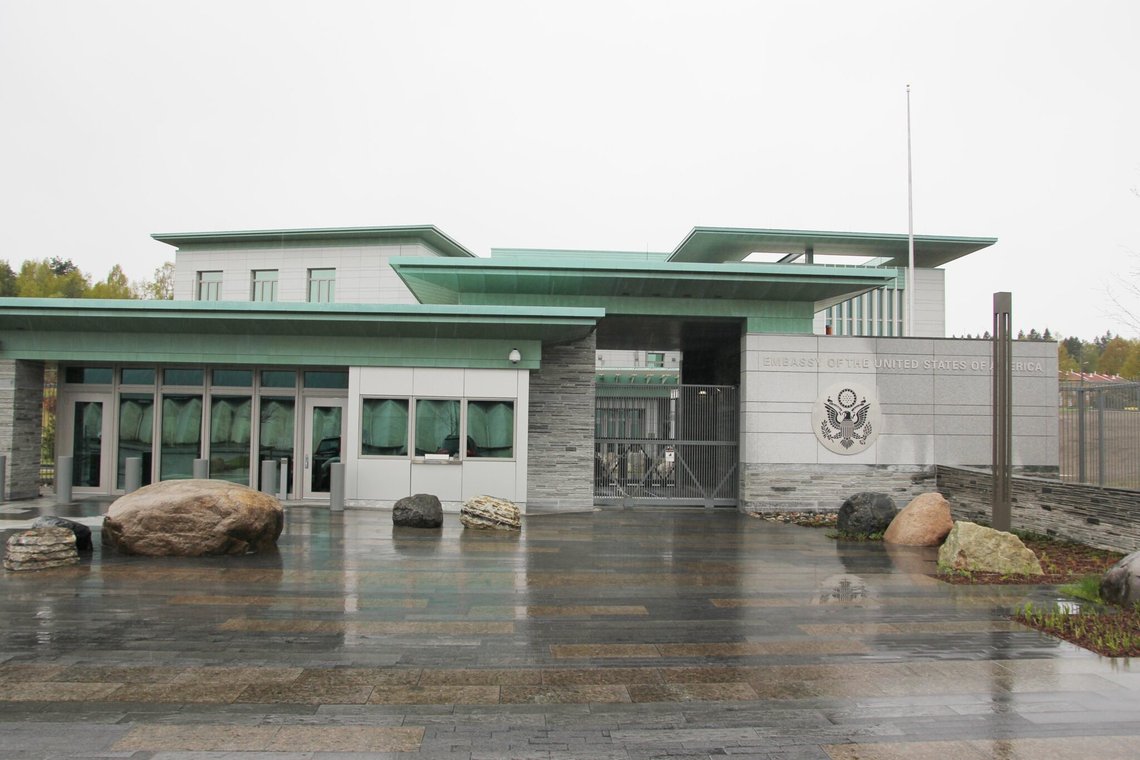
With the bomb outside the American embassy, Norway has become a frontline. We have become part of the war. There are people living in Norway who are willing to use violence to strike the United States and Israel in their war against Iran. They bring the war here. This raises a number of new questions: Why Norway in particular?
The Minister of Justice Astrid Aas-Hansen’s choice of words is not accidental. To call it “an unacceptable incident” is a neutral expression that could apply to anything. She says that the government takes it with the utmost seriousness, but then she says something remarkable:
nothing indicates that the situation is dangerous for outsiders
If one means purely concretely there and then, the statement is correct. No bombs are going to explode outside the embassy at that very moment. The police have full control. But the Minister of Justice means something else: she is attempting to reassure the Norwegian people. They are not to worry that bombs will explode in Oslo outside the embassy of our most important ally.
The question is whether Norwegians are “outsiders”. Aas-Hansen is attempting to say that this is not our war. We are now being drawn into it by our ally, but we do not wish to be a part of it. The government has condemned the war as a violation of international law (folkeretten).
When an attack occurs that involves us – and it does so by definition when a bomb explodes in a residential area – the Minister of Justice chooses to say that 1) no one is further threatened and 2) we are outsiders.
It is a political statement with two recipients: the government is attempting to cover over its responsibility by shifting it on to those who carried out the act, but also on to the United States, which started the war. The word outsiders means non-involved, neutral – and that is the position Norway has adopted.
Astri Aas-Hansen suggests that we are being drawn into a war that we are not and do not wish to be part of.
We are outsiders.
But does the world see it in the same way?
Of all the embassies where the United States is represented, it is Norway that becomes the target. Is that accidental? Or does it have something to do with ten years of incessant propaganda war against Trump, from top to bottom?
The government probably never dreamed that we could become part of the war. Now we are. The temptation is therefore great to throw the United States under the bus and say that we are “outsiders”. That it is unfair if Norway is drawn into it. If the government chooses that line – and the media and the Left will at the very least do so – the distance between Washington and Oslo will grow.
Trump called Starmer a coward. American media follow Norway more closely than we are aware. They notice it. That the Israeli ambassador has been recalled and that Norway recognised Palestine. Støre is on the same line as Pedro Sánchez in Spain; he uses international law (folkeretten) to morally condemn the United States and Israel.
In war, such a stance has consequences.
Trump has opened an entirely new front in which he uses the United States’ intelligence services and military against bad guys: as recently as Saturday he held a summit in Washington for leaders from Latin America in which he announced war against the cartels. The action against Nicolas Maduro was not an isolated case. He says that Cuba stands next in line.
Norway is not participating. Norway does not like violence and closes its eyes when others use it.
Those who thought it was terrible that Ali Khamenei was eliminated do not wish to see what he stood for. They place brackets around the 30,000 who were massacred on 8 and 9 January. They do not wish to see the true nature of the regime.
This blindness has long traditions.
On 11 October 1993, William Nygaard was the target of an attempted assassination outside his home in Dagaliveien in Oslo. Aschehoug publishing house had published The Satanic Verses by Salman Rushdie. Khomeini had issued a fatwa not only against him, but against everyone who had anything to do with the book. A translator in Japan had been killed, an Italian translator had been seriously wounded. Nevertheless, the Norwegian police were unable to see any connection between the publication and the assassination attempt.
A composite sketch was published showing a man of Middle Eastern appearance who had been seen by the tenant in the neighbouring house. She was so frightened by what she saw that she fled out of the city and lied in the first interrogation. The eyes of the stranger had frightened the life out of her. But when she understood that she possessed invaluable information, the composite sketch was produced. Piece by piece the puzzle was assembled: the man had arrived in Oslo, the embassy had organised the assassination attempt and ensured that the assassin left Oslo immediately. The course of the case was clear, but encountered resistance further up. The political leadership did not wish to know. The investigation was obstructed from the highest level. It went so far that when new tips emerged about a principal suspect who possessed precisely the weapon that had been used and he was taken in for the second time, the Deputy Chief of Police Roger Andresen intervened and ordered his release, entirely outside protocol. When the investigators arrived at work on Monday and were to begin the interrogations, the bird had flown.
Andresen had not invented this on his own. But who gave the order has never come to light.
Several years later, Leif A. Lier sat at a press conference and expressed surprise at receiving questions about whether he saw any connection between the publication of The Satanic Verses and the assassination attempt on Nygaard. He claimed that he had been unaware that Nygaard was the publisher.
The Norwegian authorities did not wish to know.
This has been the attitude towards Iran all along, and is symptomatic of the Norwegian authorities’ attitude towards radical Islam.
One can always talk about it.
The same attitude was shown towards the Muslim Brotherhood’s rule in Egypt.
But something changed with 7 October. When Israel responded, and this time in order to break Hamas, the Norwegian authorities and the opinion elite moved in the opposite direction: they became Hamas.
The parallel is the struggle of the generation of ’68 against American imperialism and in favour of FNL/Vietcong.
But this time Europe is filled with millions of Muslims who see no problem in the freedom of expression in the West being subordinated to Islam.
Støre also failed when the cartoon controversy arose.
The course of the Norwegian authorities has been one of capitulation.
The site of the new government quarter is decorated by a Palestinian artist who praised the attack on the Nova festival.
That is the artwork Støre looks down upon from his office in the High-Rise (høyblokka).
Recently it emerged that the wife of the mayor of New York, Mamdani, praised 7 October.
Støre and his foreign minister are on the same side. They have described a major shift from participation in Enduring Freedom in Afghanistan in response to 9/11 to engaging an artist who praises Israel’s response to 9/11.
Therefore the King’s refusal to send condolences to Israel after 7 October carried heavy symbolism.
Haakon VII’s refusal to the Germans stands as a monument in Norwegian history.
Espen Barth Eide forced King Harald to raise a nidstang over his grandfather.
These are the tracks along which the government continues.
Now the war is here, and the government will insist that we are outsiders. It is an echo of the policy behind Det brukne gevær (The Broken Rifle). We do not like war and believe that we can conjure war down into the earth.
But the war against Trump, that we maintain. There Norway is among the most eager.
Støre wages war in Ukraine, but it is a just war, in contrast to Trump’s wars.
Norway has entangled itself in a conflict between Islam and the West in which we are on Islam’s side.


