

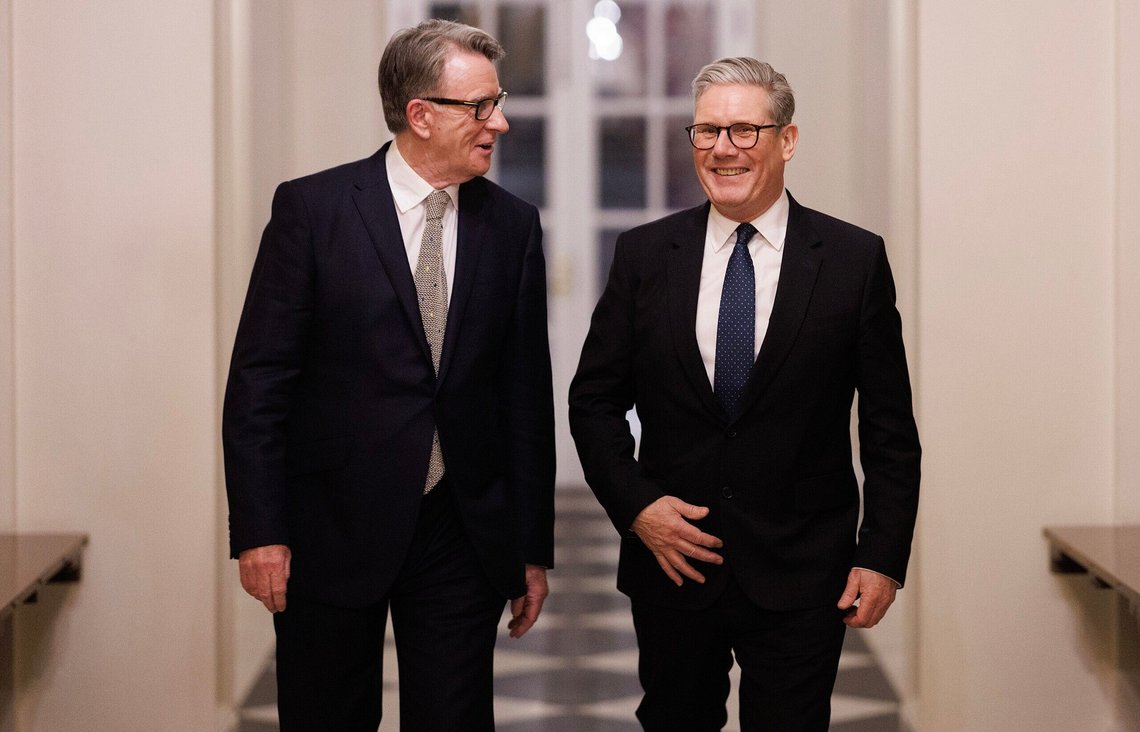
Peter Mandelson is featuring heavily in the headlines as his role in the Epstein scandal threatens to bring down Keir Starmer’s government. But the story goes much deeper: Mandelson, the disgraced former Ambassador to the US and adviser to Tony Blair and successive UK Labour prime ministers has had a finger in many unsavoury pies.
Much attention is focused on Labour politician Peter Mandelson’s friendship with Jeffrey Epstein and his failure to admit the extent of this relationship to Keir Starmer before his appointment as US ambassador. This story is grabbing the headlines because it has the potential to bring down Keir Starmer’s government. However, there is another, equally sinister story running in parallel, about the role of strategic communications firms, filled with former politicians, being paid by companies to influence government policy and win valuable contracts.
Peter Mandelson’s nickname in Great Britain since the 1980s has been “the Prince of Darkness”. He gained this name shortly after being made the Labour Party’s director of communications in 1985. This nickname reflected his ability to use dark arts ruthlessly behind the scenes to act as a go-between, schmoozing with powerful people to make things happen. This is the grey zone between politics, business and media. It is enabled by politicians, like Mandelson, who use their personal networks to influence former colleagues, creating a power hub away from the scrutiny of the public.
What is now emerging from the Epstein Files is the immoral methods Peter Mandelson used to gain influence for those paying him. Mandelson’s lack of moral compass was obvious early in his career. He resigned from the Tony Blair government in 1998 for accepting a secret interest-free loan from a fellow minister to buy a house in Notting Hill, at the same time as his department was conducting an investigation on that minister’s business affairs.
To Russia with Love?
Three years later, back in government, Mandelson was caught using his influence to fast-track a British passport application for a wealthy Indian businessman who had sponsored the Millennium Dome project. While he was the EU’s trade commissioner between 2004 and 2008, Mandelson continued to mix with the wealthy and powerful, in 2005 secretly taking a private jet trip from Davos to Moscow in 2005 with Russian aluminium oligarch Oleg Deripaska and banker Nat Rothschild that he would later defend as “entirely recreational” . As EU Trade Commissioner, Mandelson had been responsible for the decision to cut aluminium tariffs on from 6% to 3%, a decision that benefited Deripaska’s company RusAl.
The Epstein files reveal that Epstein sent three $25,000 payments to Mandelson from his JP Morgan account, as well as an additional £10,000 payment to Mandelson’s husband for an osteopathy course. It is now becoming clearer what Mandelson did in return for Epstein. Mandelson had been leaking secret plans about government bail-outs and asset sales in the final days of the Labour government in 2009. Epstein asked “what saleable assets?” and Mandelson replied “Land, property I guess”. Also in 2009, Mandelson replied to a request from Epstein to water down planned taxes on bankers’ bonuses, answering “Trying hard to amend as I explained to Jes last night. Treasury digging in but I am on the case.”
The “Jes” he refers to is Jes Staley who was CEO of JP Morgan’s investment bank at that time. Staley was a close friend of Epstein who latterly became CEO of Barclays, before being barred from working in Financial Services by Britain’s Financial Conduct Authority for under-stating the true nature of his relationship with Epstein. He is now reported to be one of the executors of Epstein’s estate. Mandelson also used his relationship with Epstein and Staley to secure a deal between the UK government and JP Morgan to buy an energy trading business that was part-owned by government-owned RBS. Throughout this period, Mandelson was honing his skills as a go-between, connecting politicians with business-people.
Global Counselling in the Shadows
When Labour lost the 2010 election, Mandelson shifted his focus onto founding his strategic communications business, Global Counsel. Here he would use his network of contacts, including Epstein, to deliver lucrative new contracts with major global banks such as JP Morgan, Barclays and Santander, as well as corporates such as Palantir, Vodafone, GlaxoSmithKline and Accenture. Many of these companies have this week announced that they have cut links with Global Counsel since news about Mandelson’s extensive communications with Epstein have been revealed. They must be hoping to minimise reputational damage. Clients of strategic communications companies obviously prefer to operate in the shadows.
As well as these corporate relationships, Global Counsel also acts on behalf of governments, including the UK government. Peter Mandelson accompanied Keir Starmer on a Washington trip to meet defence software business Palantir’s CEO in February 2025, resulting in a £240m UK Ministry of Defence data analytics contract with the company. The meeting was not minuted and there was no tender for the business, prompting Conservative Party leader Kemi Badenoch demanding that this be “looked at very, very closely”. Starmer’s spokesman is refusing to confirm whether Starmer knew that Palantir was a client of Global Counsel before he attended the meeting.
It is now becoming clearer what Mandelson did in return for Epstein. Mandelson had been leaking secret plans about government bail-outs and asset sales in the final days of the Labour government in 2009. Epstein asked “what saleable assets?” and Mandelson replied “Land, property I guess”. Also in 2009, Mandelson replied to a request from Epstein to water down planned taxes on bankers’ bonuses, answering “Trying hard to amend as I explained to Jes last night. Treasury digging in but I am on the case.”
The Epstein files also reveal evidence about Mandelson’s extensive dealings with China. Mandelson’s communications with Epstein regarding his China business dealings with China directly contradict his claims that he had no financial ties with China. Mandelson’s dealings with Epstein on China appear to echo those between Epstein and former JP Morgan and Barclays banker Jes Staley. The conclusion appears to be that Epstein was orchestrating Chinese Communist Party influence into the heart of British government. Suspicions of Mandelson’s influence on UK government policy will only be raised following Starmer’s fawning Beijing visit and controversial London Chinese super-embassy planning approval.
Chinese Whispers
Mandelson’s email to Epstein shortly after setting up Global Counsel in April 2011 appears to support the view that he always saw the Chinese as providing him with the greatest business opportunity – “Some Chinese want deals (should be able to offer that in due course). Some have deals already but need hand holding. Some want to put money into hands. CICC [China International Capital Corporation] retain us cos think we have something to offer Chinese.”
Some people in the strategic communications industry in Norway might quietly admire Mandelson for his effectiveness. “That’s how to get things done”, they might be saying. But as a light is shone on Global Counsel’s activities, we are able to observe some of the methods used to wield influence. By its nature, strategic communications is a job that is done behind the scenes, away from the public gaze. That’s by design. These people are paid by companies to influence policy without the general public noticing. It needs to be subtle because it is inherently undemocratic. We, the people, elect politicians thinking that we are in charge. It would spoil the illusion if we “little guys” worked out that the strings are being pulled far away from our view.


