

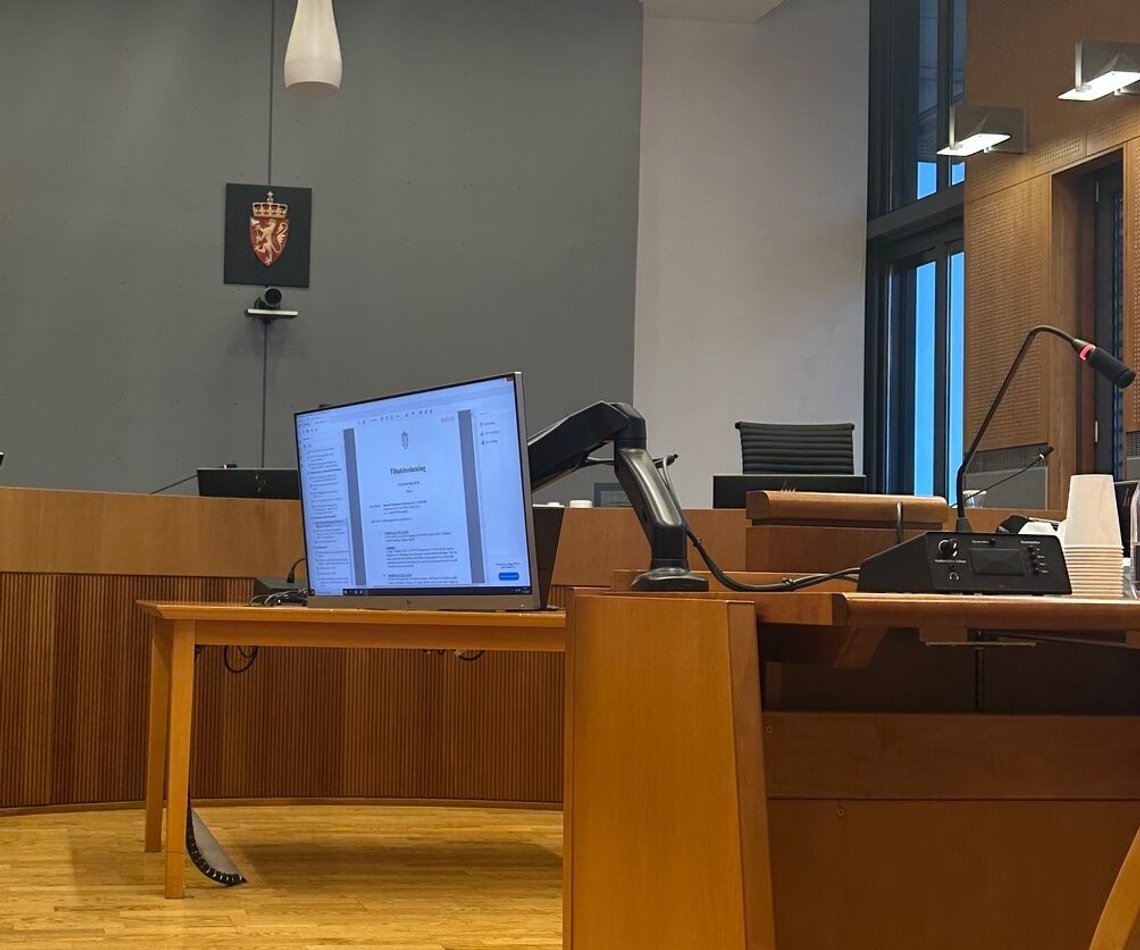
“Mohammed”, slim and in a white jumper and black jeans, sits on the dock, hiding behind a screen with his head on the desk. He looks almost asleep, but his shoulders are rocking gently back and forth as his feet quiver under the tabletop. On the opposite side, five metres away, sits the woman he raped last winter. “Kari” has put on a turquoise green turtleneck and a large necklace, and has styled her hair. She is very thin. “Kari” has COPD and other health problems, but when the judge offers her to sit in the chair next to her niece, she thanks him, but says she’ll manage to walk over to the witness stand.
Two friends have turned up, but not the Norwegian press, except Avisa Oslo, which referred to “Mohammed” as “the 21-year-old” in February. No-one has stood up for “Mohammed”, apart from public Norway; three police officers, three lawyers, a judge and two co-judges, the Correctional Service … 15 white faces, and one coal black. If the skin colour of the defendant and victim were reversed, more press would have found their way to courtroom 817 in Oslo courthouse.
Rødtvet
The prosecutor begins with the cold facts: On Saturday 15 February, before 7am, in a block of flats near Grorud Centre, the doorbell of “Kari” rings. Not the main door downstairs, but her own front door. The ringing is wild and non-stop. “Kari” thinks it might be the neighbour with lots of children who’s having problems; instead it’s an unknown man who rips open the door and enters her living room, into the kitchen, and draws all the curtains; he rummages through drawers and cupboards. “Kari” asks him to stop, but he continues; he doesn’t seem angry or intoxicated; “Mohammed” takes her mobile phone, bank cards, gift cards, a betting card, an ID card. In addition, he gains access to her Vipps account and transfers NOK 15,000 to himself.
He sets up her vacuum cleaner in the hallway. “Kari” asks why he is doing this, but gets no answer. The police report from that painful day remembers more than “Kari” does today, “I try to remember, but my head protects me from remembering the worst”. But she does remember that he made advances towards her as they sat in the kitchen.
How they got from the kitchen to the bedroom, she does not remember. The prosecutor shows the police photos of what “Kari” looked like, wearing a nightgown and with large, bleeding wounds on her legs. She remembers that the defendant was lying on top of her, with his entire body weight, using one hand to penetrate her with his penis, while the other hand squeezed her throat and mouth alternately as she shouted “No, please!” and “I can’t take any more!” She tried to resist, but he was so much stronger, and she tried to cry out in her weak voice, for the window was ajar and she had a tiny hope that the neighbours would hear something. She thought to herself as it was happening that “it would be okay if he killed her, because it shouldn’t hurt that much”.
After the rape, “Mohammed” sits down in the living room, where the defendant starts looking for his mobile phone. He doesn’t find it, and instead starts using her mobile to search for pornographic films and images. He tries to grab her crotch again and wants her to watch the porn, but “I’m not interested in pictures and films like that”, but has to look away occasionally. She’s grateful that he didn’t get angry when she pushed his hand away. “Kari” uses paper towels to wipe away the blood running down her legs. After an hour, just before 8am, “Mohammed” leaves the apartment and takes the vacuum cleaner with him, “like a cousin should get”. He transfers the NOK 15,000 from “Kari” to a girlfriend with whom he had argued the night before, and who will receive the money for shopping.
“Kari” looks out of the window to see “Mohammed” disappearing around the corner, and she calls a neighbour; the police and ambulance arrive shortly afterwards. The rest of Saturday is spent being examined at the rape centre at Aker; she has to take a number of vaccines, because “Mohammed” didn’t use a condom. She also receives wound treatment and can’t praise the health service enough for the fantastic treatment she receives. Later in the day, the ambulance takes her to Ahus for an examination of the “neck grip”.
“Kari” has to learn how to change her bandages until late in the summer, but her niece helps her, because some of the wounds become infected and have to be scraped with a knife and need a lot of antibiotics, which she has to pay for herself – including bandages and wound fluids – but this is reimbursed by her insurance. She will also be reimbursed for a new mattress topper, new bed linen, clothes taken by the police, a new vacuum cleaner and mobile phone, and Vipps will reimburse the NOK 15,000.
“Kari” apologises that her voice falters from time to time, and that “something has been forgotten, but that’s how we’re made”. She says she would hardly have recognised “Mohammed” on the street, because she didn’t dare take a good look at him while he was in the apartment. It has been an experience she will never forget. She has moved on, but a lot has probably gone inwards. She was relieved when the police caught up with him the same evening and took him into custody, because “he can’t go on like that with other people”.
During the break, “Kari” tells us that she wants everyone to know her story, “because it’s starting to get scary in Norway now”, and she is disappointed that so little press is present. But her surname must not be published, because it could be “dangerous” where she lives. All in all, “Kari” comes across as a woman with courage who, despite her age and health problems, has managed to get up and get on with her life. Kari’s social network consists of six surviving friends from her school days; they have a tradition of lutefisk and pinnekjøtt – «lutepinner» – during Advent, but now she no longer dares to leave the apartment.
Defendant’s statement
During the entire court testimony, the defendant has been lying with his head on the desk, hidden behind the computer screen. Now it’s “Mohammed” who has to take his place in the witness box. The defence counsel has warned in advance that the defendant will “try to explain himself”, and that the prosecutor must be polite and neat so that the defendant understands the questions. Legal terminology such as “do you plead guilty?” has to be rephrased and simplified several times, until it becomes “did you do it?” For the first few months, “Mohammed” denied everything, but as the evidence came to light, the explanation became “in line with the prosecutor’s claim”, with only a few marginal disagreements.
“Mohammed” speaks in a low, mumbling voice, hesitant but quick. He says that the night before he had “drunk a lot with friends”, and claims that he was intoxicated at the leisure club. Then there was a fight in the club, so the police came, they were expelled and put in a taxi. He claims he doesn’t remember “how I got into the block”, only that he “wandered around”, and “don’t know what went wrong with me, I wasn’t myself”, and “I was thinking with [my penis]”. The only major disagreement with the victim’s account is that he was “behind her back” during the rape, but this is inconsistent with the injuries caused by the throat grab, and he believes that the assault did not last very long. “Mohammed” says “I stopped myself”, “the intoxication eased somewhat”, and he “went into the living room” to watch porn. He claims that he helped “Kari” wipe blood from her legs. “But ‘Kari’ wouldn’t touch my [penis], so all I wanted to do now was go to the woman and have sex with her and go to sleep.”
The prosecutor interjects that “at this time you had two girlfriends at the same time, namely [Safiya and Pernille (not their real names)], and wants to know if “Mohammed” thinks it’s ok? “It wasn’t my intention to have two, but I had argued with one of them [girlfriends for a year and a half], and the other lived nearby [girlfriends for a month]. With one of them he can’t sleep over, “boring”, while with the other he can sleep over “with her and me”. The prosecutor asks what would happen if the two of them found out about each other: “They would die. The prosecutor explains that it means “get angry”. The last thing “Mohammed” remembers from the apartment was that he called a friend, took the vacuum cleaner that the friend was going to get and walked out of the apartment. The same day, the police find “Mohammed’s” boxer shorts in “Kari’s” bedroom, and the rape centre discovers “Mohammed’s” DNA inside “Kari”.
The prosecutor confronts him with the fact that he denied any involvement in the offences for the first few months:
- Prosecutor: «Why did you choose to speak untruthfully in the first police interview?»
- “Mohammed”: «- I had a lot of eyes on me.»
- Prosecutor: «You mean, in the interrogation situation?»
- “Mohammed”: «- Huh?»
- Prosecutor: «Why didn’t you want to tell the police the truth?»
- “Mohammed”: «I don’t know.»
- Prosecutor: «Did you want to avoid criminal liability?»
- “Mohammed”: «- What is that?»
- Prosecutor: «You wanted to avoid punishment?»
Life situation
After the break, we hear more about the defendant’s life situation. “Mohammed” grew up in Elverum. His mother and father came to Norway in the early 1990s, “Mohammed” doesn’t know what year, but he was born in Norway, and there are six siblings; two older sisters, an older brother, and two younger brothers. He says he had an “ok” upbringing, “completely normal”, he had friends there, some of whom he is still in contact with on social media. But he was only allowed to go to school, not to have a social life with friends, because after school it was straight to Koran school. His parents began to lose control of “Mohammed”, he stopped “listening to them” and started using drugs, so at the age of 13, “Mohammed” was “tricked” into going to his relatives in Kenya to be “rehabilitated”.
For the first two months he attends school and lives with his father’s relatives in a village outside the capital, Nairobi, but staying at home was gruelling, with lots of violence from an uncle and two cousins. So he lives with his mother in the village of Garse, in a barren area of central Kenya populated by the Ogaden clan, descended from predominantly Muslim herders in Ethiopia. After school, he is home alone with his maid, a woman in her 50s, who lures him into a sexual relationship. He says he «was taught», and they both took the initiative; «After you come the first time, you want more, want it every day»; «She taught me everything», but now I’m thinking that «the age was wrong, but ok to enjoy». A year goes by and his mum moves away, he goes back to Norway, and from then on he lives with his grandmother half an hour away, so now he loses contact with the maid.
“Mohammed” continues to drink and take drugs, and won’t listen to his relatives, so in autumn 2018 he is sent across the border to Somalia for the first time, for “rehabilitation” in “prison”. Things are “bad” there. “Mohammed” is beaten and whipped every day, wears an ankle bracelet all the time, can only take “small steps” and sleeps with the chains on. His parents call once every two weeks, but it’s just “hey hey and done”. He tries to escape several times. Now “Mohammed” says that he was often beaten at the Norwegian school, and tried to run away from there too, so his parents chose to send him somewhere where he “can’t run away”.
It is only when the parents send “Mohammed’s” brother to the same “rehabilitation programme” that the Norwegian authorities are contacted, via the brother’s friends who “after a month” discover, via social media, that the brother is in “prison in Somalia”.
Criminal history
In November 2021, 18-year-old “Mohammed” returns to Norway. In September 2022, he receives his first waiver of prosecution (for substance abuse), i.e. he is found guilty but avoids punishment and is only registered in the criminal register. But in the meantime, “Mohammed” has committed a number of other crimes from December 2021 to August 2022, leading to a 9-month prison sentence in December; the prosecutor only has time to mention a few of the incidents:
- Gross assault: On a February evening in 2022, in a park near Heimdalsgata in Oslo, he sneaks up on «Christine Agate», grabs her around the neck and pushes her head against a fence. He then follows her down the street where he again pushes her, punches her, gropes her crotch from behind, grabs her body and holds her down. She screams and manages to free herself, but “Mohammed” catches her again and takes another stranglehold on her. She screams and sees light streaming out of a window that opens on the other side of the street; it’s the Salvation Army’s substance abuse centre “Bosatt”, where the night watchman has heard noises, and she is again attacked from behind by “Mohammed”, but manages to get inside the gate that the night watchman opens, “Mohammed” tries to tear it open, but the night watchman slams it shut. Christine Agate thought she was going to be raped and maybe killed, she is struggling with severe psychological trauma and reduced quality of life.
- Gross theft.
- Highways Traffic Act, two cases, September 2022: In Elverum, he runs out into Storgata and throws a chair at a Volvo, which brakes, and he then throws himself over the bonnet of the Volvo, rips open the door on the passenger side, crowds the driver «Gunnar» and tries to grab the car keys, which causes the driver to break his back and collide with the car behind. Now “Mohammed” says that the driver has hit him and wants him to pay him NOK 4,000, otherwise he will be reported. He then lies down in the road in front of the car and shouts and screams; later in the day he runs out into the road on Route 4, where several cars have to apply their emergency brakes to avoid hitting him.
- Sexually abusive behaviour: 11 September 2022 at Elverum emergency room: grabbed his genitals (under his boxer shorts) and told ambulance drivers «Aleksander» and «Kristoffer» that he had «big equipment» and that «no one could fuck women in Elverum like him». He did the same to a nurse while asking how old she was.
- Threat, August 2022: “I’m going to come and get you and valla [I swear] I’m going to destroy the car and the house» [said to a man with a Tamil/Sinhalese name.]
Weeks passed between “Mohammed” returning from Kenya/Somalia to Norway (Nov. 2021) and his first recorded criminal offence (Dec. 2021), and one year before he receives his first prison sentence (Dec. 2022). The period the defendant is sentenced to imprisonment is called a sentence run, and “Mohammed’s” first sentence run stretched from Dec. 2022 to August 2023, but he will be released from prison in May 2023.
Second prison sentence
During his first month of freedom, no offences are recorded for “Mohammed”, but he takes drugs on a daily basis and has no memories of this period, «everything went fast». Already the following month, new offences are registered. His second prison sentence is for one year, of which three months are suspended. Some of the items in the indictment:
- Agggravated theft: June 2023 in Sporveisgata in Oslo: hits Fredrik many times in the face with his fist and takes a packet of cigarettes from him.
- Carried a knife, July 2023: had a samurai knife in the waistband of his trousers.
- Threats, two counts, July 2023: held a samurai knife to the throat of «Benjamin» and repeatedly shouted «I’ll kill you» and similar threats; one month later he tells the security guard «Johan» that «I’ll kill you» and get friends to exert more violence against him and similar threats.
- Body violation, two counts, September 2023. “The [point a.] is nonsense,” says Mohammed. “It’s good that you mention it, so you don’t agree with this point,” says the prosecutor. Later in the month, he puts his upper arm around the neck of store employee «Ali».
- Vandalism, September 2023: Smashed a computer screen inside 7-Eleven.
- Worn replica gun, September 2023: visible in the waistband, Hammersborggata.
“Mohammed” wears expensive designer clothes, here in the courthouse, and in police custody the day he assaulted “Kari”. Drug sales are not an issue in the courtroom today. He is not working or in education, and drinks/drugs daily.
Even during his five-month stay in Halden prison, “Mohammed” continues to take drugs. One wonders why Norwegian prisons are unable to offer drug-free detention. The defence counsel recommends treatment at the private drug clinic Tyrili Centre, which is drug-free, and so-called § 12 sentencing:
is an opportunity to serve all or part of a prison sentence in an institution outside the criminal justice system, such as a treatment centre. It is an option for people with a need for substance abuse treatment, rehabilitation, residential and social training, or care that cannot be provided in a regular prison.
At the treatment centre, he is just one day away from “the prison coming to get me”, and the staff believe he is selling “drugs” to gangs in Oslo. “Just nonsense”, says “Mohammed”.
The prison sentence runs from December 2023 to March 2024, with a probation period of three months.
Third prison sentence
“Mohammed” is released from prison on 14 March 2024, and already between 16 March and 9 April, a number of new «offence dates» are registered, i.e. within the release’s probation period, which runs until 15 June 2024.
- Prosecutor: “You know that if you commit new criminal offences you will go to prison. Can you remember if you reflected anything about that?
- “Mohammed”: «- What do you mean, reflected?»
- Prosecutor: «Did you give any thought to this phase here, you’ve been released from prison and you’re on probation, which means that if you commit any new criminal offences you’ll have to go back to prison. You know that… [longer pause without response from the defendant; the prosecutor continues] and so you do it… you commit new criminal offences while on probation, and why do you do it?
- “Mohammed”: [longer pause:] «- I don’ know.»
- Prosecutor: «Do you understand my question?»
- “Mohammed”: «- Yes.»
- Prosecutor: «Is it about intoxication?»
- “Mohammed”: «- Everything is intoxication.»
He is released from prison and immediately begins to take drugs, and at the same time he starts committing new offences. In this round, “Mohammed” is sentenced to seven months in prison. The most serious offences:
- Assault, 9 April 2024: in Oslo, kicked and punched «Karl Omed» in the body and against the head so that he fell, and continued to punch and kick the victim against the body and head so that he suffered swelling with wounds on the forehead. «- We argued», adds “Mohammed”.
- § 286 [Violence against particularly vulnerable occupational groups:] March 2024: against ambulance personnel at Oslo’s emergency room; hits “Berg” and “Halvorsen” in the chest and face. “Had seen a crime film,” says “Mohammed”.
He is serving his sentence from 1 November and will be released on 6 January 2025, with probation until 23 March. So it is during the probation period, on 25 February, that “Mohammed” carries out the incident Oslo District Court is now dealing with, over two days in December 2025: the assault on “Kari” at Rødtvet.
- Prosecutor: “So you committed the incident while on probation, and while intoxicated. What kind of thoughts do you have about it?
- “Mohammed”: «I regret it.»
- “Mohammed”: «I have a drinking problem.»
- Prosecutor: «And what is it going to take for you not to repeat such incidents in the future?»
- “Mohammed”: «- I have to give up alcohol.»
- Actor: «And how are you going to do that?»
- “Mohammed”: «- I have to go to rehab.»
- Prosecutor: «Is that sufficient, detoxification?»
- “Mohammed”: «- What do you mean?»
- Prosecutor: «Is it sufficient to be detoxed? Do you then want to stop drinking alcohol?” [pause] “Detoxification means that you stop drinking alcohol. That you are no longer under the influence of intoxicants.” [pause] “But do you think that’s enough for you to stop committing this type of crime? While intoxicated?
- “Mohammed”: «- I have to work on myself.»
- Prosecutor: “If you had been released today, what would have happened?
- “Mohammed”: «- What would have happened?»
- Actor: «Yes?»
- “Mohammed”: «- I would have gone to rehab?»
- Prosecutor: «Would you have been able to stay in rehab?»
- “Mohammed”: «- Yes.»
- Prosecutor: “Have you taken hashish or cocaine while you are in prison now?
- “Mohammed”: «Yes. Two or three times.
«The will is there, but not the ability.»
Then it’s time for a new witness, the Correctional Service’s environmental therapist; “Sindre” has known “Mohammed” for two and a half years, and says he’s nice and friendly, even when he’s intoxicated, but that “Mohammed” has been “persona non grata” in all the drug user flats he’s stayed in previously. It’s difficult to say “what is the right and enough treatment” for “Mohammed”, and that he can become “a completely different person” when he’s intoxicated. “Sindre has met “Mohammed” for an hour a week, and isn’t sure if I’ve managed to make a difference”. Together they have tried to motivate him to complete primary school, but there has “obviously been a lot of stop-start”. He has been reminded of appointments, but the circadian rhythm is a challenge. “Mohammed” has also received counselling on consumption habits, but hasn’t got very far with it. “Sindre says a drug-free life is key; how it’s achievable is the question, and in an ideal world there must be a degree of compulsion.
“Sindre” says that “Mohammed’s” ex-girlfriend [in the autumn of 2024] wouldn’t let him take drugs, but this solution is no longer available. “Although he expresses a desire to be drug-free, I don’t think he can do it on his own, and I don’t know how this could be achieved, and it doesn’t matter whether “Mohammed” is in prison for two or ten years. Based on what “Mohammed” has done, “society must protect itself”.
The “Flexible Follow-up Team” centre has the capacity to follow up “Mohammed” for only 1-2 hours per week. We let «Sindre» have the last word: «I have, of course, asked myself whether I have contributed anything positive at all.»


