



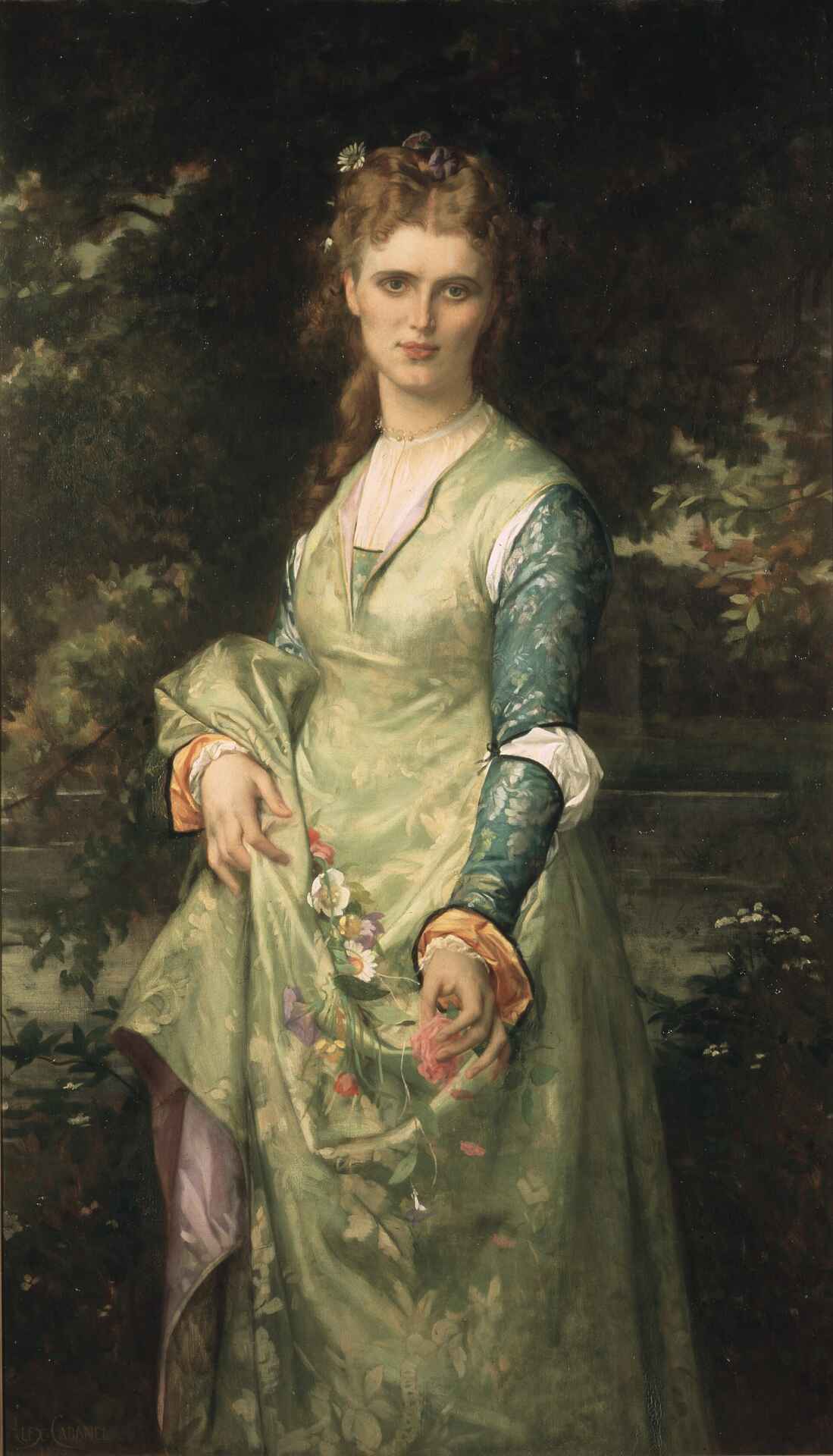
Alexandre Cabanel (1823–1889).
Oil on canvas, 153 × 90 cm, Gripsholm Castle, Sweden.
Portrait of Christina Nilsson (1843–1921) in the role of Ophelia in Ambroise Thomas’ opera Hamlet from 1868.
When the curtain rises in a modern opera house, the audience beholds a world of velvet, gold and sublime beauty. They hear voices that defy human anatomy, and see bodies moving with weightless elegance. To the secular spectator, this is the result of human interdisciplinarity, luck and relentless hard work. But for those of us who carry the long lines of history in our blood – who descend from Huguenots who fled for their faith, and hardy fishermen who placed their lives in the Lord’s hands upon the stormy sea – the rising curtain is something far greater. It is a window into the architecture of Providence. Opera and ballet are not merely art; they are extreme sports governed by an invisible director. It is the Lord’s governance upon the stage.
In a previous column, I argued that opera and ballet must be understood as extreme sports. That is a claim which withstands every anatomical examination. An opera singer pushes the vocal cords to their utmost limit, while the heart pounds at a rate that would send the average couch potato straight to the emergency department. A ballet dancer crushes his or her toes, wears out the menisci, and sustains asymmetrical wear injuries at express speed. This is a physical sacrifice that demands an iron will of stone and steel.
https://www.document.news/culture/2026/06/opera-and-ballet-the-extreme-sports-nobody-calls-sport
This unwavering discipline is not unlike that possessed by my Protestant forefathers. As French Huguenots, they fled persecution, abandoned everything, and placed blind trust in Providentia – God’s Providence. Later, as fishermen in the stormy North, they learned that man must labour from morning until evening, but that, in the final analysis, it is God who governs both the catch and the storm. At sea, there are no blind spots for the Lord’s eye.
The same applies upon the stage. A Baroque fortress such as Fredriksten in Halden was designed by engineer officers such as my ancestor thirteen generations removed with millimetre-precise geometry to cover the terrain with intersecting fields of fire. The stage space in an opera is subject to the same strict geometrical order. Every point of light, every set piece, and every step is calculated. But just as in war or upon the sea, the human plan is only a framework. What fills the space is something greater.
The symmetries of history and the Two Christinas
The cosmos hates contradictions, but it loves symmetry. For those with eyes to see, God’s governance reveals itself in the remarkable coincidences of history. One of the most striking examples is found in the story of two Swedish women who were born exactly one hundred years apart, and who both embodied this artistic extreme sport.
The first was Christina Nilsson, born in 1843. She was a poor crofter’s daughter from Småland who was discovered at a marketplace and went on to become one of the greatest international opera stars of the nineteenth century. Her voice enchanted audiences from Paris to New York. She lived a life of extreme discipline, in which the body served as an instrument for the most demanding vocal roles. She died in 1921.
Exactly one hundred and forty-seven years after the heyday of the first Christina, in our own time, we find a new Christina Nilsson. She is one of the brightest opera stars of our age, born in 1990, and moreover has a background precisely in the merciless world of ballet. She bears not only the same name, but has stepped into precisely the same physical and artistic shoes. She sings the same roles with the same uncompromising, athletic presence demanded on today’s opera stages.
For the modern sceptic, this is nothing more than a curious coincidence. Two Swedish women with the same name and the same profession. But for my forefathers, who understood that nothing happens outside God’s will, this is a clear sign of the choreography of Providence. It is as though the Lord draws fine, invisible lines through the centuries to show us that history is not a chaotic jumble of events, but a beautiful musical score unfolding according to His plan.
The stage as a spiritual apotropaion
When a performance reaches its climax, something happens that science cannot fully explain. It is the moment when physical exhaustion, the muzzle-loaded pressure upon the lungs, and the dancer’s pain are transformed into pure metaphysics. In ancient Greece, people spoke of the apotropaion – acts or symbols that warded off evil and cleansed the surroundings of negative energies. The cat that lies like a sphinx at the foot of the bed to ease a swollen stomach after a damp weekend operates within this field through its biological purring frequency.
Opera does the same on a grand scale. When everything comes together, the vibrations of the singers and musicians resonate with the bodies of the audience themselves. The intense physical energy released from the stage functions as a process of spiritual purification. The stresses of the age, the frustrations of everyday life, and the unrest of the soul are washed away. But whereas the cat employs biology, the performing arts employ Divine Providence. Man gives his utmost, but it is the Lord who blesses the moment and allows art to heal.
This requires a rare form of humility. A great opera singer or ballet dancer cannot be arrogant. They know that one false step can shatter a knee, and that an infection can close the vocal cords forever. Like the fishermen upon the cold seas of Northern Norway or the soldiers in the trenches at Fredriksten, they must carry out their hard labour from morning until evening, while at the same time acknowledging their own powerlessness. They must surrender themselves to the Providence of the stage.
Truth requires no defence
Our age is marked by a tyranny of the majority that seeks to rationalise and secularise everything. We see it in public debate, where technocrats and politicians believe they can govern everything through statutory provisions and quotas, and we see it in cultural life, where everything is to be reduced to measurable subsidy funding and entertainment value. Attempts are made to force the spiritless ideals of the majority into enclosed spaces, while forgetting that the deepest truths cannot be enacted by majority vote.
But truth requires no defence. The data concerning the wear inflicted upon human anatomy in its encounter with extreme art stand firm. And the symmetries of history – such as the two Christinas – remain there as open historical facts. One may choose to close one’s eyes to them, but for those who dare to look behind the scenery, it becomes evident: Man proposes, but God disposes.
When the curtain falls and the lights are extinguished in the opera house, we are left with the certainty that we have witnessed something greater than ourselves. It was not merely muscles, tendons and vocal cords that performed. It was the Lord’s governance that held His hand over the stage, allowing the fine lines of history to be cross-cut into a perfect, divine moment.
Articles about both the younger and the older Christina Nilsson can be found here and here.


