

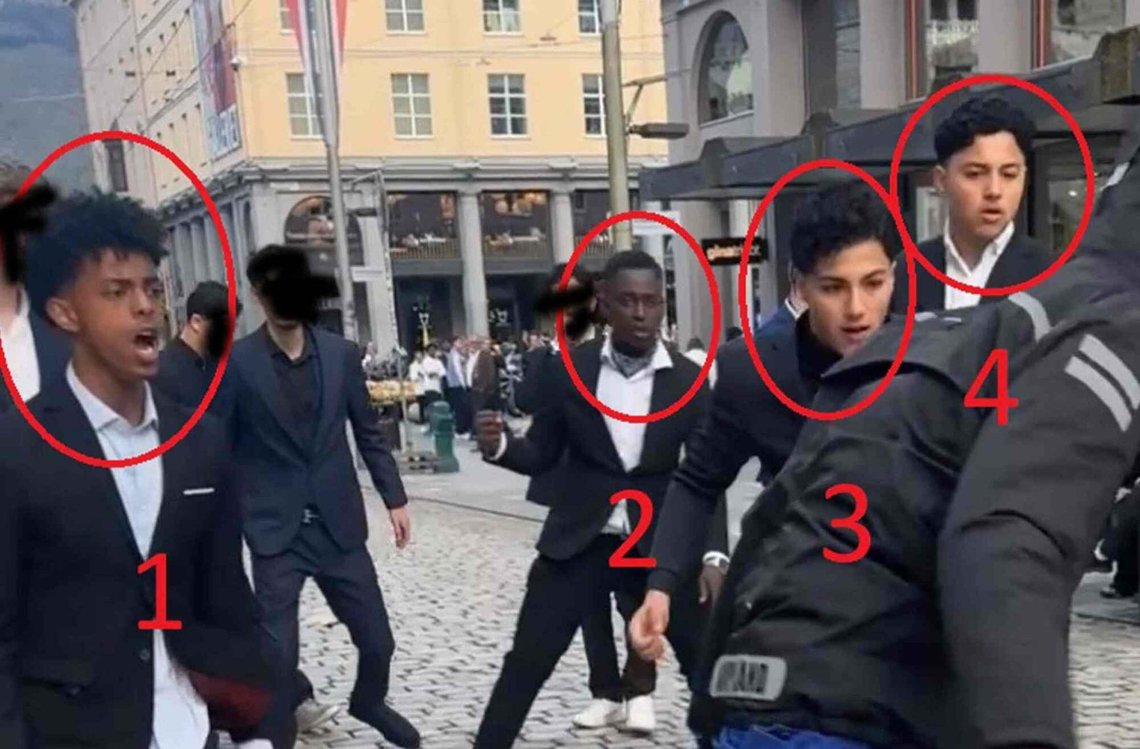


Progress Party (FrP) politician Jon Helgheim was fully within his rights when he published a photograph of the immigrant gang that attacked a boy wearing the blue graduation overalls (blåruss) on Constitution Day (17 May). The Public Prosecutor’s Office (Statsadvokaten) has now confirmed this.
The assailants who were filmed in Strandgaten in Bergen while attacking a lone boy wearing the blue graduation overalls (blåruss) on Constitution Day (17 May) must accept that images of them were published on social media without their faces being blurred. Their appeal against the police’s decision to discontinue the case has been rejected by the Office of the Public Prosecutor for Western Norway (Vest statsadvokatembete).
Jon Helgheim has thus been cleared of any possible wrongdoing in connection with his publication of a photograph of the attack on Facebook without first blurring the perpetrators’ faces. He blurred the image shortly afterwards, following considerable criticism of its publication.
Document wrote about the police’s decision to discontinue the case in June.
At the time, the police wrote, among other things, that “regard has […] been had to the fact that several of the complainants behaved in a manner in a public place that was liable to attract attention, and at a time when many people were present”.
Helgheim comments on the Public Prosecutor’s decision as follows:
The assailants from 17 May in Bergen continue to complain because the violence they committed had consequences for themselves. They chose to beat up a russ in the middle of the city on Constitution Day, yet according to them it is the publication of photographs from the incident that is problematic.
They appealed against the police’s decision to discontinue the case, and the Public Prosecutor has now ruled on the matter. The Public Prosecutor has concluded that my publication of an unblurred image of the incident does not constitute a criminal offence under any statutory provision. Like the police, they point out that the assailants themselves placed themselves in this situation.
It is good to see that the prosecuting authorities in Norway are acting rationally and are capable of interpreting the law as it ought to be interpreted.
The lesson from this case should be simple:
Do not beat people up in a public place if you do not want photographs of yourself beating people up in a public place to be published!
The Public Prosecutor’s statement reads:
The police have correctly concluded that it is unlikely that an investigation would result in a finding that the objective and subjective conditions for criminal liability are satisfied under any of the relevant penal provisions.
The appeal argues that the relevant provisions are Sections 267a, 267 and 266 of the Penal Code (Straffeloven), and provides a more detailed explanation as to why the matter is said to fall under the first-mentioned provision concerning the sharing of offensive images. However, no explanation has been given as to which factual circumstances might be clarified further or materially altered as a result of an investigation.
As the case stands, neither Section 266 of the Penal Code concerning reckless conduct, Section 267 concerning violation of privacy, nor Section 267a concerning the sharing of offensive images is considered applicable, even when interpreted in the light of Article 104 of the Constitution (Grunnloven). The same applies to Section 104 cf. Section 79 of the Copyright Act (Åndsverkloven).
In assessing the objective and subjective conditions for criminal liability under all the provisions, particular regard has been had to the situation in which [the minor assailant] had placed himself when he was filmed/photographed, and the context in which the image was briefly published.
There is no basis for believing that an investigation could obtain information or evidence capable of materially altering the decisive aspects of the case. Reference is otherwise made to, and concurrence expressed with, the police’s reasons for discontinuing the case.
The appeal has not succeeded. The case remains discontinued.
The decision leaves, among many others, lawyer Jon-Wessel Aas of the law firm Glittertind in an awkward position. His areas of specialisation are media law, freedom of expression and privacy, and he is regarded as one of Norway’s foremost experts in the latter two fields.
“As a lawyer, my clear advice would have been that the photograph could not lawfully be published publicly in such a context without the faces being blurred,” he told the newspaper BA on 25 May this year.
“In this example, where minors are involved and where the context is also highly damaging, the privacy interests of those depicted will carry considerable weight. That applies even more so if the person publishing the material adds damaging comments about those involved,” Wessel-Aas told the newspaper.
In his original post, Helgheim pointed to what he described as a broader societal problem:
Gangs with an immigrant background, especially from parts of Africa, Asia and the Middle East, attack, rob and beat up lone Norwegian boys. Such cowardly and revolting attacks are suffered by a great many young Norwegian boys.
SIAN leader Lars Thorsen, for his part, points out that a SIAN supporter was convicted for publishing a video of a violent assault, even though the victim’s father testified before the District Court (tingrett) that he was unable to recognise his own son in the video.
He believes the Public Prosecutor’s conclusion in Helgheim’s case demonstrates a set of double standards in the Norwegian courts.
17. mai-volden: «Lite sannsynlig» at Helgheims publisering var straffbar


