



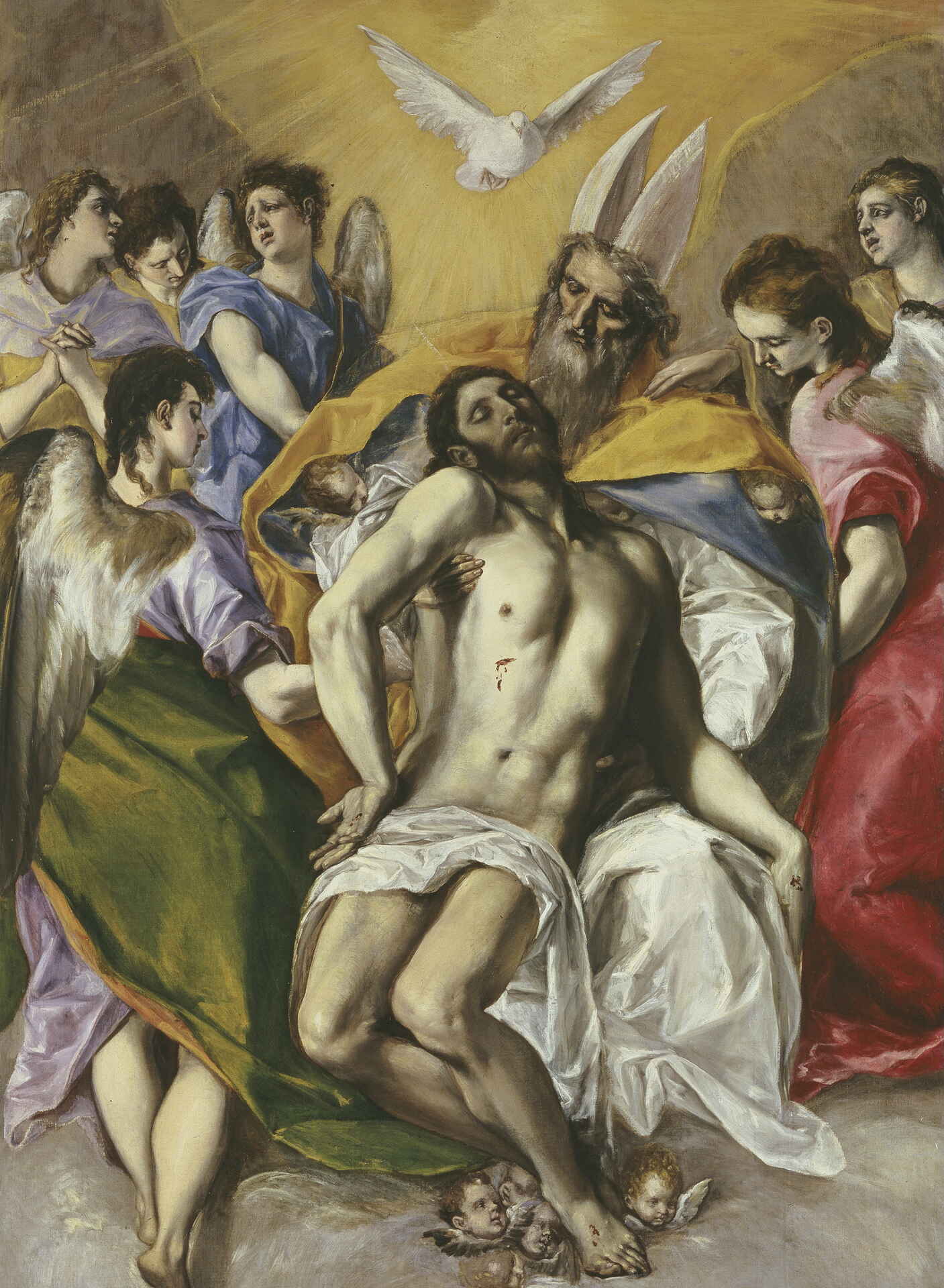
 El Greco (1541–1614), «The Holy Trinity», Prado Museum, Madrid.
7 Beloved, let us love one another!
For love is from God,
and everyone who loves has been born of God
and knows God.
8 Whoever does not love has never known God,
for God is love.
9 And in this the love of God was manifested among us,
that God sent his only Son into the world
so that we might live through him.
10 In this is love, not that we have loved God,
but that he loved us
and sent his Son to be the propitiation for our sins.
1 John 4:7–10
What does it mean that God is love, and does it have relevance for our own time?
It is the seventh Sunday in Trinitytide, and today’s text says something very important about how it is possible to say that God is a triune God. For John points to a decisive characteristic of God, namely that he is love.
In John, love and truth cannot be separated from one another. Love is not an independent value; it is the love that God is, not merely what he does.
But this love also entails another central attribute of God, namely that he is the absolute truth.
John does not say directly: «God is truth», in the same way as he says «God is love» (1 John 4:8) and «God is light» (1 John 1:5). But he binds God, Christ and the truth so closely together that they are inseparably connected.
Jesus says in the Gospel of John 14:6:
«I am the way, the truth, and the life.»
And in John 17:17 Jesus prays:
«Your word is truth.»
In 1 John we also see this connection:
- «Let us not love with words or tongue, but in action and in truth.» (1 John 3:18)
- «The Spirit is the truth.» (1 John 5:6)
John therefore presents love and truth as mutually dependent.
If one tears love loose from the truth, love can be reduced to affirming everything a person desires or feels, which is typical of today’s liberal Christianity and postmodern thinking. But that is not John’s understanding.
At the same time, if truth is separated from love, truth can become hard, merciless and used as a weapon. That is not John’s ideal either.
In John they belong together:
- True love rejoices in and presupposes the truth.
- The truth shall be expressed in love.
- Both have their origin in God.
- And decisively: Both limit God’s omnipotence.
God’s love therefore does not presuppose truth as something outside God; love and truth both spring from God’s own being, and God cannot call something good that is contrary to his being.
Since love is a relation between the Father and the Son, we see here the starting point for the doctrine of the Trinity.
Before the world was created, there already existed a relation of love between the Father and the Son. Love did not therefore arise first when God created human beings.
This became an important argument in classical Trinitarian doctrine.
Augustine of Hippo (354–430) developed this further. He held that if God is love in his own being, God cannot have been lonely before creation and only become love when he had someone to love. In that case love would have been dependent on creation.
Instead Augustine maintains that love is eternal, because from eternity there exists:
- the one who loves (the Father),
- the one who is loved (the Son),
- and the love that unites them (the Holy Spirit, as Augustine often describes the Spirit’s role).
Although this last point goes further than what John himself expressly says, it is built upon Johannine texts about the Father, the Son and the Spirit.
There is a stream of love that has its origin in God himself.
This also says something about what love is. If God is one God in three persons, love is not merely an attribute God possesses, but something that characterises God’s own life. Love is relational. It involves giving oneself to another and living in mutual fellowship.
Because God is triune, love is therefore not something God began with when he created the world. It is an eternal feature of God’s own life. Creation and salvation are expressions of a love that already existed in the fellowship between the Father, the Son and the Holy Spirit.
What we are then left with is that if the doctrine of the Trinity is not true, both the revelation of God, salvation and the understanding of God’s love are fundamentally altered.
This was also the reason why early Christians were so clear in their struggle against all teaching that cast doubt on Jesus as true man and true God. Something we saw not least in the controversy against Arianism.
Bishop Arius (250–336) taught that the Son was the highest of all creatures, but not eternal God. This implied that there had been a time when the Son did not exist.
Against this, Athanasius of Alexandria and others replied that this was not merely a technical disagreement about the nature of Christ. It concerned the gospel itself.
His reasoning can be summarised as follows:
- If the Son is created, he is not fully God.
- If the Son is not God, we do not know God through Christ.
- If Christ is not God, he cannot fully save humanity either.
- And if the Father only began to love when the Son was created, love is not an eternal feature of God.
When John says that «God is love», the Church Fathers understood this as a description of who God is in his eternal being.
If God from eternity was only one person, without an inner relation, he could not love in the way John points to.
Therefore the Trinity was not only an explanation of biblical texts, but also a logical understanding of the statement «God is love», that is, that God is relational from eternity.
What should then concern us is how many Christians today so easily argue that God can change his mind about what is true and good, and what image of God they are then actually presupposing.
But that can be the topic for next Sunday.
Have a lovely Sunday!


