




The 32-year-old Swede who was assaulted by an African migrant at Islands Brygge has now been declared dead. By every account, the murdered man was a good man. He had travelled to Copenhagen to watch a football match with a friend. He was a police officer in Sweden, a husband and the father of two young children. Now a wife must explain to two children why their father is not coming home.
The accused, a 31-year-old man, had previously been sentenced to seven years’ imprisonment for attempted murder. He was not deported – for reasons unknown. This serial criminal psychopath was free to walk the streets of Denmark, and on Tuesday evening he brutally murdered an innocent man, destroying the lives of an entire family.
The murdered Swede had travelled to Copenhagen to experience one of the finest things a community can offer: streets filled with colour, people cheering a football match on a giant screen, strangers greeting one another, embracing one another and patting one another on the shoulder. In his daily life, he worked to protect others.
His wife and sister have written moving words on social media about their loss. At Christmas and on birthdays, there will be a chair that no one will ever sit in again. The children will grow up with a photograph instead of a father. With a lifelong sense of loss and grief.
That is the bill a country’s immigration policy presents to entirely ordinary families.
The figures that few people know
This terrible case is an expression of a pattern that the official statistics conceal.
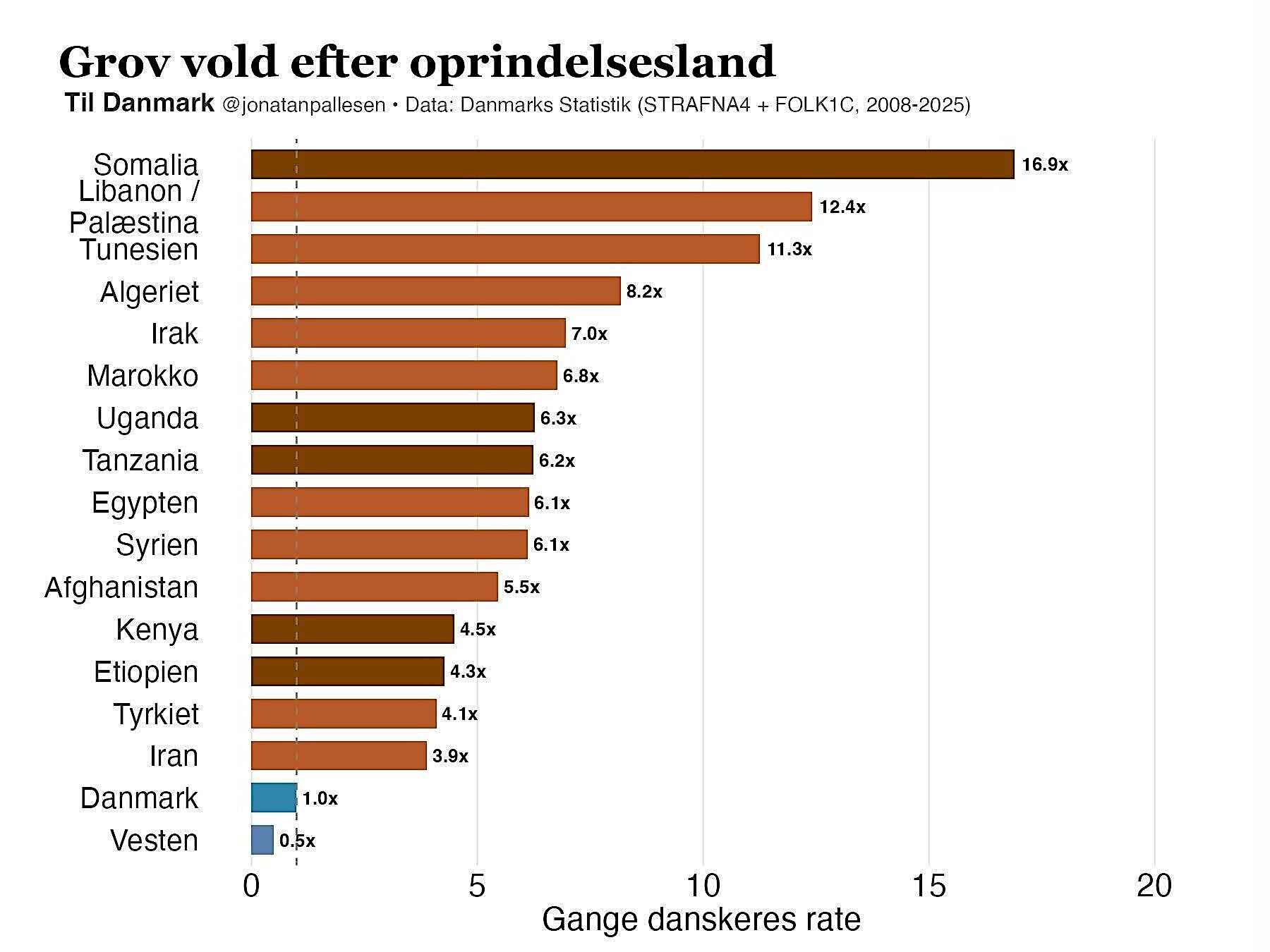
Statistics Denmark’s own figures show that non-Western immigrants and their descendants commit crime around three times as often as ethnic Danes. But that figure is an average of averages: all countries of origin and all forms of crime have been combined and then adjusted for age and socio-economic factors.
If, instead, one examines the individual countries of origin without this equalisation, a very different picture emerges.
Somali immigrants commit serious violent offences almost 17 times as often as Danes. Seventeen times! For immigrants from Lebanon (including Palestinians), the corresponding figure is more than 12 times. These are astonishing figures, and they reveal a pattern that the wider public is rarely shown in its full extent. Data analyst Jonatan Pallesen has presented the figures:
The city that closes in on itself
The expected political response has already been announced: the giant-screen event at Islands Brygge should be cancelled. For this is not the first time violence has struck this particular location, but this time it cost a life.
The solution, then, is less urban life, less community, less of the very freedom and joy that made the place worth visiting. Peaceful citizens lose their celebration.
This is not merely a cultural loss but a form of collective punishment, in which the innocent pay for the actions of the guilty while politicians can appear decisive without addressing the real cause – the catastrophic immigration that is destroying Europe – and without taking any action. No deportations after a first conviction, no complete halt to immigration from the MENAPT countries.
From failure to vigilantism
There is a term for the condition in which the state can no longer protect its citizens from violence, but instead directs its energy towards monitoring and restricting the law-abiding: anarcho-tyranny.
When citizens conclude that the state, politicians and the justice system are unable to protect them, the temptation to take matters into their own hands grows. This is not a wish, but a warning. History shows that when the state, in the eyes of its citizens, loses its monopoly on the legitimate use of force, sooner or later it also loses the right to be obeyed.
When will Europeans begin killing criminal immigrants? When will states governed by the rule of law degenerate into violent clan societies?
Why are so few politicians and opinion-makers asking themselves this crucial question? Why is it left to banned films?
The murder at Islands Brygge lays bare, in all its brutality – with all the fear, grief and anger it causes – a decadent Europe without the will or the ability to defend itself. But anyone who believes that angry Europeans will tolerate this for much longer is making a grave miscalculation.


