

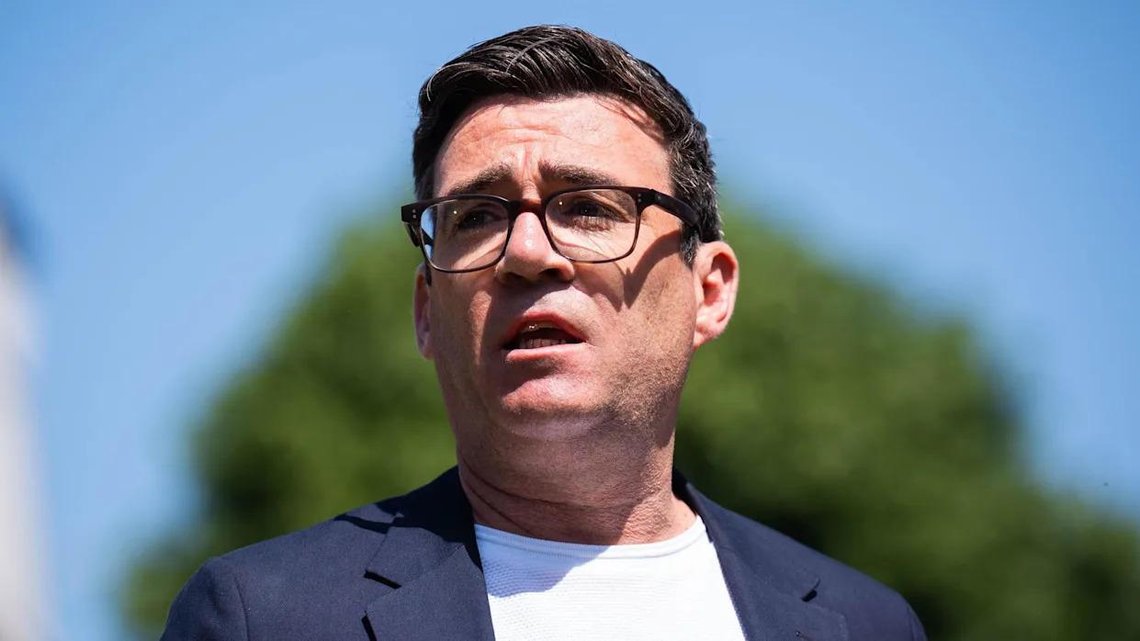


Andy Burnham has been dubbed the “King of the North” by the media, and appears to be sailing towards becoming Britain’s next Prime Minister without opposition. Who is he, and what does he stand for? Is he, as Trump claims, “extremely liberal”? Or is he a breath of fresh air after the robotic Starmer? And does he deserve the nickname “King of the North”?
Andy Burnham is tall and dark, and is often complimented on his long eyelashes and thick mane of hair. He frequently dresses in a black T-shirt and presents himself as the man who will save Britain from sinking even deeper. Burnham grew up outside Liverpool in an ordinary middle-class family. His father was an engineer and his mother worked as a receptionist at a doctor’s surgery. Burnham was academically gifted and earned a place at the University of Cambridge, where he studied English literature. From there, his career followed only one direction: upwards. His career in Labour has been long and extensive, and after serving, among other positions, as Secretary of State for Health under Gordon Brown, he secured the office for which he is best known in 2017: Mayor of Greater Manchester, winning 63 per cent of the vote.
As Mayor of Manchester, Burnham became popular. He was even re-elected with an even larger share of the vote — 67 per cent — in 2021. Then, as now, he argued that politics was far too London-centric. He wanted to give the regions greater room for self-government and stimulate economic growth. Whether he succeeded is disputed. Critics would argue that he failed. The Greater Manchester area remains one of the poorest regions in the United Kingdom, where one in four neighbourhoods ranks among the country’s poorest ten per cent. Sexual offences and violent crime are above the national average. Educational attainment is below the national average, while drug-related deaths are above it. The list of depressing statistics is long.
Not least, Manchester has had more than its share of grooming gangs — something that is naturally connected to the large Pakistani population living there: Greater Manchester is home to more than 200,000 Pakistanis, one of the largest concentrations in the country. The grooming gangs, which are estimated to have abused 250,000 young British girls, had a marked overrepresentation of Pakistani men.
Yellow buses and culture
Burnham’s supporters would argue that his powers as mayor were limited, and that it was Conservative policy — the need to tighten public spending under David Cameron — that undermined Burnham’s agenda. They would also point to the positive changes achieved under his leadership. Burnham carried out a reform of bus transport in the Greater Manchester area, bringing it back under public ownership and rebranding the system as the Bee Network. The yellow buses have become popular in Manchester, as have the low ticket prices. His investment in culture has also contributed to his popularity. He earned the nickname “King of the North” when he demanded more funding for the region from the Government during the Covid pandemic. And despite the depressing poverty figures, Manchester can boast the fastest-growing economy in the country.
But precisely where Burnham stands politically is more difficult to define. He is hardly as woke as Sadiq Khan in London, nor as fanatical about meeting climate targets as Energy Secretary Ed Miliband. Immigration is the most important issue for British voters, and for now Burnham is keeping his cards close to his chest. His previous voting record nevertheless suggests that he is somewhat more liberal than Starmer, while at the same time signalling a tougher line by saying that he wants to deport Shabir Ahmed, a grooming gang leader who was recently released early from prison. “Nothing is off the table” in getting rid of him, Burnham believes. He has also stated that immigration must enjoy public support and that national borders must be respected, indicating that he may have become less liberal recently. Anything else would, of course, amount to political suicide for Labour.
State ownership and more censorship?
As his time as mayor demonstrates, he is otherwise in favour of state ownership and wants the energy and water companies returned to public control. That is classic Labour Party policy and is unlikely to surprise anyone.
Document and the undersigned have long been concerned with the state of freedom of expression in the United Kingdom. It is unlikely to improve under Burnham. While he was Mayor of Manchester, firefighters who supported Reform UK received formal warnings, and colleagues in the fire service were encouraged to inform on one another. The Free Speech Union wrote directly to Burnham warning him about the practice. Burnham wants newspapers to be subject to stricter regulation, in line with television and radio broadcasters, which fall under Ofcom, a regulatory authority that exercises considerable power in the United Kingdom.
For the time being, Burnham remains an unwritten chapter as a prospective Prime Minister. If events unfold as expected, and no challenger emerges at the last minute, he could move into 10 Downing Street as early as this month. The British public has grown thoroughly weary of Keir Starmer, and Burnham will probably give Labour’s popularity a modest boost. Burnham is less robotic than Starmer and comes across as a man of flesh and blood. He is an Everton supporter, and in a recent photograph he can be seen jogging in an old Everton shirt. He is reasonably photogenic, and although he unquestionably belongs to the elite, he is not from London, which may prove an advantage. Whether the policies will be genuinely new is too early to say, but the packaging is at least somewhat more appealing. The British people, however, are not fools. If he fails to meet expectations, his popularity is also likely to decline. Being tall, dark, and down-to-earth may not be enough if he is unable to change the country’s course.


