



Yan Friis, chairman of Rolf Riktor’s Friends, lets rip!
In the past we zapped around in the TV companies’ programme flora. Now we zap between streaming services. Netflix, Disney+, HBO Max, Prime Video, Viaplay, TV 2 Play, YouTube and TikTok. Everything is there: the series, the reality talk-of-the-town, the cinema films and the documentaries. The range is so overwhelming that keeping up to date is a full-time job. Every week a new series appears that someone says you simply must watch. As a rule it has already reached season four. How are you supposed to catch up when you can barely remember the titles of the series you are already following, or which streaming services they are on. (What was that crime series from Wales with the dead children? I wake up at night with the cliffhanger that ended episode 3 on my mind.)
It is a jungle out there. And a gnawing, burning unease in here.
I do not regret following the recommendations and checking out some of the most popular series. The first season of The Bear is epic! The third season of The White Lotus is irresistibly fascinating, for some characters! The Last of Us, sci-fi based on a net game, unexpectedly successful storytelling against a backdrop of downfall and death. So Squid Game can manage without me.
My point is that series have undergone a sovereign lift since Seinfeld and The Sopranos were what saved TV evenings. All the other series just tried to resemble these, they were American, they swarmed with young, mediocre actors (with perfect teeth) who did not listen to what their co-stars were saying, but just waited for their cue. They struggled with silly lines and wondered if there was a mirror nearby.
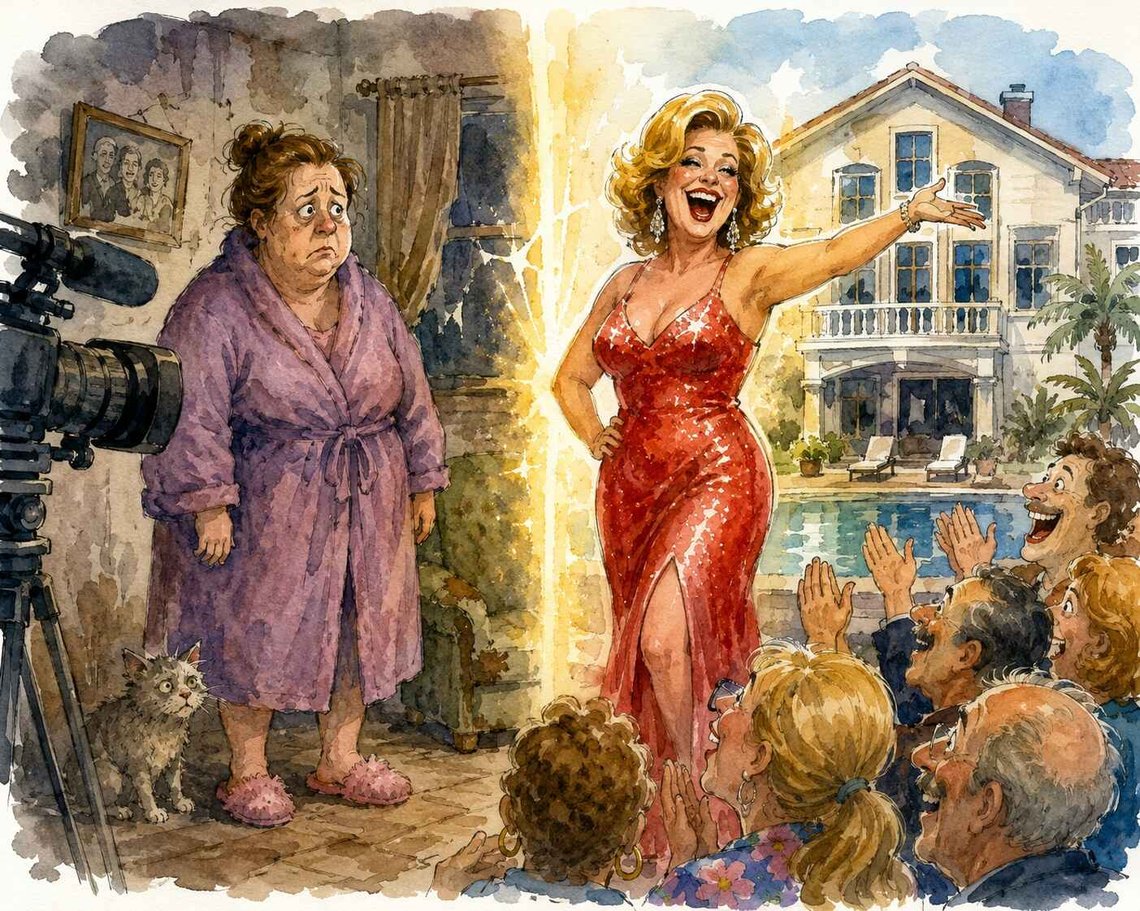
Reality series have survived. They are classically constructed. But the themes are more limited. The fear of offence has crept in. The series that focused on people’s appearance have become woke today. I admit I miss the kitsch kick they gave. Here we met people who suffered from something: high weight, low weight, crooked nose, ugly teeth, poor self-image, lack of empathy, prolapsed uterus, anything – with the common denominator that they hated themselves – probably because they did not look like the actors in the Cheers copies. The TV stations did something about it. Full speed with surgeons and hairdressers and designers and psychologists – hysterically cheered on by the victim’s close relatives and friends, who did not recognise the victim when the transformation was complete and the TV cameras captured the children’s horrified facial expressions.
The housing version of ugly people was Extreme Makeover: Home Edition. Here the victim’s close relatives and friends were joined by the entire neighbourhood when the person lived in a really un-cosy house that the TV company subjected to extreme renovation and turned into a mini-resort for people with bad taste, far too much free time and no interests. Here it was important that at least one family member suffered from a rare and incurable disease, and preferably that the mother was a single mother on disability benefit. Then there was the most crying. One could wonder why they had not sold the property long ago and moved into a cheaper flat, but OK, they obviously had to have a detached house.
This type of renovation has now been taken over by things like “celebrity does up house”, “interior and styling”, “craftsman competition”, and perhaps most of all “people who buy dilapidated smallholdings or manor houses they cannot afford to renovate”. It is no longer the family that is to be saved. It is the smallholding from 1873. After six episodes, three relationship crises, frequent drone filming and a budget that bursts even before the first commercial break, they stand there with a kitchen costing four million and a contract for season 2.
Then of course there are the traditional elimination series. Here Robinson was first, but has acquired worryingly many competitors – with the IQ show Paradise Hotel as perhaps its most dangerous challenger – mostly because it would have been a miracle if any of the Paradise participants were even able to buy a bus ticket without help. Then every day is a gift.
After these came Love Island (naked bodies, romance, intrigues, elimination and celebrities) and Ex On the Beach (as scandalous as Paradise Hotel, clearly the series that has given the most tabloid headlines). Robinson tried novelty one year and surprised with an entire series in freezing cold. It was not smart, as all people look the same in polar clothing. Then it becomes difficult to find someone to cheer for.
The glue that holds everything together is called “influencers”. Their daily activities (which often include displaying at least one thigh), video clips (actually the video version of a selfie), unannounced switching between duck face and wide eyes, and holiday reports from luxury hotels in Dubai (preferably by the hotel’s swimming pool), fill large parts of the population’s heads day after day, week after week, month after month.
Influencers rarely have time to ponder the mysteries of existence. They have to make it to their skincare appointment. Yes, they have actually found the answer to the mysteries, for the answer is “me” and the meaning of life is “me”. My skin, my hairstyle, my tattoos, my kilos, my hairless genital organ, my polished nails.
And to go back to the classic Paradise Hotel for a moment: It is perfectly fine to believe, as a couple of 19-year-old Danish actors in the TV series did, that Hitler was a German prime minister who was locked in a basement with his grandfather during the Second World War (which lasted from 1884 to 1900), but who fortunately won the war, so that Denmark got its own prime minister. Perfectly fine to believe, as long as one has control over the more important things in life: rubber breasts and Angelina Jolie lips (for the gentlemen it is about tattoos and six-packs).
There are no limits to how much time one should spend on one’s body. It makes one tired. Then it is good to unwind with American series and reality programmes after the influencers’ taste that deal with the same: looking young and sexy, preferably interspersed with simple humour and a little whining. Old age is banned, it is met with surgical interventions until one looks like the scariest thing we know: the siblings of Cruella de Vil, Joan Collins and Dolly Parton.
There is light at the end of the tunnel, and it is not the train. One should be an optimist. Even in 2026. Yes, perhaps especially then. The streaming range is namely so rich and of such quality that I do not need to succumb either to TikTok, the influencer revue from Dubai or depictions of grumpy people who cannot stand each other over a smallholding. I can sit in my own living room and enjoy the crime series I have found myself, or been made aware of, and if I feel like playing a vinyl record, it is just to pause the episode and fire up the stereo to 11.
The streaming range has a little for everyone, and a lot for me. Actually life as an old person is not so bad. Exciting, lavishly produced films with brilliant actors as much as we want. You cannot kill time better than that. And then one can supplement with whisky and banana chocolates and vinyl records and perhaps a little piece of honey cake (fresh). Yes, I am smiling now, and I can see it:
Life is about killing time until one becomes senile and eats porridge and drinks red cordial voluntarily. Then you do not notice anything anyway. That’s all.
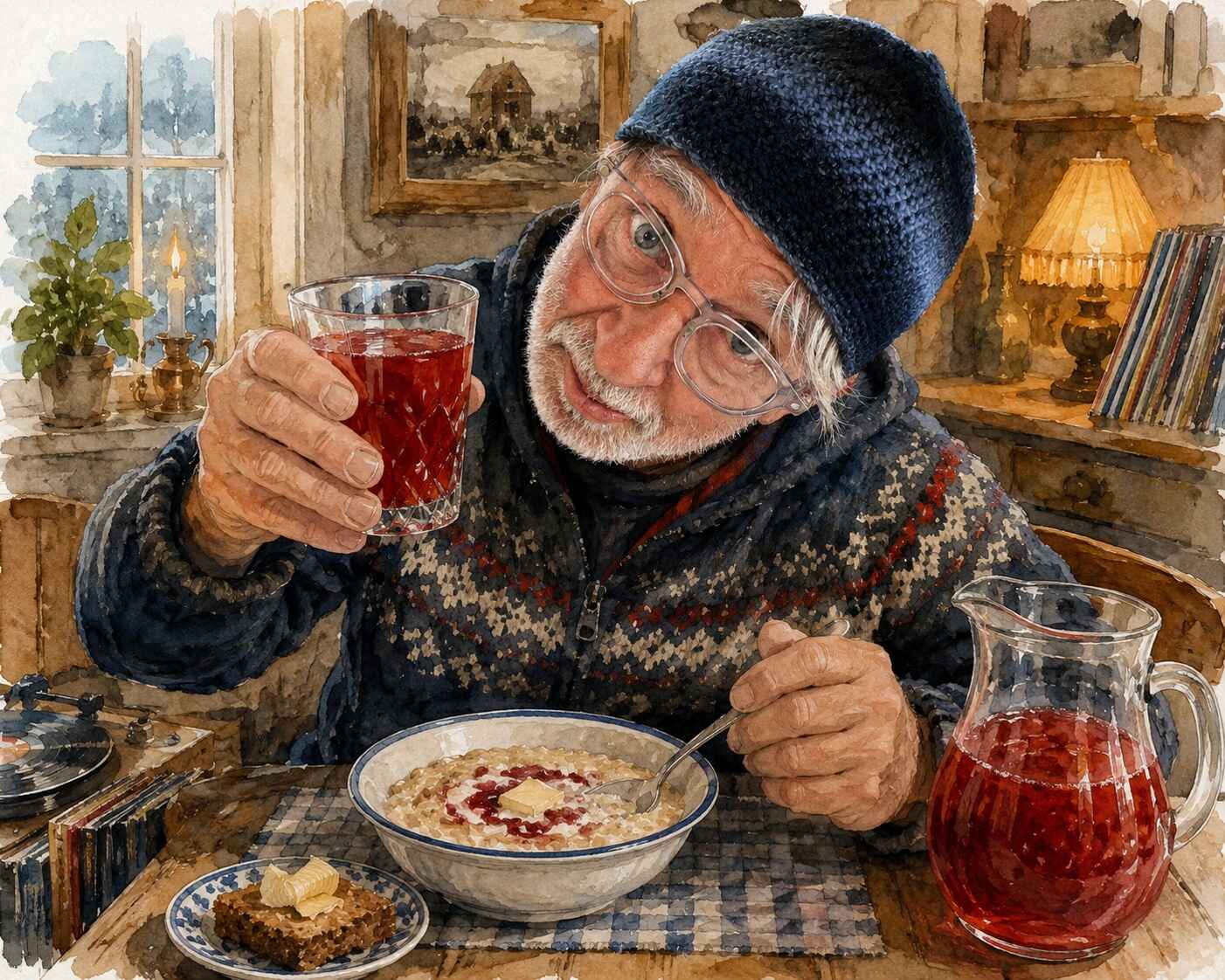 The sum of everything and the real meaning of life: Porridge, red cordial and early to bed. (Thanks to my sister Aino, who crocheted the hat.)


