

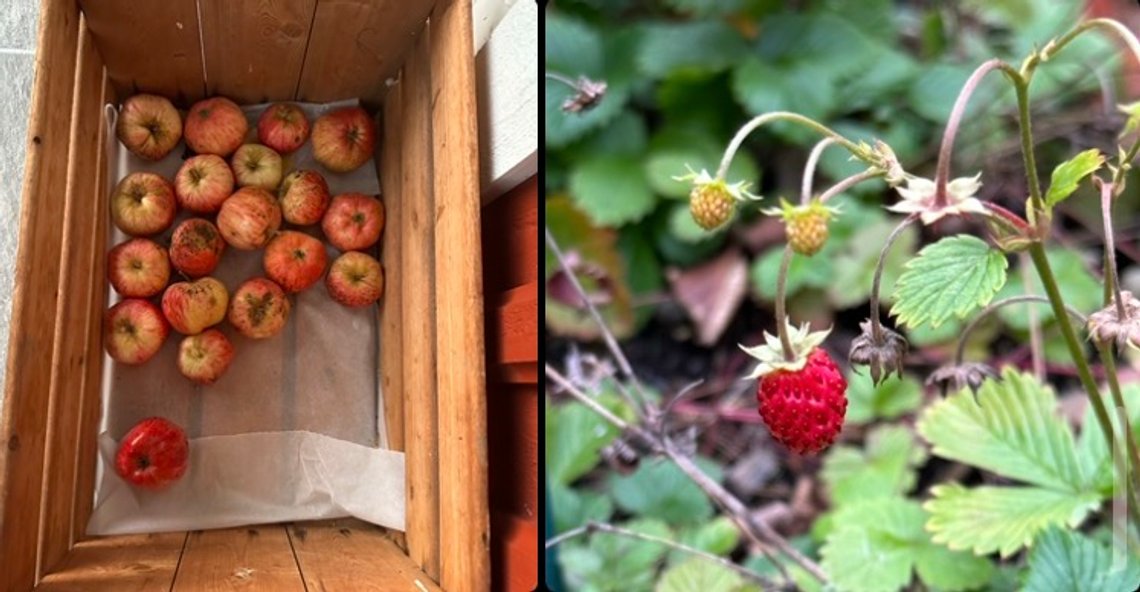
Fear of war with Russia has gripped the whole of Norwegian public life. Now, according to NRK, we are also supposed to fear food shortages and years of poor harvests.
“We have not experienced food shortages for a very long time. We have forgotten.”
This is how NRK opens its fearmongering propaganda. But they have the solution: we can use nature as our shopping basket if a crisis occurs.
The backdrop is, of course, the war between Russia and Ukraine, seasoned with a little climate panic.
War in Europe, extreme weather and drought are causing concern and showing how fragile our systems are. The authorities are telling us to stock up on crispbread and water, but what do we do if a week has passed and the crisis continues?
We can eat much of what grows in the garden, they claim—even half the lawn is edible, according to forager Patrick Børs. Or we can “rush out into the forest, hungry and a little desperate. With an old plant identification book in our hands.”
The great foraging trip
To offer readers a way out of the panic, NRK heads into the forest to investigate the following question: Is it actually possible to survive on nature’s own larder? Joining them are Børs and Ingrid Indergaard, who is also a forager and an expert on edible wild plants with the Norwegian Mycological and Foraging Association (Sopp og Nyttevekstforbundet).
According to Indergaard, around 350 plants in Norwegian nature are edible. Even the urban environment can fill a shopping basket.
That is interesting enough, and anyone with a military background is likely to have encountered the need to procure food from nature. Nevertheless, one is left with a certain sense of unease. For quite quickly, reference is made to the Second World War and the German occupation.
Because of food shortages during the war, Norwegians began supplementing their food supply (matauk). They picked berries and mushrooms, and the practice continued afterwards. Even my own children have gone out to stock the pantry—not out of fear of war, but because it is both useful and enjoyable.
Now it is the spectre of Russia that is supposed to frighten us—a country with which Norway has always had an acceptable relationship. Today things are different, and politicians throughout Western Europe speak of the risk of a Russian invasion.
“Now people have started talking about ‘supplementing the food supply’ (matauk) again. They want to know how they can forage and build up a food store,” says Indergaard.
A Russian attack on European NATO countries could, of course, once have been regarded as entirely unthinkable. People may hold differing views on how Norway and other European countries ought to have responded to Russia’s invasion of Ukraine in February 2022. But there is little doubt that the massive deliveries of weapons used to kill Russian soldiers irritate the Kremlin.
At the same time, political leaders such as Macron and Starmer speak incessantly about sending troops they do not possess into Ukraine following any future ceasefire. The fact that Russia’s Foreign Minister Sergei Lavrov has repeatedly declared that the Kremlin will never accept NATO troops on Ukrainian soil is simply ignored. Instead, European countries discuss deploying nuclear weapons close to Russia’s borders, bordering the world’s largest nuclear power.
This is compounded by alienating the United States, NATO’s only genuine military power. The lack of sympathy for President Donald Trump has led the European NATO countries to risk losing American protection.
Norwegian politicians are following suit, speaking of a defence force based on the EU. Few seem concerned that this is completely unrealistic. Nor is anyone talking about the enormous fifth column of around 50 million immigrants who would have free rein to tyrannise and abuse our women and children on the home front.
Even in peacetime we experience terrorism, assaults, murders and hundreds of thousands of rapes, yet we continue allowing more enemies in. Imagine what the situation would be like while men leave their homes to perform their duty in uniform.
Very few of these new Norwegians would stand on the front lines to defend Norway. Not even after the Norwegian Armed Forces promote Islam by showing Muslim soldiers chanting “Allahu Akbar” (Allah is Greatest).
https://www.document.news/news/2026/06/during-pride-month-norways-military-features-islamic-prayer-allahu-akbar
The misguided British were well ahead of us in this regard, when the British Army was already promoting Islam in a recruitment video back in 2018. The British soldiers naturally postpone the mission, which is militarily inexcusable, but one must, after all, show “respect” for the “religion of peace”.
Fear of war and pandemic hysteria
The Norwegian Mycological and Foraging Association has experienced growing interest, and its membership has doubled since 2020. This suggests that the pandemic hysteria also contributed to making people more conscious of keeping a reserve of food in the house. The same happens whenever war breaks out, says Indergaard.
“Interest increases with every war, and when we know that conditions in the country were generally poor.”
In such circumstances, foraging becomes highly relevant, but it requires preparation.
“We must plan our preparedness before we need it; otherwise there is an awful lot to learn in a very short time.”
The foragers take NRK in search of seaweed and kelp, which are edible, although not especially tasty (a matter of taste). One can fish, provided one lives somewhere that is not too polluted. Shellfish make excellent food but must be eaten relatively quickly. It is also possible to prepare foods that keep well, such as heavily salted saithe or smoked salmon. If one lives in the right place, one can even produce klippfisk (salted and dried cod) or stockfish. There are many possibilities for those who possess the necessary knowledge.
Berries can be turned into jam. If the mushroom harvest is abundant, one can make dried mushrooms, which are excellent in risotto, among other dishes. It is very simple: just spread the mushrooms out on a baking tray lined with baking paper and leave them in the oven at around 40–50 degrees for 12–24 hours, until all the moisture has evaporated while all the flavour remains.
But this ought to be done in order to raise children well and to enjoy pleasant experiences with family and/or friends—not because our politicians appear to want a war with Russia.


