

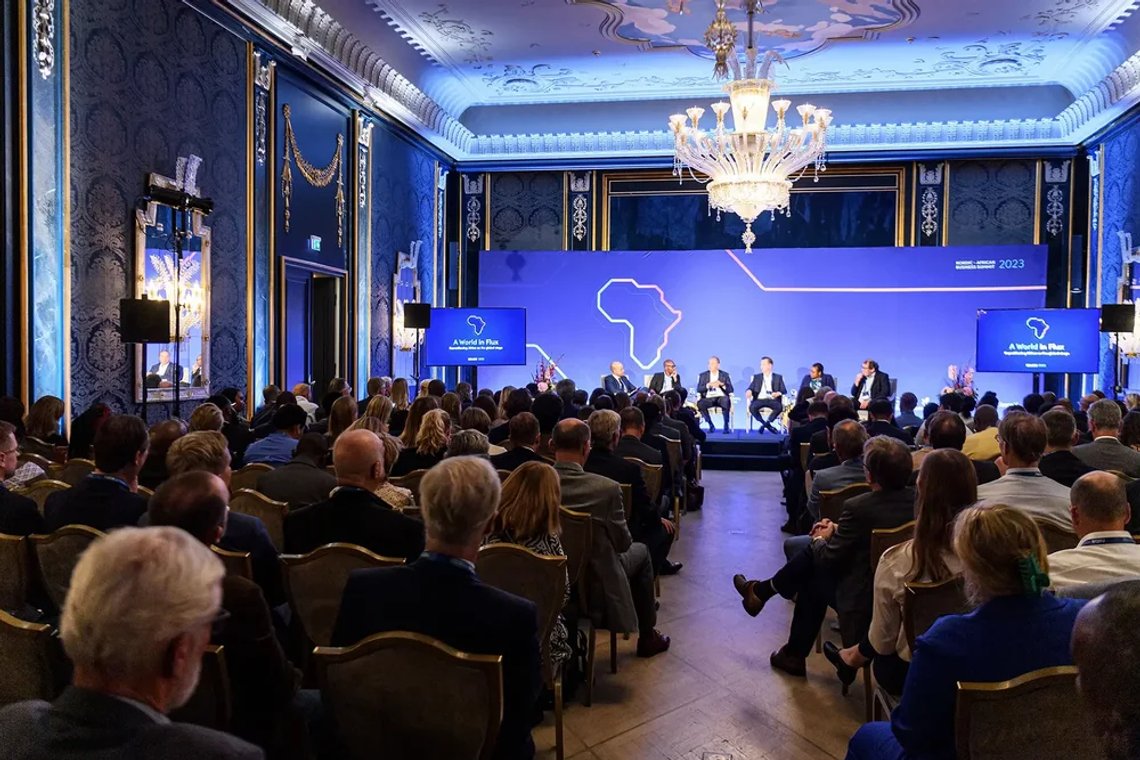


The Nordic-African Business Summit 2026 offers a test of how Nordic companies approach African market entry across energy, minerals and agri-trade. The summit is scheduled for 8 October at the Grand Hotel in Oslo and is organised by the Norwegian-African Business Association in partnership with Norfund, Africa Finance Corporation and the Norwegian Ministry of Foreign Affairs. NABA says the 2026 summit will focus on energy, critical minerals and agri-trade, three sectors where capital, logistics, regulation and political relationships decide whether interest can become contracts, financing or long-term partnerships. Those themes give the event a clear commercial frame, but the measurable question is whether the summit shortens the distance between Nordic boardrooms and the practical conditions of doing business in African markets.
NABA’s wider model shows how paid access is packaged. The summit sits alongside membership, advisory work, business missions and contact with decision-makers, while NABA’s published membership fees run from NOK 6,480 for small companies to NOK 32,400 for large companies. That pricing structure is modest compared with the cost of a failed market-entry exercise, where travel, legal work, poor local selection, payment disputes and regulatory misunderstanding can absorb management time without producing a contract. The commercial logic therefore rests on whether NABA’s network can help companies identify credible counterparties, understand local constraints, reduce avoidable mistakes and reach decision-makers who are difficult to approach through ordinary outbound sales.
African market entry from Norway and the wider Nordic region is difficult because the continent cannot be treated as a single commercial unit. Rules, currencies, permits, tax treatment, payment risk, port access, customs procedures, business culture and political relationships vary sharply by country and sector. Nordic firms may bring energy expertise, maritime competence, project-finance discipline, agricultural technology, industrial equipment or digital systems, but those capabilities do not automatically translate into bankable projects. Trust, local knowledge, enforceable contracts, credible partners, financing terms and post-installation execution decide whether a polished introduction becomes revenue.
Energy is the most immediate execution test because African development cannot be separated from electricity, grids, generation, storage and financing. NABA frames energy as central to Africa’s development trajectory, with rising demand, expanding grids and new models for generation and storage, which makes the sector attractive to Nordic firms with experience in power systems, maritime infrastructure, engineering and long-cycle industrial partnerships. The commercial questions are operational rather than rhetorical: who builds, who finances, who carries currency risk, who guarantees payment, who maintains the asset and who absorbs political or regulatory change after the launch ceremony has passed. A summit can expose those questions to the right people, but it cannot remove the project-level discipline that lenders, developers and buyers will impose later.
Critical minerals give the summit a stronger strategic layer. The European Commission says 63 per cent of the world’s cobalt is extracted in the Democratic Republic of Congo, 97 per cent of the EU’s magnesium supply is sourced from China, and all rare earths used for permanent magnets are refined in China. The IEA has also warned that China is the leading refiner for 19 of the 20 strategic minerals it tracks, with an average market share of about 70 per cent. That makes African critical minerals a supply-chain, financing and governance question, with extraction only one part of the commercial equation, because Western buyers looking for alternatives still need projects that can secure permits, power, roads, processing routes, tax stability, ownership clarity and political durability.
Agri-trade is less glamorous but may provide the cleanest test of practical value. NABA describes the sector through changing production capabilities, new logistics corridors and direct sourcing from African producers to Nordic off-takers, which puts the emphasis on reliability rather than rhetoric. Buyers need predictable supply, producers need market access, logistics firms need volume, banks need repayment visibility and governments want food security without turning every transaction into a subsidy exercise. Commercial value appears only when contracts, quality standards, cold chains, payment systems, insurance, customs handling and margins can survive transport delays, bureaucracy and currency swings.
The summit should be judged by its ability to reduce transaction friction between Nordic companies, African counterparties, financiers and public-sector actors. The presence of development finance, diplomacy and corporate networks may increase the quality of introductions, but it also exposes the event to overclaim, where access language outruns investable reality. The harder test is whether companies leave with qualified leads, whether African partners gain serious capital conversations, whether Nordic firms develop country-specific execution plans, and whether projects can survive currency risk, regulatory change, payment uncertainty and political friction. The useful measure is whether the Oslo conversations produce credible counterparties, bankable structures and contracts capable of surviving the legal, financial and logistical pressure of the markets being discussed.


