

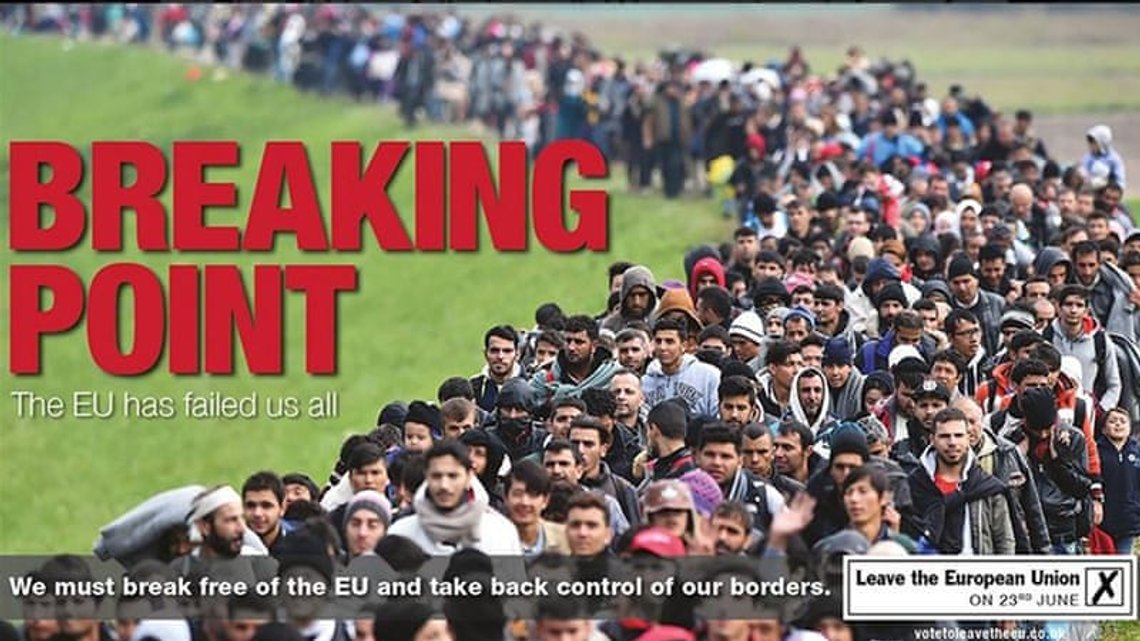
It has been ten years since Brexit, and Norwegian News Agency NTB is running full pro-EU propaganda. Now Norway is to enter the EU, and the British have realised that they made a mistake in 2016. The reason was disinformation and propaganda, we are told. Keyword: Immigration.
A narrow majority of Britons voted yes to the proposal to “take back control from Brussels” and define relations with Europe according to their own interests. Immigration issues in particular preoccupied Brexit supporters.
2015 was the year of mass migration through Europe. The British saw what they saw. But NTB does not mention that.
They use Erik Oddvar Eriksen, Professor of Political Science at the University of Oslo, as an oracle.
He says that the British have realised that they made a blunder in 2016. The United Kingdom has fared poorly. They have acquired “the far-right party Reform”, which profits from polarisation.
The presentation is untouched by contact with reality, but it is useful as an illustration of the ideology that characterises NTB and academics.
Now they see their opportunity: The war against Russia and the war against Trump may bring Europe together. Did we not know it? This is the plan! It is useful to have it in black and white.
According to Eriksen, the outcome was based on disinformation and propaganda.
“The opinion polls show that people understand that it was a mistake, and that there is a majority in favour of rejoining the EU,” he says.
Economic ConsequencesEriksen points out that Brexit has had negative economic consequences for British society.
The US National Bureau of Economic Research has calculated how the British economy has developed compared with a continuation of EU membership.
The bureau indicates that the country’s gross domestic product is 6–8 per cent lower than it would have been had the country remained in the EU. Employment and productivity are estimated to be 3–4 per cent lower, and investment has been reduced by 12–18 per cent.
The political uncertainty surrounding Brexit had consequences for trade policy. It led to fewer investments, lower demand than expected, and slower productivity growth. Selling British goods to the EU has become more difficult, as have entry rules for Britons. However, the EU remains by far the United Kingdom’s most important trading partner.
“Brexit has led to polarisation and widespread dissatisfaction,” says Eriksen.
A lack of respect for politics in general and increasing contempt for the established parties that have alternated in government throughout the entire post-war period are conspicuous. The far-right party Reform UK, led by Nigel Farage, is growing in step with increasing dissatisfaction.
Moving Back Towards the EUToday, the British government is once again working to strengthen its ties with the EU in various ways, particularly in the fields of research and education.
The United Kingdom is once again associated with the Horizon Europe research and innovation programme, and from 2027 it will also become part of Erasmus+. This means that Norwegian students will once again be able to travel free of charge on exchange programmes to popular universities such as the London School of Economics, King’s College, and the University of Edinburgh.
“Presumably, as in Norway, that is where the authorities wish to have as much involvement with the EU as possible because they believe they can benefit from it,” says Eriksen.
He points out that the United Kingdom cooperates particularly closely with the EU on foreign and security policy.
How do you think Brexit will look over the next ten years?
“We are in a completely different global situation now than ten years ago, with wars and a United States that has become entirely unpredictable with regard to the values that we expect it to uphold.”
Eriksen believes that these factors may lead to a more united Europe, with greater integration and more cooperation in the years ahead. (NTB)


