

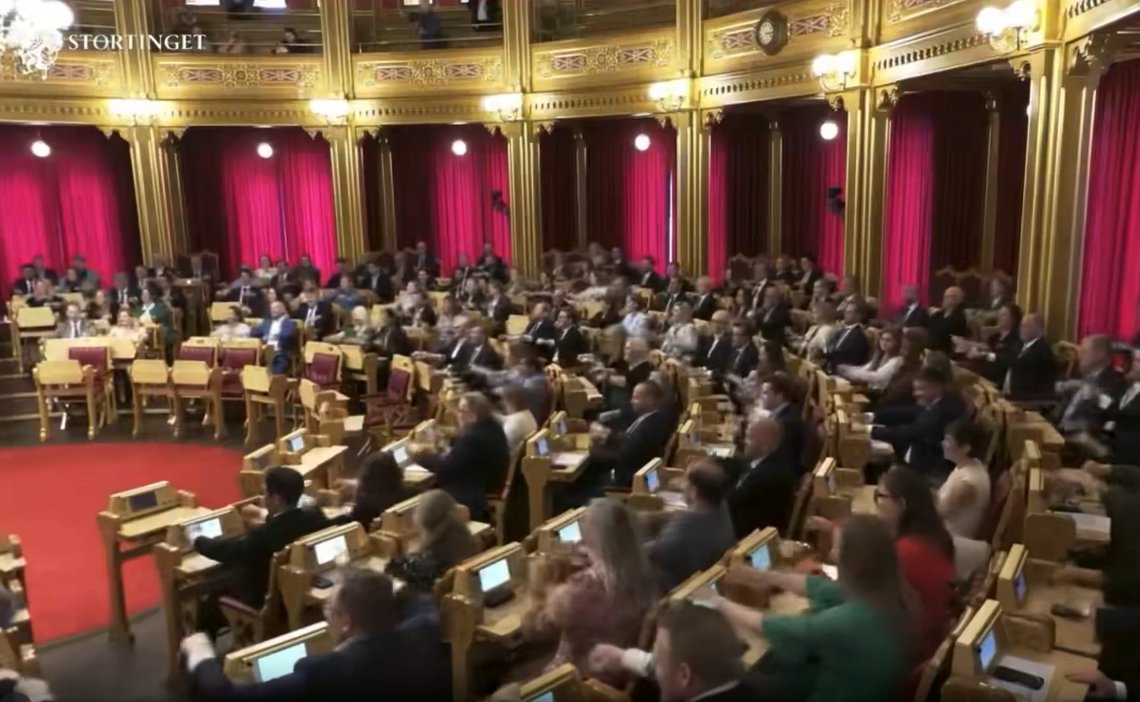
There was something almost perfect about the Norwegian parliament doing the Viking row.
Not perfect in the polished, official sense. Perfect because it was awkward, funny and revealing. A room full of politicians briefly stopped behaving like politicians and copied the supporters. They rowed.
According to Reuters, Thursday’s parliamentary session was interrupted after the speaker suggested members repeat the rowing action that Norwegian fans had made famous during the World Cup. The response was enthusiastic and cross-party. After Norway’s 4–1 win over Iraq in Boston, Reuters noted that red-clad supporters, many wearing Viking helmets, had been seen rowing in unison in bars, on public transport and even on escalators around the stadium.
There it was. Culture, in its natural habitat.
Not in a seminar. Not in a museum. Not as an approved slogan printed under a federation logo. Just people doing something together because it felt like theirs.
That is why the parliamentary row matters. It exposed something Norway’s official class often seems nervous about admitting. Heritage is real. National symbols still carry weight. People understand them instinctively, especially when football gives them permission to stop apologizing for five minutes. The timing made it even better.
Earlier this week, the Associated Press, in a story carried by Fox Sports, reported that Norway’s Viking-themed World Cup photographs had caused debate. The Norwegian federation had commissioned British photographer David Yarrow to shoot the players in Viking attire, with weapons, shields, long boats and a fjord behind them. Markus Slettholm of Morgenbladet called the image “chauvinistic” and said it was “a bit reminiscent” of what neo-Nazis had been concerned with years earlier.
This is where modern cultural anxiety often ends up. A shield, a boat, a fjord and a few footballers suddenly require a nervous explanation.
Then the tournament began.
The same Viking image moved from a staged photo into public life. Supporters embraced it. Foreign fans noticed it. Parliament copied it. What had been treated by some as suspicious became, almost overnight, a national joke, a celebration and a shared rhythm.
That is not a small contradiction. It is the whole argument.
When heritage appears in a promotional image, parts of the commentariat reach for warning labels. When ordinary people take ownership of it, the mood changes. Suddenly it is charming. Suddenly it is harmless. Suddenly even politicians want to join the row.
There should be no shame in that. A nation should be able to laugh with its own symbols without treating them as contraband. Norway is not demanding that the rest of the world kneel before Scandinavian seafarers. It is doing what football nations do during major tournaments. It is dressing itself in memory, humor and exaggeration.
Every country does this in its own way.
That is why people watch international football. The ball brings everyone to the dance, but nobody comes dressed the same. People arrive with language, songs, flags, food, history and old family habits. Iraq does not arrive as France. Senegal does not arrive as Norway. That is the point. The tournament still feels alive because the nations have not been flattened into one polite global brochure.
The World Cup does not erase difference. It stages it.
That is why the Viking row has struck a nerve. It reminds people that culture is not an abstract concept reserved for government papers and academic panels. It is movement, sound, clothing, jokes, pride, embarrassment and memory. It is what people do when they forget they are being watched.
Football has a way of bringing the true person out. It does the same with countries.
For ninety minutes, a nation becomes less careful. The songs get louder. The old symbols return. The polite mask slips a little. Sometimes that makes elites uncomfortable. Sometimes they join in before they remember to be uncomfortable.
Norway’s players have a match to play and a tournament to survive. Ståle Solbakken was probably right when he said there are bigger and more difficult topics than a Viking photo. Football managers are not hired to settle civilizational disputes. Lucky men.
But the dispute is there anyway, because the World Cup always reveals more than tactics. It shows what people still love, what they still recognize and what they still feel belongs to them.
On Thursday, that feeling made it all the way into the Storting. Every one rowing for Norway.


