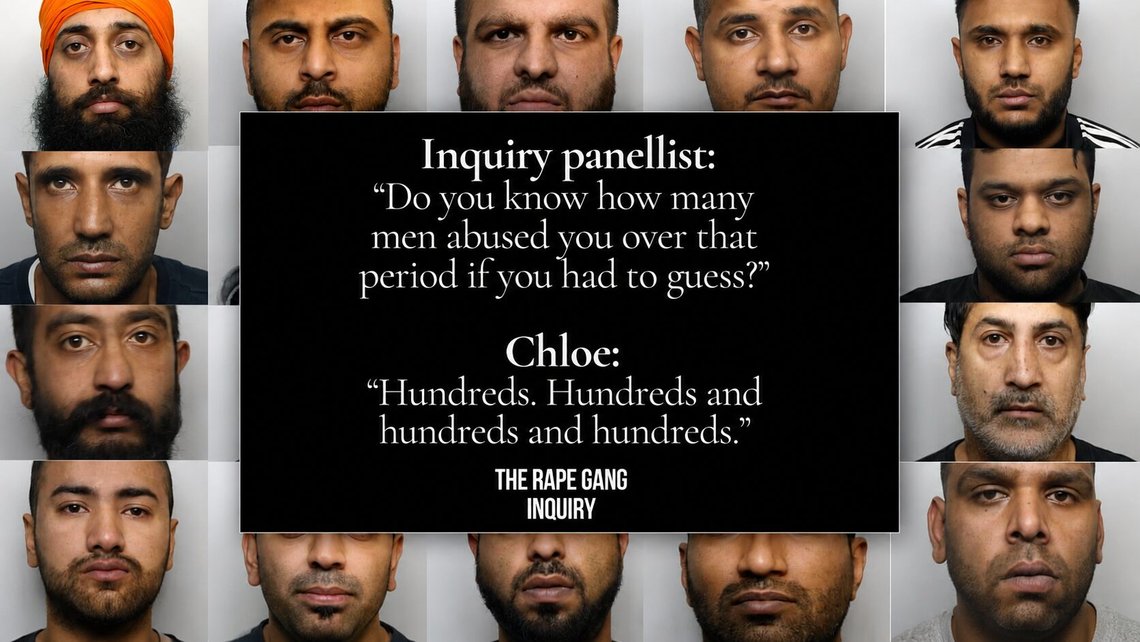
At least 250,000 young white British girls have been subjected to repeated rapes, gang rapes, trafficking and torture by organised gangs. The perpetrators are overwhelmingly Pakistani Muslims. The authorities knew about it for decades, but chose to look the other way.
A new report from the independent inquiry The Rape Gang Inquiry describes what may be one of the greatest institutional failures in modern British history.
The 219-page report is led by Member of Parliament Rupert Lowe and builds on witness statements from survivors, parents, whistleblowers and professionals. Analyses and court data in the report show that between 87 and 95 per cent of the identified perpetrators were Muslims. The same patterns have repeated in at least 149 British districts over several decades.
The girls were often recruited from as young as eleven years old. They were lured with gifts, alcohol and drugs, picked up in taxis outside schools and children’s homes and driven to houses, flats and hotel rooms where groups of men were waiting.
There they were raped. Again and again.
Many recount that the assaults were filmed and used for blackmail. Several describe how they were referred to as “white trash” and “kuffar” by the men who abused them.
The report contains witness statements about girls who became pregnant after rapes, minors who were pressured into abortions, and young girls who were sent abroad for forced marriages.
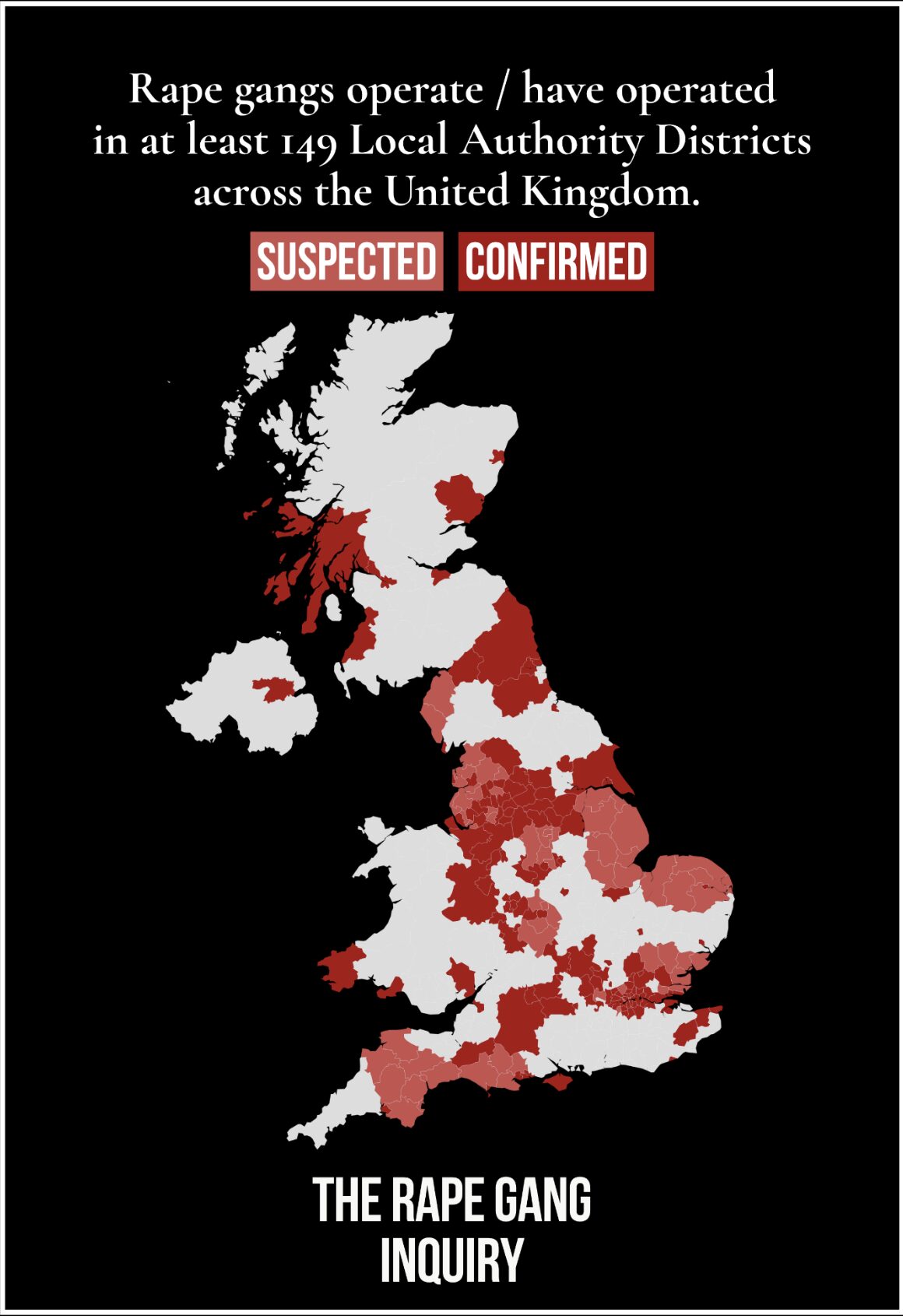 Map from The Rape Gang Inquiry showing areas where the report claims grooming gangs have either been documented or are suspected of having operated. According to the inquiry, this applies to at least 149 British districts. Photo: Screenshot The Rape Gang Inquiry
The heart-wrenching witness statements
One of the most horrific stories comes from “Chloe”.
She had a relatively stable upbringing in the early years, until her father died suddenly just before she turned ten. She then moved in with her mother and her mother’s new husband, whom she herself describes as a paedophile. Her stepfather’s abuse against her quickly escalated to rape. The mother discovered the abuse several times but did not intervene. On one occasion she saw the stepfather in the shower with her daughter but simply closed the door and left.
From the age of eleven, Pakistani men in the town centre began approaching her and her friend. They gave them alcohol and attention. The grooming quickly became more intense. One evening the two girls were taken to a hotel room. Her friend was led into another room with several men, while Chloe was left with the man who remained. She tried to resist but was beaten. The girls were thrown out of the hotel in the middle of the night while heavily under the influence of cannabis.
When she was twelve years old, she was raped in a car by a 25-year-old man and his friend. Later she was abducted by a drunk abuser and driven to a graveyard. There he raped her after forcing her to drink whisky. He pulled out just before ejaculation and forced the empty bottle into her vagina. The bottle broke. Chloe went to the emergency ward herself with glass shards inside her. No one asked how the injury had occurred.
She was often missing for days at a time. During these periods she was transported between men in taxis, drugged and raped. On one occasion she was raped at a textile factory where one of the men worked. The police found her several times with gang members but let the men go without further investigation. When she told the police about the abuse, she was dismissed as a prostitute. They asked if she had “consented”, even though she did not even know what the word meant.
When she was 14 and finally taken seriously by a social worker, she was instead asked if she wanted to act in Emmerdale as a victim of sexual abuse. Upset and disappointed, she ran away from the foster home and was abducted by a Muslim gang.
For six months she was transported between abusers across Britain. She was moved from house to house and raped by man after man after man. The men paid the gang to use her. She was reported missing, and her picture was shown on TV. The abusers just laughed when they saw it. “You are the missing girl on TV,” they said.
When the police finally found her, the man she was with was released without charge.
 A grooming victim tells her story in the documentary film «Grooming Gangs: Britain’s Shame». Still image: GB News.
Later the situation became even worse. After she moved out on her own, the gang reappeared and took control of her home. They smashed windows and doors and subjected her to severe abuse. She recounts being raped with objects such as soft drink bottles, keys and a baseball bat.
The gang also brought underage boys into the house. According to the witness statement, the older men pressured and bullied the boys into participating in the abuse. One evening one of the men pushed her down on the sofa, pulled down his trousers and sat on her face while the rest of the gang watched. He raped her orally.
She was drugged with heroin, developed severe anorexia and weighed only around 32 kilos as an 18-year-old. At the same time she was forced to commit crimes on behalf of the abusers. When she tried to report to the police, she herself was threatened with arrest.
After a suicide attempt she discovered she was pregnant. The father of the child, a Pakistani illegal immigrant, moved in and forced her to convert to Islam and enter into an arranged marriage. Both to give the pregnancy “Islamic legitimacy” and to secure residence permission. She was beaten daily, forced to wear a hijab and forbidden to look out the windows. The child was born with serious health problems due to injuries to her uterus.
Chloe herself estimates that “hundreds and hundreds and hundreds” of men abused her over the years. She knows at least twenty other girls from her area who were subjected to exactly the same thing.
Other witnesses recount similar fates. A mother describes how her 12-year-old autistic daughter gradually lost faith that anyone would help her. She was met with bullying, distrust and indifference before she eventually died of an overdose after the authorities failed her at every level.
Several survivors recount that pregnancy was used as a tool for control and subjugation. Children were born into the same reality that had broken their mothers. At the same time the women describe daily rapes, severe ill-treatment and extreme torture in so-called “red rooms”. Some were later taken to the Middle East and forced into Islamic marriages.
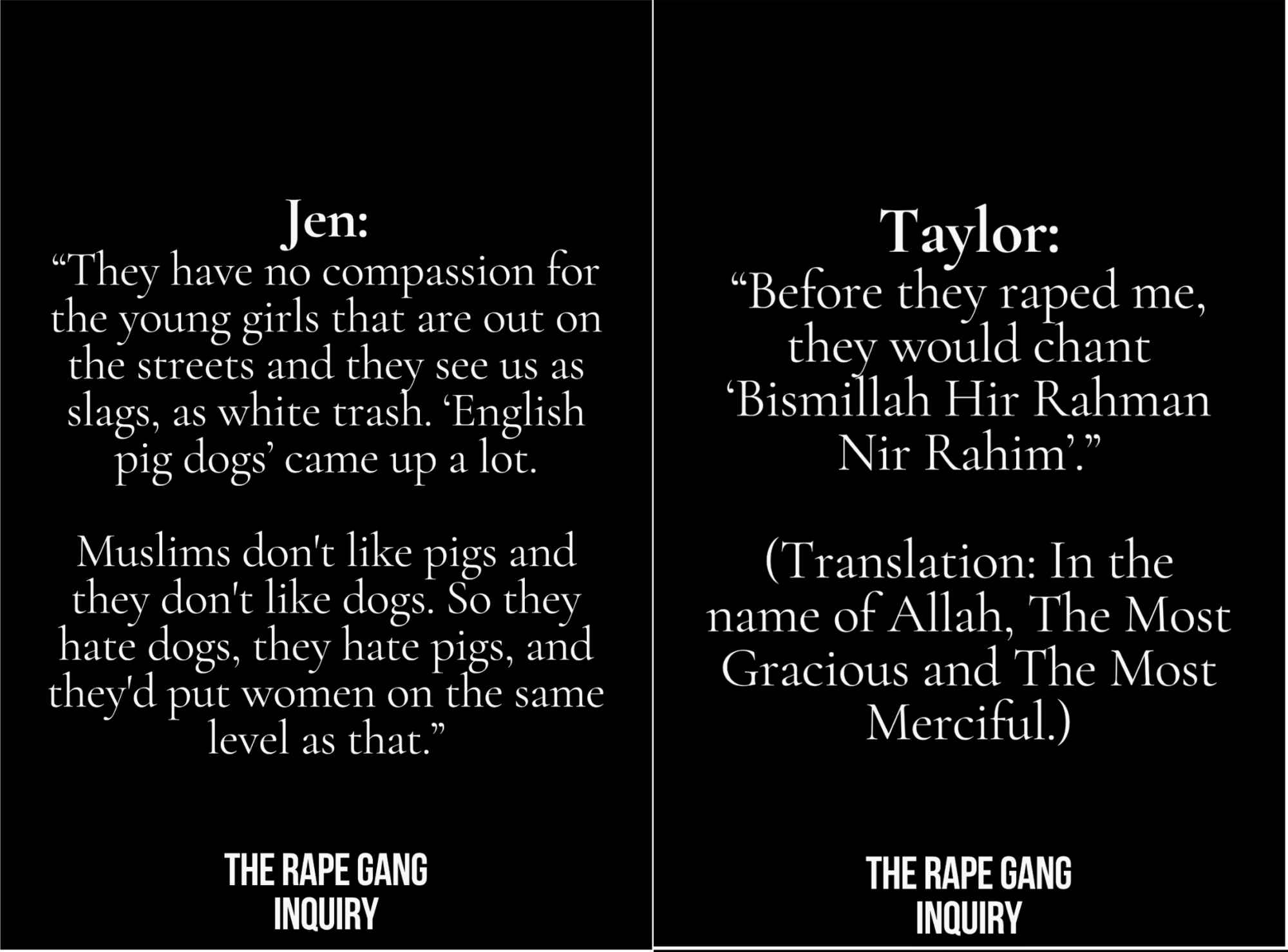 Two of the witness statements in The Rape Gang Inquiry. Survivors recount racist insults against white girls and religious expressions used by the perpetrators during the assaults. Photo: Screenshots from The Rape Gang Inquiry.
Islam’s role
The report points directly to cultural and religious factors behind the assaults. The perpetrators operated within an honour and shame culture in which non-Muslim girls, particularly white working-class girls, were viewed as available prey.
This was reinforced by Islamic notions of Muslim superiority, the principle of loyalty to one’s own and distance to others, the absence of a fixed age of consent and acceptance of sexual relations with non-Muslim women in subordinate positions.
The networks also targeted Sikh girls, until Sikh communities began to protect their own. White girls received no equivalent protection.
Total institutional failure
The report directs crushing criticism at British authorities and describes it as a total institutional failure.
The police are said to have ignored reports, criminalised victims, destroyed evidence and let known rapists go free on bail. Social services undermined parents who tried to protect their children, placed vulnerable girls in children’s homes that served as recruitment arenas for the perpetrators, and in several places are said to have retaliated against whistleblowers.
The health service recorded serious genital injuries, sexually transmitted diseases in minors and pregnancies resulting from rapes. Yet the girls were sent straight back to the perpetrators. Schools saw adult men picking up girls at the school gates but in several cases reacted by punishing or excluding the victims rather than protecting them.
The taxi system is also highlighted. Drivers known to be linked to abuse networks were allowed to keep or renew their licences.
The report highlights the political failure as the fundamental cause. Labour in particular is criticised for having prioritised consideration for Muslim voter groups, opposed or weakened inquiries, failed to publish ethnicity data and labelled concerns about the phenomenon as “far-right”.
When the authorities were finally forced to respond, the report claims they set up inquiries with such narrow mandates that questions of ethnicity, culture and religion were largely kept out.
The criticism does not, however, fall only on Labour. The report also accuses Conservative governments and Scottish authorities of having failed to introduce systems for mandatory registration of the perpetrators’ ethnic and religious background.
In the foreword Rupert Lowe writes:
«Britain doesn’t have a racism problem, it has an immigration problem.»
Lowe points to British immigration policy since the British Nationality Act 1948, and particularly the developments under Tony Blair, as a fundamental cause of the problems the report describes.
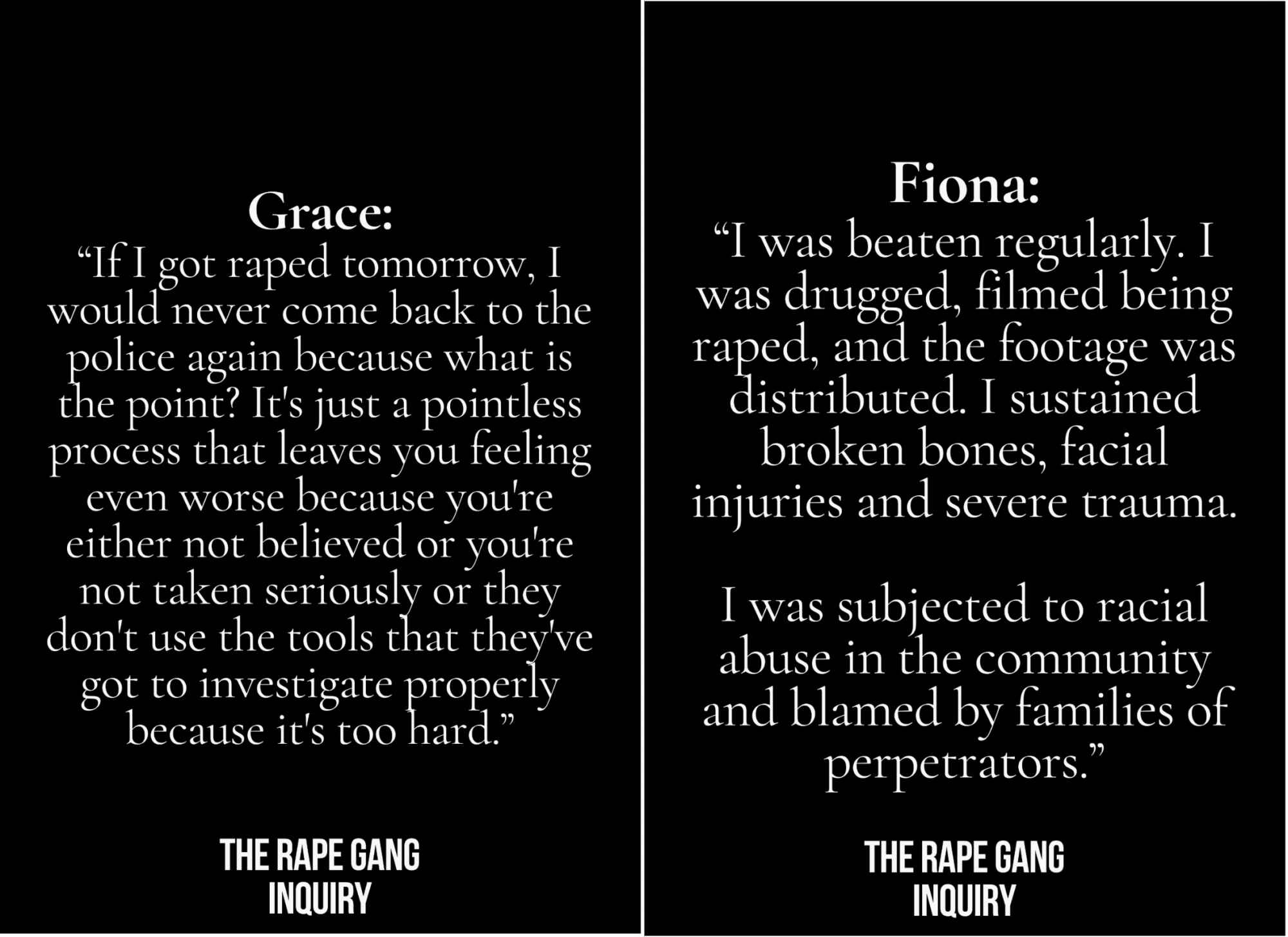 «What is the point?» asks Grace about reporting rape. Fiona describes years of violence, rapes and serious injuries. Both are among the survivors who testified. Photo: Screenshots from The Rape Gang Inquiry
A national scandal
The report describes the grooming gangs as “a national scandal of industrial scale” and refers to the assaults as a form of modern slavery that was enabled, protected and prolonged by British authorities’ failure at every level.
The consequences for the victims have been enormous. Survivors recount lifelong PTSD, drug addiction, chronic pain, interrupted education, loss of their own children and persistent fear. Several have attempted to take their own lives. Some have succeeded.
It is warned that the harmful effects do not stop with one generation. Trauma, mental health problems and social marginalisation are passed on and also affect the victims’ children.
The report states that more witness statements, further documentation and new identifications of responsible politicians will be published in the time to come. Work is also underway on both civil and private legal action against individuals who, according to the authors, contributed to enabling or covering up the abuse.
The Rape Gang Inquiry is not a state inquiry. It is an independent investigation funded by more than 20,000 British donors. Nevertheless, the report provides a detailed and deeply disturbing insight into a scandal that many believe British authorities have never fully accounted for.