

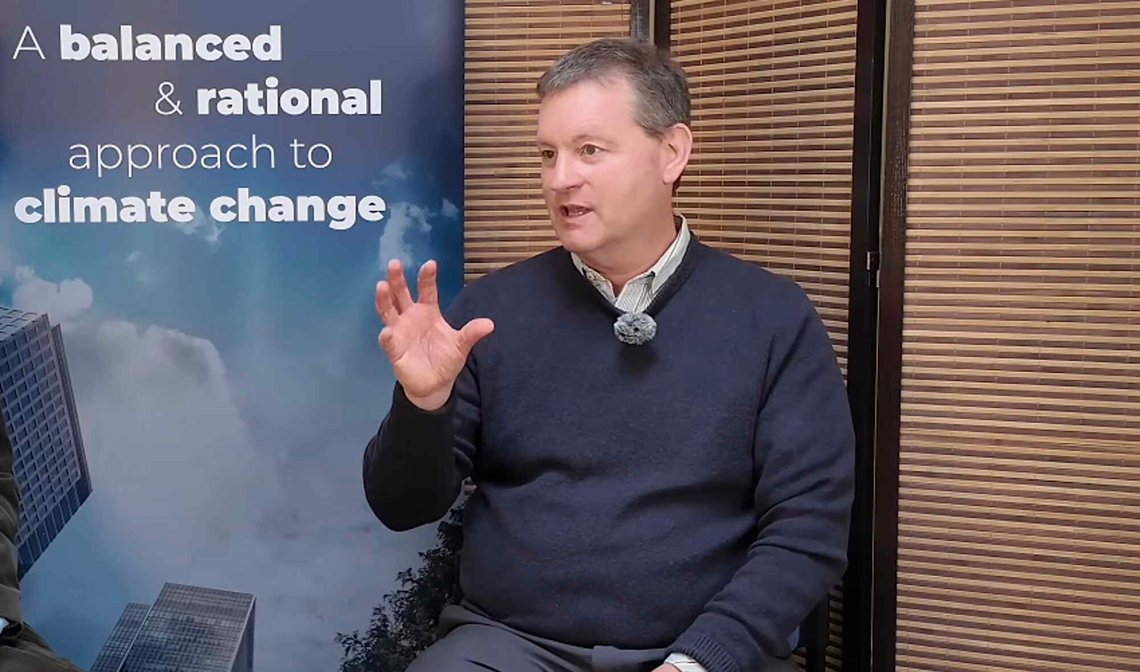
Climate scientist Roger Pielke Jr. scored a moral victory when a research group developing scenarios for the UN climate panel (IPCC) recently discarded the strongest warming scenarios as unrealistic. Pielke had long been highly sceptical of the catastrophe scenarios and was himself the first to comment publicly that they had been abandoned.
Before that moment, however, Pielke had paid a high price for speaking truthfully about climate change, for this rather unusual inclination cost him his academic career.
Die Welt science editor Axel Bojanowski recounted the story of what he calls a chilling witch-hunt against Pielke in a book published in 2024, whose title translated directly into English is *What You Always Wanted to Know About the Climate but Never Dared to Ask*. Earlier in June, the German newspaper published an excerpt from the book telling Pielke’s story.
Roger Pielke Sr. (b. 1946) is himself a renowned atmospheric physicist, and Roger Jr. (b. 1968) began following in his father’s footsteps as a mathematics student at the University of Colorado Boulder, where he later became a researcher and achieved a degree of success himself.
But he quickly became sceptical of the politicisation of research:
His basic position was that climate change is real and that reducing CO2 is sensible, but that scientific findings must not be distorted for political purposes. Early on, he criticised the climate debate for entering a “meaningless spiral” in which each side used new scientific findings as ammunition for political ends.
The problems began when he became involved with the Republican administration:
The decisive conflict began in 2001. Pielke was asked to provide testimony on weather disasters and climate change for the new Bush administration. His analysis showed that the damage data contained no statistically robust connection between climate change and increasing disaster losses.
Pielke was quickly informed that such things were not to be said:
Colleagues warned him that such statements could benefit the climate-sceptical Bush administration.
Nevertheless, Pielke insisted on presenting the state of the research in a sober manner. As he put it himself, he wished to be an “honest broker” and not succumb to “Noble Cause Corruption” — that is, not to sacrifice scientific accuracy in the name of a worthy cause.
In the IPCC’s Third Assessment Report, he found unsupported claims about the costs of anthropogenic climate change originating from an insurance executive:
In the Third IPCC Assessment Report from 2001, Pielke found formulations that contradicted his analysis: extreme weather could partly be attributed to climatic factors, and rising losses were consistent with expectations arising from human-induced climate change. Yet the IPCC provided no reliable scientific source, only reports from Munich Re. An expert from the reinsurance company even served as a lead author of the report.
To clarify the matter, Pielke organised an international conference together with Munich Re at Hohenkammer Castle in 2006. There, 32 experts from 16 countries discussed whether a climate signal could be detected in damage caused by extreme weather. The conclusion: No.
Entirely different factors were responsible for increasing insurance payouts:
More people, more settlements, greater concentrations of value in vulnerable regions, and inflation. These findings were later published in the journal *Science*.
That information was not welcome within the climate panel. Pielke was actively censored:
Pielke believed the matter had thereby been settled. But in the Fourth IPCC Assessment Report of 2007, the Hohenkammer consensus document did not appear.
Instead, the report once again identified a trend towards increasing weather-related losses.
Emails released later revealed that prominent researchers had deliberately excluded Pielke’s work from the IPCC report.
But the damage had been done. Pielke was now regarded as a thorn in the side. The establishment media did what they do best:
Shortly afterwards, a journalist from the publication *Foreign Policy* portrayed him in an article as a “climate sceptic”, even though Pielke did not deny climate change. Activists and political organisations launched attacks, and Pielke became the target of an organised campaign of discreditation.
In particular, the left-wing Center for American Progress (CAP) and its blog Climate Progress repeatedly attacked Pielke as a “denier”, “fraud” and “careerist”. CAP has close ties to Democratic Party strategists such as John Podesta and is funded by supporters of renewable energy and climate activists.
Some years later, the climate panel acknowledged that Pielke had been correct:
In 2012, the IPCC’s Special Report on Extreme Events largely confirmed Pielke’s position: weather-related losses cannot be unequivocally attributed to climate change. Certain types of extreme weather may become more frequent, but it is impossible to demonstrate a clear pattern in loss data.
Pielke presented this position during a hearing in the United States Senate in 2013 — explicitly citing the IPCC.
But by then the matter had become political:
John Holdren, science adviser to the Obama administration, contradicted him on the official White House website. Holdren described Pielke’s statements as misleading.
The attack from the White House had enormous consequences for Pielke. First, he lost his column at the data journalism site FiveThirtyEight — even though the criticised article was factually correct.
WikiLeaks would later reveal that the campaign against Pielke had been orchestrated. Before that, however, the smearing continued:
In 2015, the campaign reached a new peak. Democratic Congressman Raul Grijalva announced an investigation into Pielke and suggested that he might have received funding from the fossil-fuel industry. No evidence existed. Nevertheless, Grijalva demanded that Pielke’s university disclose financial grants and correspondence. The media amplified the suspicion.
Pielke denied the allegations: he had never received money from the fossil-fuel industry or its organisations. His university initially failed to protect him and instead launched an investigation. Support came from the scientific journal *Nature* and the American Meteorological Society, which criticised Grijalva’s actions as intimidating to researchers. Pielke was completely exonerated, but the suspicion lingered.
It did not matter that he was right. He found both colleagues and the research establishment turning against him:
For Pielke, the events had serious consequences. He describes years marked by upheaval, lost invitations, terminated collaborations and missed funding opportunities. Colleagues avoided him because association with him was considered risky.
A government representative informed him that applying for further support was pointless because he was too controversial. Pielke was removed as director of the Centre for Science and Technology Policy Research, which he himself had founded. In internal forums on climate blogs, activists openly expressed their desire to “bring him down”.
Pielke eventually had enough. He left the university and joined the conservative think tank American Enterprise Institute (AEI), a move that also triggered a torrent of insults.
Standing up for the truth in institutions established for the purpose of discovering it is not necessarily cost-free. The corruption of academia runs far deeper than most people without an academic background realise.
Today, however, Pielke is once again being invited to conferences, and his Substack page has tens of thousands of subscribers, Bojanowski notes.


