

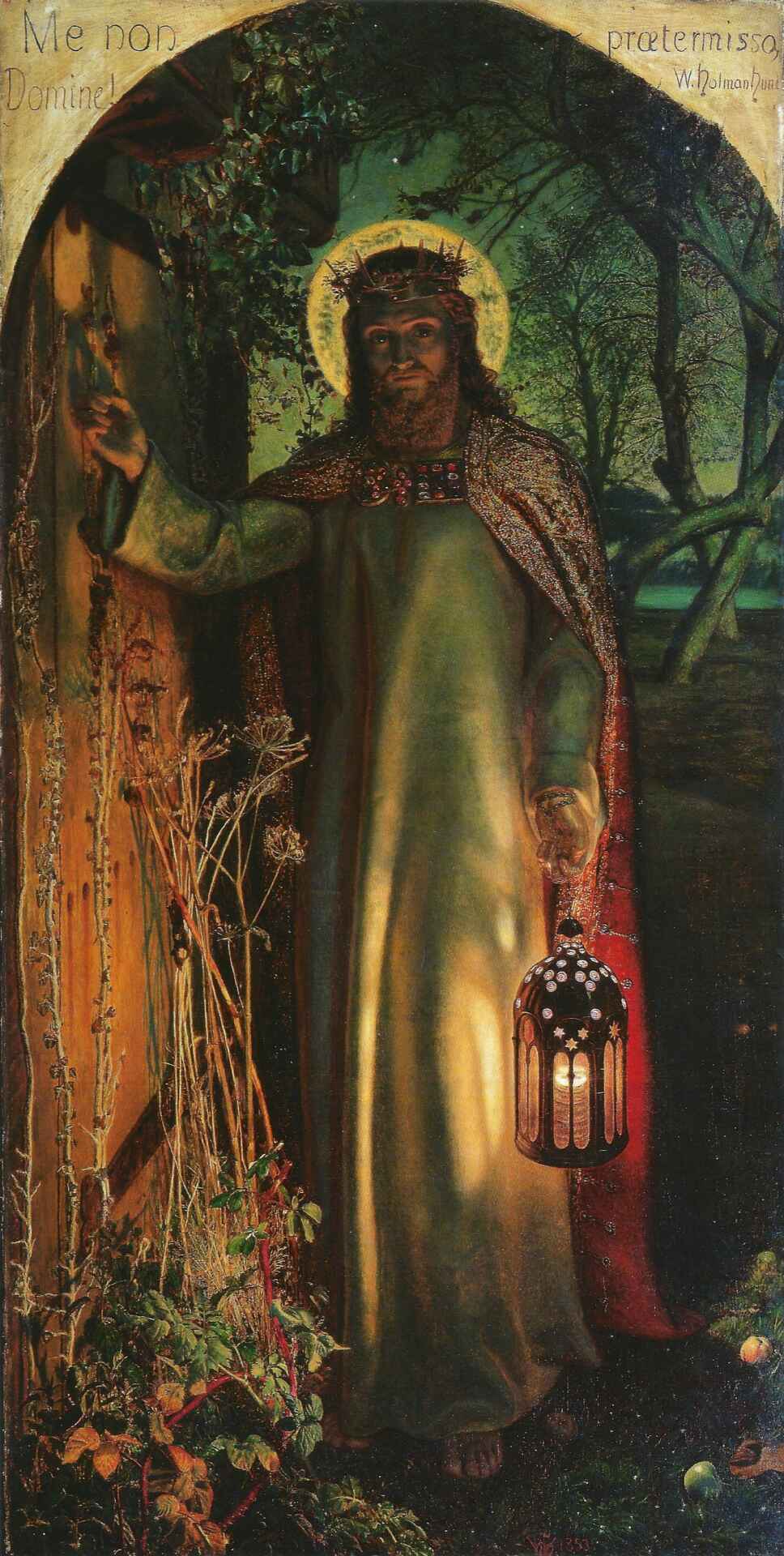
 William Holman Hunt (1827–1910), “The Light of the World”, Keble College, Oxford. Jesus is knocking on a door that has not been opened for some time; He does not force His way in.
8 Owe no one anything, except to love one another; for he who loves his neighbour has fulfilled the law. 9 For the commandments, “You shall not commit adultery”, “You shall not murder”, “You shall not steal”, “You shall not covet”, and whatever other commandment there may be, are summed up in this word: “You shall love your neighbour as yourself.” 10 Love does no wrong to a neighbour; therefore love is the fulfilment of the law.
Paul’s Epistle to the Romans 13:8–10
Last Sunday I explained how C.S. Lewis showed that love of neighbour, without absolute truth as its point of departure, will be corrupted, distorted and abused. Today I shall continue this analysis by taking as my starting point G.K. Chesterton’s treatment of the same question: Can love of neighbour and humanism function as an ideal if Christianity loses its influence?
C.S. Lewis and G.K. Chesterton lived at the same time, and G.K. Chesterton was one of those who inspired C.S. Lewis on his path to the Christian faith.
Lewis himself said that Chesterton’s book “The Everlasting Man” was important to his conversion. It was through this book that he first saw the Christian understanding of history presented in a way that made sense to him. I myself read it after reading Lewis, and recognised the line of argument.
Chesterton was a towering Christian thinker in pre-war Britain, and at his requiem Mass in 1936, the priest Ronald Knox stated:
This generation has grown up to such an extent under Chesterton’s influence that we do not even know that we are thinking Chesterton.
Chesterton is known for his fundamental confrontation with political materialism and naturalism, but today I shall present his confrontation with the abuse of love of neighbour, a confrontation that is even more relevant today than when he wrote “Orthodoxy” in 1908.
Chesterton writes ironically that the modern world is not evil, but in a certain sense far too good.
Already in 1908, Chesterton believed that the modern world was full of virtues that were no longer under Christian control. He argues that when the Christian order is shattered, it is not only the vices that are set loose, but also the virtues, and that these cause a hundred times greater disasters.
Chesterton describes the virtues as turned inside out into their caricatures because, individually, they have become isolated and wander about on their own, and it is as though he foresaw our own age. He points out that there are those who attack Christianity because they have become obsessed with the Christian virtue of love, and that:
They have fallen into the delusion that it will be easier to forgive sin when they declare that there is no sin to forgive, but they do not understand that such a love will result in anarchy.
And he concludes aptly: They act as enemies of humanism precisely because they are so humane.
This is precisely what we experience daily in our own time. We have a political class so concerned with being humane that the result becomes an inhumane policy. They have distanced themselves from truth and are left with a love of neighbour without limits. A love of neighbour that demands that others sacrifice themselves for their need to demonstrate their humanism. And this is happening in ever more areas.
We see it very clearly now in June. Document reports that a report from the National Health Service (NHS) in Britain concludes that 78 children may have been harmed after receiving puberty blockers and hormone treatment at the NHS clinic WellBN practice in Brighton and Hove (this is only one of many clinics). How many have been harmed for life in Norway, we do not know.
These children have not been harmed because of evil. No, their injuries are the result of an intense desire to be good in a society where boundaries are perceived as hostile.
The law against conversion therapy demonstrates this clearly. It criminalises those who wish to save children from a destructive treatment whose goal is to change the patient’s sex.
Those who dare to object are labelled evil.
But it does not stop there.
Every day, illegal immigrants arrive in Europe, yet the majority of our politicians do not consider whether the desire for a humane refugee policy imposes excessive human costs on Europe’s inhabitants, and is therefore inhumane. It is as though the peace, security and prosperity we once enjoyed were a stolen privilege. Chesterton would have said that the situation is the consequence of a political class so full of virtues that it does not care about the destructive force to which it exposes society. We have received the anarchy Chesterton warned against.
As Chesterton rightly points out, these politicians cause far greater harm than politicians struggling with their vices. They find sin only in those who still stand upon classical Christian foundations, and they lay the groundwork for a society in which love of neighbour, in reality, harms our neighbour.
But there is no one, neither politicians nor representatives of various church communities, who comes to the defence of the people. No one apologises to the people. The only thing preached is that, in the name of love of neighbour, this is something we must endure.
To that there is only one thing to say: then it is no longer a matter of true Christianity.


