

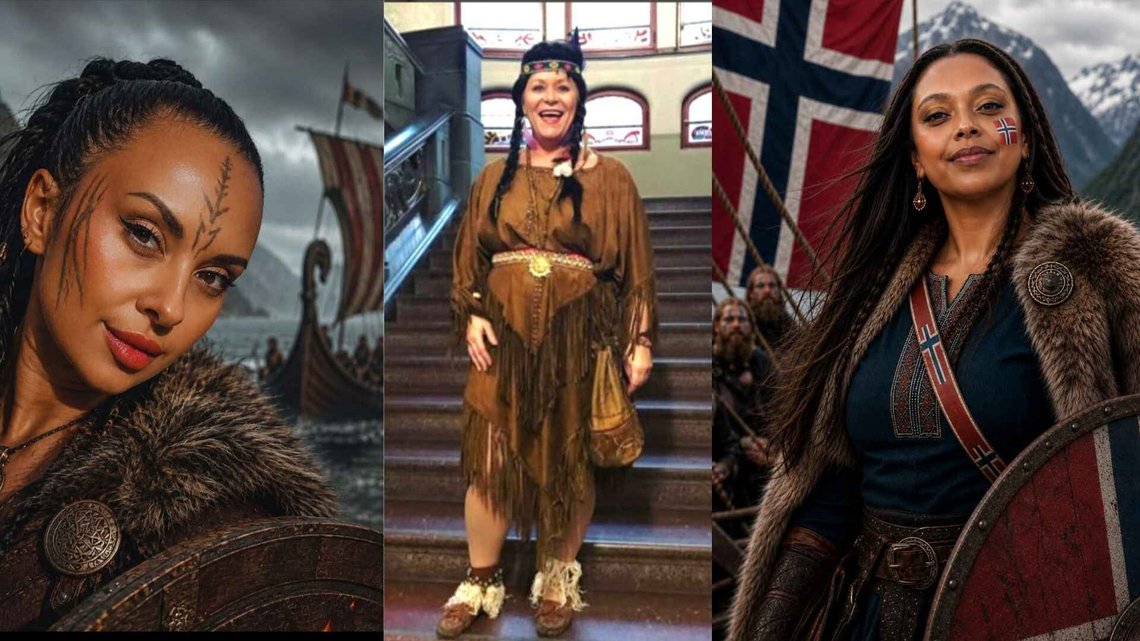
Tamil-born Member of Parliament Kamzy Gunaratnam (Labour Party) and Laial Janet Ayoub of the Anti-Racist Centre are among those who have virtually donned our Viking heritage in recent days. They themselves are, respectively, a Tamil from Sri Lanka and an Arab from Lebanon. A few years ago, people were shocked because the then leader of the Progress Party (FrP), Siv Jensen, dressed up as a Native American at a costume party. The debate raged, but perhaps it does not when Norwegian culture is appropriated by people without Norwegian roots?
Tamil and Arab with Viking ship
It is probably the new World Cup kits of the Norwegian national team that have inspired people to transform themselves into Viking heroes, as Gunaratnam and Ayoub have done by using artificial intelligence in image creation. The images feature the classic symbols: Viking ships, Viking ornamentation and fur garments. Plus a few refined versions of a self-portrait in the middle.
“This is meant as a cheer for the men’s national team and a bit of fun. So just enjoy it,” writes Kamzy Gunaratnam, including the royal motto: Alt for Norge (“Everything for Norway”).
Meanwhile, Laial Janet Ayoub writes alongside her own Viking image:
“Then I’m joining the trend. Come on Norway and Nusa,” writes Ayoub, making special mention of the most “colourful” member of the national team, Antonio Eromonsele Nordby Nusa, whose father is from Nigeria.
Cultural theft?
But is it cultural theft, or borrowing, when peoples from one part of the globe adopt the culture of other peoples? That is, cultural appropriation, which according to the Great Norwegian Encyclopedia (Store norske leksikon) is as follows:
“Cultural appropriation is when members of one ethnic group adopt the cultural production of another ethnic group, for example symbols, clothing, music or rituals.”
In any case, the two are unlikely to have much “Viking blood”, as they were born in Sri Lanka and Lebanon respectively, but perhaps they have a particular interest in Norwegian history and cultural heritage? Of which the Viking Age is the best known internationally. Not because it lasted long, only 200–250 years, but because Vikings from Norway, Sweden and Denmark left a tremendous mark behind them, partly as traders and partly as brutal conquerors.
Uproar over Siv in a Native American costume
In 2017, there was in any case a tremendous uproar when the then leader of the Progress Party appeared in a Native American costume at a party in the Ministry of Finance.
Ulrikke Falch, known as Vilde from the youth series Skam, was among those who criticised the Finance Minister’s costume. She wrote on her Instagram account that “people’s culture is not a costume”, according to NRK. They also sought out Kenzie Allen for the occasion. She was of Oneida descent, that is, a member of an Indigenous people of North America, or an “Indian”, as we said until recently. Allen, who has ties to Norway but was a doctoral student at the University of Wisconsin–Milwaukee and an assistant in the Department of American Indian Studies, was highly dismayed by Jensen’s choice of costume.
“I was shocked,” the Sámi Christina Henriksen told NRK at the time. Henriksen spoke as a member of the Sámi Council and a former representative of the Sámi Parliament.
Kiwi’s Sámi blunder
Dressing up as a Sámi is not acceptable either. The Kiwi supermarket chain knows all about that, after it shocked many people during its annual party in Tromsø in 2010. Six hundred and fifty employees from across the country dressed in specially tailored kiwi-green copies of the Kautokeino gákti (traditional Sámi costume). The costumes were allegedly sewn in China. The neon-green gákti garments were fiercely debated both on social media and in reader contributions to iTromsø and Nordlys. The then President of the Sámi Parliament reacted very strongly.
According to contributions to the debate, those who identify themselves as Sámi were divided in their views on the Kiwi stunt. While some used words such as mockery and racism, and called for a total boycott of the Kiwi chain, others thought it was amusing, wrote NRK.
We could also have mentioned the Joika tin as something that some considered such a case of cultural theft that it has now ceased to exist. It is said, however, that the Vilti carton bears a resemblance.
Kamzy worked for a Tamil state
Kamzy has been involved in the Tamil Youth Organisation, an organisation that campaigned for a separate Tamil state, exclusively for Tamils. An organisation that was once regarded as a terrorist organisation by the authorities in Sri Lanka, and Kamzy herself was denied entry. The activism she pursued from Oslo as a young woman led Labour veteran Raymond Johansen to recruit her into the Labour Party, and Kamzy has enjoyed a meteoric political career, long since securing a seat in the Norwegian Storting. There, like Ayoub, she fights racism in what is arguably the least racist country in the world.
Kamzy snakker om «strukturell rasisme», men blir rasende på tall som viser innvandrer-kriminalitet
Laial Janet Ayoub ended up at the Anti-Racist Centre
Antirasistisk Senter har fått 200 millioner siste 16 år – for politisk aktivisme?
Laial Janet Ayoub has also been a Labour politician, but has additionally served in what was the Christian scouting movement, KFUK-KFUM, and the Norwegian Women’s Public Health Association. The Association is now considerably more woke than it once was, something Document has written about. She is now an adviser at the Anti-Racist Centre, the activist organisation that has received more than NOK 200 million in taxpayers’ money in recent years. Before all this, she was a Muslim advocate of the hijab.
Ayoub was a hijab advocate
“Some people genuinely feel that the hijab is a source of joy and a way of expressing themselves.
To be completely honest, I am somewhat tired of everyone who believes that children at a young age cannot choose to wear the hijab themselves. That says more about their view of children than anything else, if one truly believes that children of, for example, nine years old cannot make such choices, because this choice is no worse than choosing to wear make-up, wear short clothes or choose to have boyfriends, for example,” Ayoub wrote in an article in Aftenposten in 2016. She argued that the hijab absolutely must not be banned in Norwegian schools.
She later removed the hijab.
“I was never supposed to be the girl who gave up the hijab; I was supposed to be someone who fought for the hijab to become a normal thing in Norway, but that is not how it turned out. I, who wore the hijab for 20 years and appeared in the media fighting for it. The hijab became a burden,” Ayoub wrote in Aftenposten in 2017.
She has also written a book about herself:
“Laial Janet Ayoub (35) came from Lebanon to Norway as a child. She grew up in Askim and Oslo. Her book about a childhood in poverty, liberation from her parents, negative social control and divorce from her husband is powerful reading. Through this publication one gains insight into what can happen to children who are never identified by the child welfare services, and what some of the veiled young women from Muslim countries may experience in terms of oppression and invisibility, as well as self-imposed silence,” wrote an Aftenposten reviewer in 2020.
One wonders whether the adviser at the Anti-Racist Centre would permit Norwegians to discuss that side of her religion and cultural background. And what much of that sort does to Norway.
Redaktør beklager at avisen brukte ordet «indianer». Helgheim: – Skaff deg litt ryggrad!


