A majority of the British people want better control of the borders. But governments and Parliament ignore them, election after election. Eventually, the anger erupts.
After Vickrum Digwa was found guilty of the murder of Henry Nowak, Labour’s primary focus was to prevent widespread unrest in society.
The police at the scene may have contributed to Nowak’s death, since they placed him in handcuffs and ignored his pleas for help while he bled to death.
Nowak’s family were used as figureheads, such as his father, who was quoted in every newspaper as saying:
“We do not want his death to be used to create further division.”
Therefore, Labour representatives said in grave tones, we must “respect the family’s wishes”. But the division, too, has been caused by politicians, with substantial assistance from the British police.
“On the surface, this sounds like an entirely reasonable wish. However, I have one small question,” writes Michael Deacon in The Telegraph.
He turns to the case of Rhiannon Whyte (27), who worked at a migrant hotel in Walsall. In October 2024, she was stabbed to death by an asylum seeker from Sudan, who used a screwdriver to carry out the killing.
After the murder, the killer went in to buy himself a beer while wiping the blood from his body. Was he celebrating his deed?
Asylsøker dømt for drapet på en britisk kvinne som var ansatt på et asyl-hotell
Eighteen months later, the victim’s mother, Siobhan Whyte, demanded to know why so many migrants continue to cross the Channel and remain on British soil.
“The government should close the borders and send them back.”
No one in Labour demanded that people should “respect the family’s wishes” on that occasion. Why not?
Of course, we all know the answer. They “respect the family’s wishes” only when those wishes happen to coincide with their own. But honestly, it is high time they started listening to people like Siobhan. Because if they do not, this country faces serious problems. And as evidence, one need only look at what is happening in Northern Ireland.
Politicians condemn the riots, but never mention the reason why people are taking to the streets.
Sinn Féins hykleri i forbindelse med opptøyene i Belfast er sjokkerende
Prime Minister Keir Starmer said: “What happened in Belfast [on Tuesday night] was shocking and wholly unacceptable.”
There is zero understanding, and apparently little concern, for the victims of the consequences of mass immigration. The damage includes economic crisis for the working class; some experience violent, life-threatening or fatal attacks; and the relatives of many others develop mental health problems as they endure grief or lose all hope of a better future.
I am sure that all decent people share these feelings. We do not want riots. But when are our politicians going to wake up and accept their share of the responsibility?
The British have, election after election for decades, asked for stricter border controls, only to be ignored or branded racists. It is therefore not particularly surprising that many end up thinking:
“Voting does not help. And peaceful demonstrations do not seem to have much effect either. So we must find an alternative way of making politicians listen to us.”
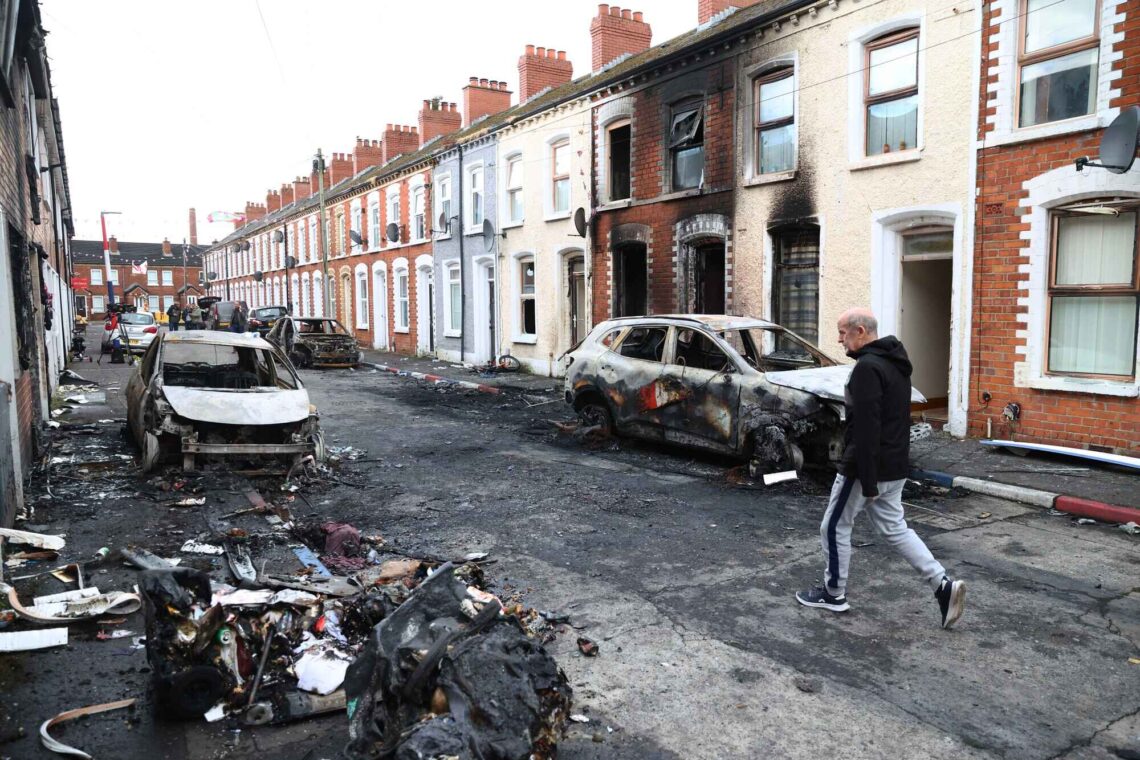
This is the alternative now playing out in Belfast, and which has spread to other parts of the United Kingdom.
Although most people do not support violent riots, it is in fact politicians of the Starmer & Co variety who have the power to stop them.
For if they do not, even the least perceptive among them ought by now to be able to see what will happen.
Unfortunately, it is far more likely that they will talk about “division”, and focus on the riots rather than on the atrocity that triggered them.
Addressing, or even acknowledging, the real cause of the problem is unthinkable. Even though it requires nothing more than taking a look in the mirror. Or remembering how they themselves reacted when one of their own became a victim.
After Sir David Amess of the Conservative Party was murdered in 2021, many of his parliamentary colleagues responded by demanding stricter measures against abuse on social media. Sir David’s murder had nothing to do with offensive tweets – he was stabbed to death by an Islamist.
No one talked about Islamist violence; everyone focused on social media.
So one should not be surprised if the same crowd decides that this week’s riots were also caused by social media. So far, they have focused solely on preventing the video of the attempted murder from spreading via Facebook and X.
Thus, while most of us cannot support setting fire to buses, cars and homes where immigrants are living, the anger expressed by the British is entirely understandable.
We do not want to live in a country where hotel employees are murdered with screwdrivers. And we do not want to live in a country where innocent pedestrians risk being beheaded in the street.
Britain already has enough problems as it is, without importing more. That is why we want our government, from now on, to place our safety first.
The British are experiencing a far worse situation than we Norwegians. But everything indicates that we will end up in the same situation within a few years, since our politicians care no more about their own population than British politicians do.
Deacon concludes with something that could apply equally well to large sections of the political mafia throughout Western Europe.
This, therefore, should be our message to the country’s political elite: “Follow your own advice – and respect our wishes.”