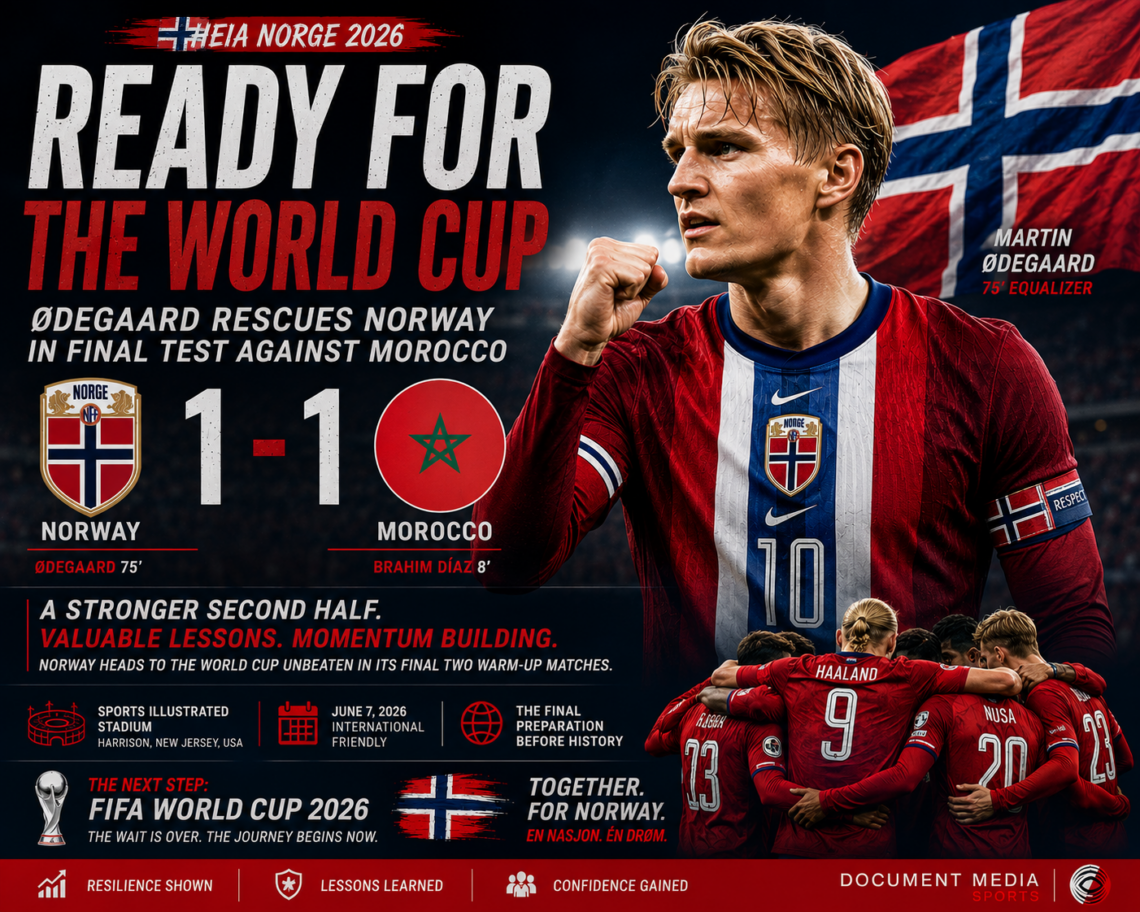
📍 Sports Illustrated Stadium
📍 Harrison, New Jersey, USA
📅 June 7, 2026
For nearly three decades, Norwegian supporters dreamed about returning to the World Cup.
Now, with the tournament only days away, Norway has completed its final rehearsal.
A second-half goal from captain Martin Ødegaard earned Norway a 1–1 draw against Morocco on Sunday evening in Harrison, New Jersey, closing the book on the team’s pre-tournament preparations. The result ensured Ståle Solbakken’s squad heads into the FIFA World Cup unbeaten in its final two warm-up matches.
Morocco struck first through Brahim Díaz in the opening stages and looked the sharper side during much of the first half. Norway struggled to establish rhythm early and spent long periods reacting rather than dictating play.
The challenge was exactly the type of test Solbakken wanted.
Morocco arrived in the United States carrying the confidence of a nation that reached the World Cup semifinals four years ago and remains one of the most respected teams outside football’s traditional powers.
Norway responded.
As the match progressed, Martin Ødegaard increasingly influenced proceedings. The captain found more space between the lines, Norway’s midfield became more assertive, and the team gradually pushed Morocco deeper into its own half.
The breakthrough eventually arrived when Ødegaard found the equalizer, rewarding Norway’s improved second-half performance and rescuing a draw that felt deserved by the final whistle.
The scoreline itself may ultimately matter less than the lessons learned.
This match was never primarily about the result.
It was about readiness.
Norway needed to know how it would respond when trailing against elite opposition, know whether it could create chances against a disciplined defense and know whether it could remain composed under pressure.
In many respects, the answers were encouraging.
The reaction after conceding early demonstrated a maturity that has become increasingly evident throughout Solbakken’s tenure. Previous Norwegian teams occasionally struggled when matches turned against them. This squad appears more resilient.
That resilience may become essential during the World Cup.
Yet the evening also reinforced concerns that international observers have repeatedly highlighted. Norway’s defensive organization remains a work in progress. Morocco created dangerous moments in transition and occasionally exposed gaps between midfield and defense.
Against Iraq in the opening group match, those vulnerabilities may not prove decisive.
Against Senegal or France, the margins become much smaller.
Still, there was far more reason for optimism than concern as Norway left Sports Illustrated Stadium.
Erling Haaland emerged unscathed.
Ødegaard looked sharp.
Antonio Nusa continued to show flashes of the creativity that has many observers labeling him Norway’s potential breakout star.
Most importantly, Norway competed effectively against one of the strongest non-European sides in the tournament
International reaction following the match reflected a similar assessment.
Several outlets focused on Norway’s ability to recover after falling behind, while others pointed to Ødegaard’s influence as evidence that the Arsenal captain may be just as important to Norway’s World Cup hopes as Haaland’s goals.
For Morocco, much of the attention shifted toward fitness concerns after injuries disrupted parts of their final preparation match.
For Norway, the conversation was different.
The waiting is over.
The preparation is complete.
The next match will not be a friendly.
The next match will be the FIFA World Cup.
And after 28 years away, Norway appears ready for the challenge.