
 Kjell Skartveit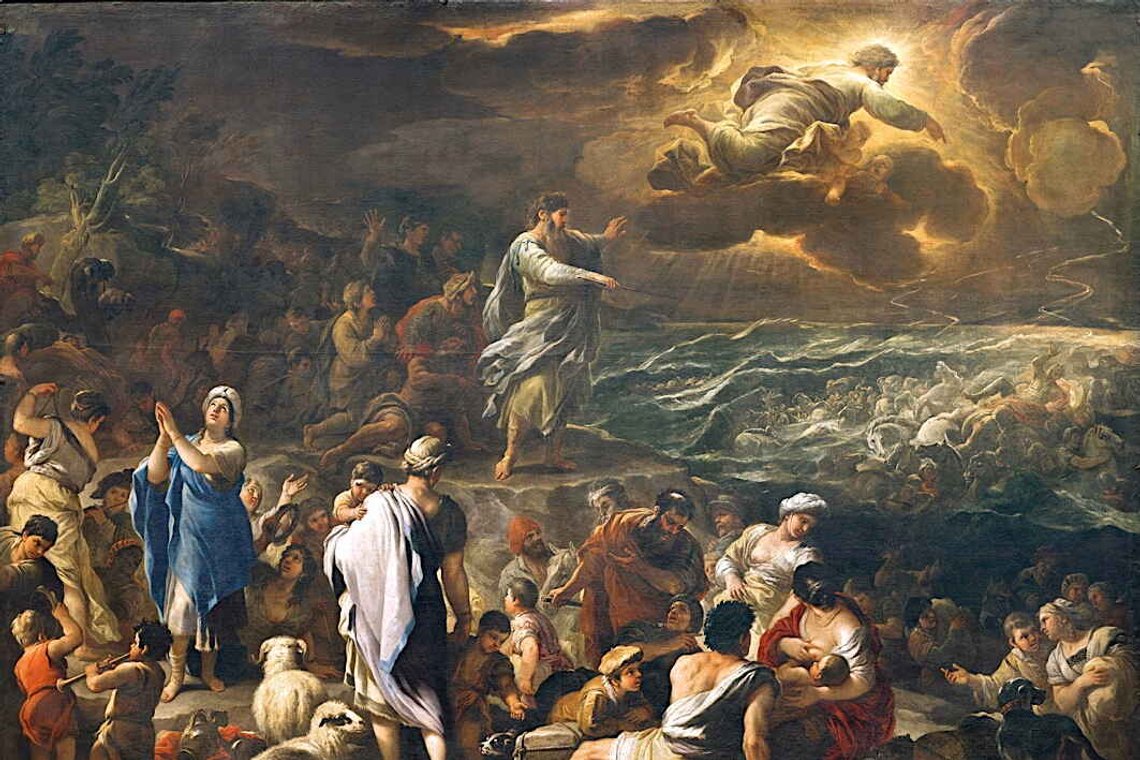
15 Then the Lord said to Moses, “Why are you crying out to me? Tell the Israelites to move on. 16 Raise your staff and stretch out your hand over the sea to divide the water so that the Israelites can go through the sea on dry ground. 17 I will harden the hearts of the Egyptians so that they will go in after them. And I will gain glory through Pharaoh and all his army, through his chariots and his horsemen. 18 The Egyptians will know that I am the Lord when I gain glory through Pharaoh, his chariots and his horsemen.”
19 Then the angel of God, who had been travelling in front of Israel’s army, withdrew and went behind them. The pillar of cloud also moved from in front and stood behind them, 20 coming between the armies of Egypt and Israel. Throughout the night the cloud brought darkness, yet it gave light to the other side; so neither went near the other all night long. 21 Then Moses stretched out his hand over the sea, and all that night the Lord drove the sea back with a strong east wind and turned it into dry land. The waters were divided, 22 and the Israelites went through the sea on dry ground, with a wall of water on their right and on their left.
Exodus 14:15–22
Today is 7 June, one of the most important dates in Norwegian history. The Storting’s decision of 7 June 1905 paved the way for the dissolution of the union with Sweden, and on 7 June 1940 the King and Government chose to flee to Britain in order to continue the struggle against Germany. Both decisions were made by people with great love for their own people and a willingness to sacrifice something for peace and freedom.
Just as the people of Israel and Moses trusted in God during their flight from the Egyptians, the Christian faith was most likely alive among the majority of Norwegians in both 1905 and 1940. That same people expected the country’s leadership above all to care for them in the struggle for freedom.
It is difficult to give the same description of today’s political leadership. Now the focus is on international solidarity and love of neighbour.
Across large parts of the Western world, leadership is inspired by a desire to avoid discrimination against what are called vulnerable groups. The result has been a policy built on the ideological programme of DEI (Diversity, Equity, and Inclusion), or interseksjonalitet (intersectionality), as it is known in Norwegian. The goal is equality, but the result is a form of love of neighbour or justice that does not accord with what we are accustomed to from classical Christian faith.
This way of thinking leads to the security of the country’s indigenous population being overlooked. Actions so extreme that only a few decades ago they would have set every alarm bell ringing are today scarcely commented upon by politicians or covered by the mainstream media. One clears up and moves on as though nothing had happened.
The love of neighbour that invites demands complete acceptance of the consequences.
How are we to relate to this apparent demand for unconditional love of neighbour? The demand for blind obedience testifies to a lack of ethical grounding for love of neighbour, and we are permitted to discuss the phenomenon.
What we are witnessing is that love of neighbour is being presented as a fundamental human instinct on a par with a moral law, and therefore as an imperative we ought to follow without requiring an ethical compass. This is what we see, for example, in the British police. They are so concerned with being good that they fail to see the consequences.
One of those who reacted to this demand was C.S. Lewis (1898–1963). In The Case for Christianity (1943), he pointed out that we must relate to the moral law when dealing with what we call instincts and other forms of behaviour, and he was clear that the moral law is not an instinct. He argued that if it were, we ought to be able to identify an impulse within ourselves that is always what we call “good”. Lewis maintained that this is not the case; quite the opposite.
The moral law stands above all other grounds for action. It is not itself an instinct, but a guide for all the others. Lewis believed it to be a mistake to think that some of our impulses—such as maternal love or patriotism—are good, while others—such as the sexual instinct or the fighting instinct—are bad.
He points out that all impulses must either be restrained or encouraged, and that, strictly speaking, there are no good or bad impulses. They can all be used in either a good or a bad way. What is needed is a sensible harmony:
Think of a piano. It does not have two kinds of notes, the “right” notes and the “wrong” notes. Every note is right in one place and wrong in another. The moral law creates a kind of melody (which we call goodness or right action) by directing the instincts.
And it is here that C.S. Lewis becomes so relevant to our own time, for not even love of neighbour escapes his critical gaze. He writes:
Incidentally, this has great practical consequences. The most dangerous thing one can do is to take one of one’s own impulses and set it up as something that must be followed at all costs. There is not one of them that will not make devils of us if we elevate it into a decisive guide. One might think that love for humanity in general would be safe enough in that regard, but it is not. If one leaves out justice, one will soon find oneself breaking agreements and bearing false witness “for humanity’s sake”, and in the end one becomes an evil and treacherous person.
There are several factors suggesting that contemporary immigration and crime policy is not grounded in a higher moral law. First, those responsible are not concerned with discussing whether the policy is just. They are primarily concerned with our duty to act with love of neighbour towards the stranger.
Second, those same politicians demand that we blindly follow precisely their own understanding of love of neighbour. Public debate is absent, yet the consequences for the police and the justice system may prove fatal.
Third, the suffering they risk inflicting on their fellow citizens becomes irrelevant. The politicians need not have a poor self-image or be unaware of the consequences. They do, however, believe blindly in a world without discrimination and have themselves been educated to believe in DEI. What they actually base this love upon, apart from their own feelings, we are never told. But we do know that a love of neighbour which requires us to accept the suffering of innocent people is not grounded in a higher moral law. The Good Samaritan never asked the innkeeper to bear the cost; he paid everything himself.
No journalist asks a critical question of responsible politicians about the losses many people suffer as a result of immigration. The reason appears simple: when the motive behind an action is as noble as love of neighbour, one reaches a point at which it is no longer possible to turn back. The political capital invested and the apology that would be required become so great that retreat is impossible. And we are drawing perilously close to the situation C.S. Lewis warned against: that even love for humanity is in the process of making devils of us because it takes no account of justice.
The difficulty is that an increasing number of areas of politics are characterised by such an ethic of conviction, in which the most important thing is that one acts according to what one personally regards as love of neighbour, not according to what is true or right.
Lewis’s premise is that one must have a sacred point of departure in order to know where one stands in the moral landscape. Without a holy God as an objective fact, it becomes impossible to assess the consequences of political decisions. Everything becomes relative and therefore meaningless.
The foundation is in the process of crumbling away. It is up to us to build it again.


