
 Henry Galeano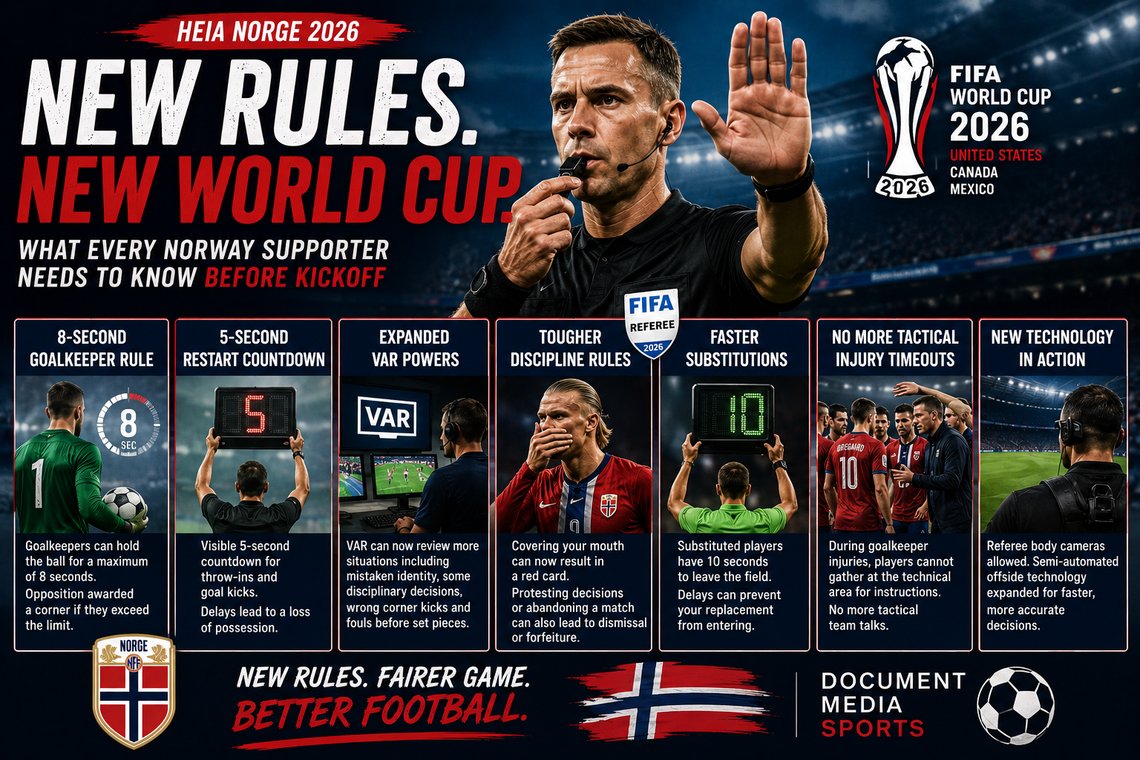
The 2026 FIFA World Cup will be remembered for many firsts.
It is the largest World Cup in history, featuring 48 nations across the United States, Canada, and Mexico.
But it will also be the first major tournament to use a new collection of football laws designed to speed up play, reduce gamesmanship, and improve the experience for supporters.
As Norway prepares for its long-awaited return to the World Cup, players and fans alike will be adapting to some significant changes.
Here are the biggest new rules you will see during the tournament.
Goalkeepers Can No Longer Waste Time
One of the most noticeable changes involves goalkeepers.
If a goalkeeper holds the ball for longer than eight seconds, the opposing team will be awarded a corner kick. Referees will use a visible countdown to signal the final seconds. The change is designed to eliminate one of football’s most common time-wasting tactics.
Five-Second Countdown for Restarts
Referees will also enforce visible five-second countdowns for throw-ins and goal kicks.
If a team delays a throw-in beyond the countdown, possession is awarded to the opposition.
If a team delays a goal kick, the opposition receives a corner kick.
The objective is simple: keep the game moving.
VAR Has More Power
Video Assistant Referee technology will have a larger role than ever before.
VAR can now intervene in additional situations, including mistaken identity, some incorrect disciplinary decisions, wrongly awarded corner kicks, and certain fouls that occur before set pieces are taken. These changes are intended to correct clear errors more efficiently.
Tougher Discipline Rules
Players who cover their mouths during confrontational exchanges can now face a red card.
The rule was introduced to address concerns about abusive or discriminatory comments that cannot be properly reviewed when conversations are intentionally concealed.
Players who leave the field to protest referee decisions can also be sent off, and teams that deliberately cause matches to be abandoned risk forfeiting the game.
Faster Substitutions
Substituted players now have ten seconds to leave the field.
Players who delay their exit can create a temporary disadvantage for their own team, as replacements may be forced to wait before entering. The rule aims to eliminate another common form of time-wasting.
No More Tactical Injury Timeouts
FIFA is also targeting a growing trend where goalkeepers go down injured to allow coaches to conduct unofficial team talks.
During goalkeeper injury stoppages, players will not be permitted to gather around technical areas for instructions. The goal is to preserve fair play and prevent manufactured breaks in momentum.
Referee Cameras and New Technology
Supporters may also notice new technology during broadcasts.
Referee body cameras are now permitted in competitions that choose to use them, giving viewers a unique perspective from the official’s point of view. FIFA has also expanded its use of semi-automated offside technology to deliver faster decisions.
What It Means for Norway
For Norway, these changes place a premium on discipline, concentration, and game management.
Small mistakes that previously went unnoticed may now be punished.
Time-wasting tactics will be more difficult.
VAR reviews will be broader.
And every second could matter in a tournament where margins are often razor thin.
As Norway prepares for its first World Cup appearance in 28 years, supporters will not only be watching a new generation of players.
They will also be watching a new version of football.
Following Norway Around the World?
Whether you’re travelling for the FIFA World Cup, watching matches abroad, or protecting your connection on public Wi-Fi, Proton VPN helps keep your online activity secure and private.
👉 Get Proton VPN and enjoy a 70% discount on their 2-year VPN Plus plan!
Disclosure: This article contains affiliate links. If you purchase through these links, we may earn a commission at no additional cost to you.


