

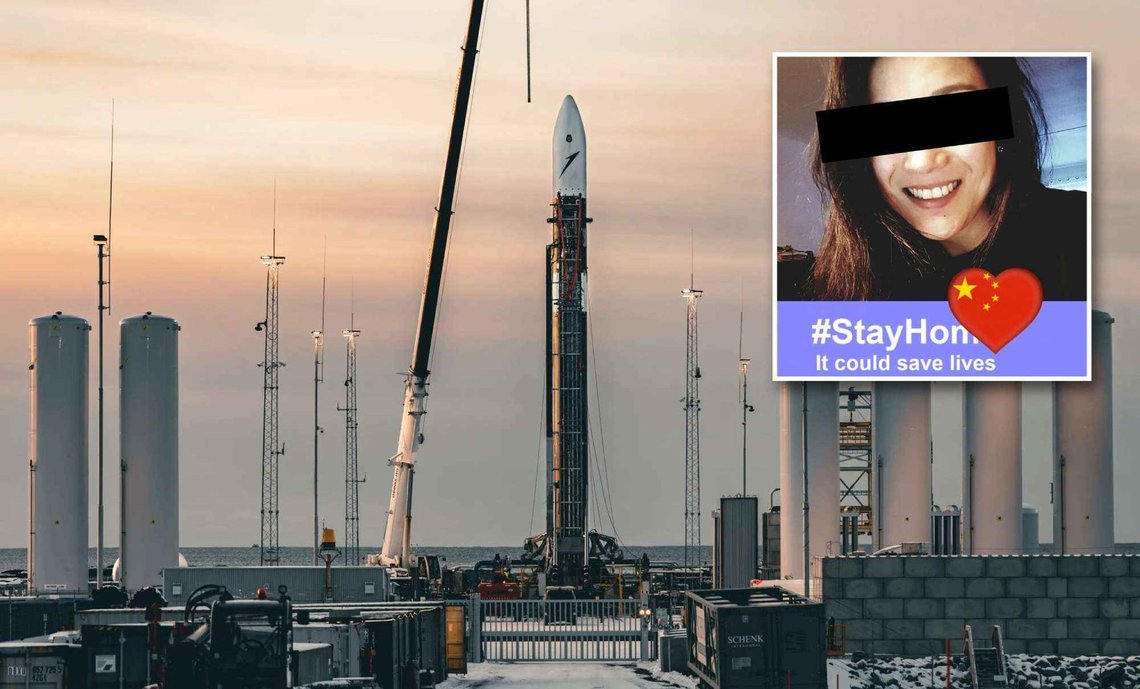


The house that PST raided on Andøya on 7 May is located near Andøya Spaceport, where NATO-funded space rockets are launched. The house belongs to a company with Chinese ownership. A former employee of the man charged with espionage now works for the supplier of the rocket base’s communications system.
The 22-tonne satellite receiver from China that PST seized at the Port of Oslo in April was addressed to the company Karmøy Health Norway AS, which has the status of an accused party in the espionage case.
This is the same company that purchased the remote detached house at Bjørnskinnveien 644 in Risøyhamn on Andøya in March of this year.
The company is controlled by a holding company in Singapore, Karmoy Health Norway Pte. Ltd. The owner is the Singapore-registered Chinese national Wei “William” Qiu (43), who has been resident in Norway since 2022.
 Wei Qiu in October 2021. (Photo: Helene Hovden/GD/crop)
“The Singapore Man”
In the Norwegian press, Qiu is referred to as “the Singapore man”. That is where he indicates that he is currently staying. In Norway, he is registered with a private address in Otta and an annual income of just over NOK 317,000 in 2024.
PST has not responded to Document’s questions concerning Qiu, but has previously confirmed that he is one of the three accused persons, all of whom have connections to Karmøy Health Norway.
Qiu himself claims that he was led up the garden path by a former schoolmate from China, who put him in contact with individuals willing to pay for assistance in establishing themselves in Norway.
– Here, PST has rolled out the artillery and taken aim at an entirely ordinary pigeon in the backyard, only then to announce that it might be a dragon, Qiu writes from his Singaporean telephone number.
He does not comment directly on the content of the article, but instead expresses criticism of what he calls “the Nordic art of slow living”, which he believes is also reflected in PST’s investigation.
Before Karmøy Health and the plans to sell krill oil products, Qiu, together with Oliver Nilseng Horvei (30) from Lillehammer, attempted to build data centres in Gudbrandsdalen.
It was in connection with this project that they hired a Chinese woman in her forties, resident in Oslo, in May 2022.
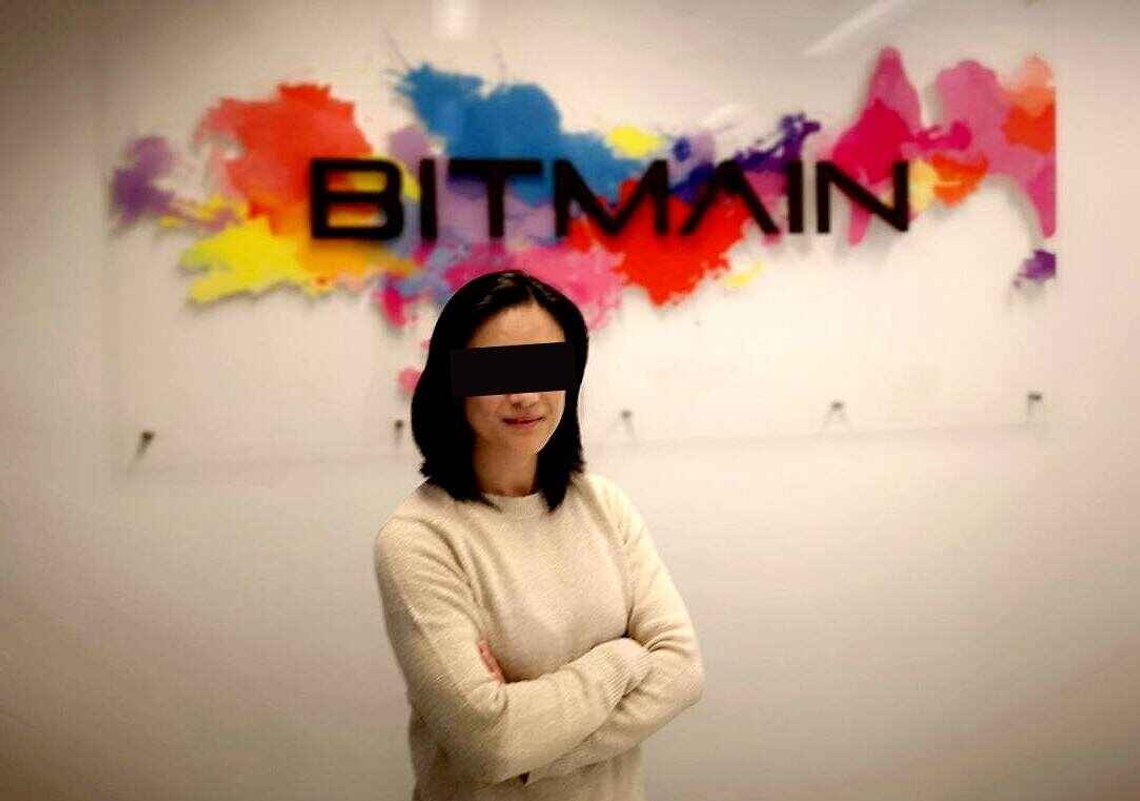 The woman was head of the Norwegian branch of the Chinese company Bitmain before later being employed by Wei “William” Qiu, who is managing director of the company that PST suspects was used as a front operation for Chinese intelligence. (Photo: Private/LinkedIn)
The woman holds a master’s degree in telecommunications and came to Oslo in 2009 to work for the Chinese company Huawei.
Under the leadership of Wei and Horvei in the company Krefter AS, her duties included “working on technical solutions in Norway and communicating these effectively in Mandarin to [Chinese] investors”.
Since 2023, she has been employed as a key account manager at the Austrian company Frequentis, which supplies safety-critical systems for, among other things, space operations, drones, air defence and airspace surveillance.
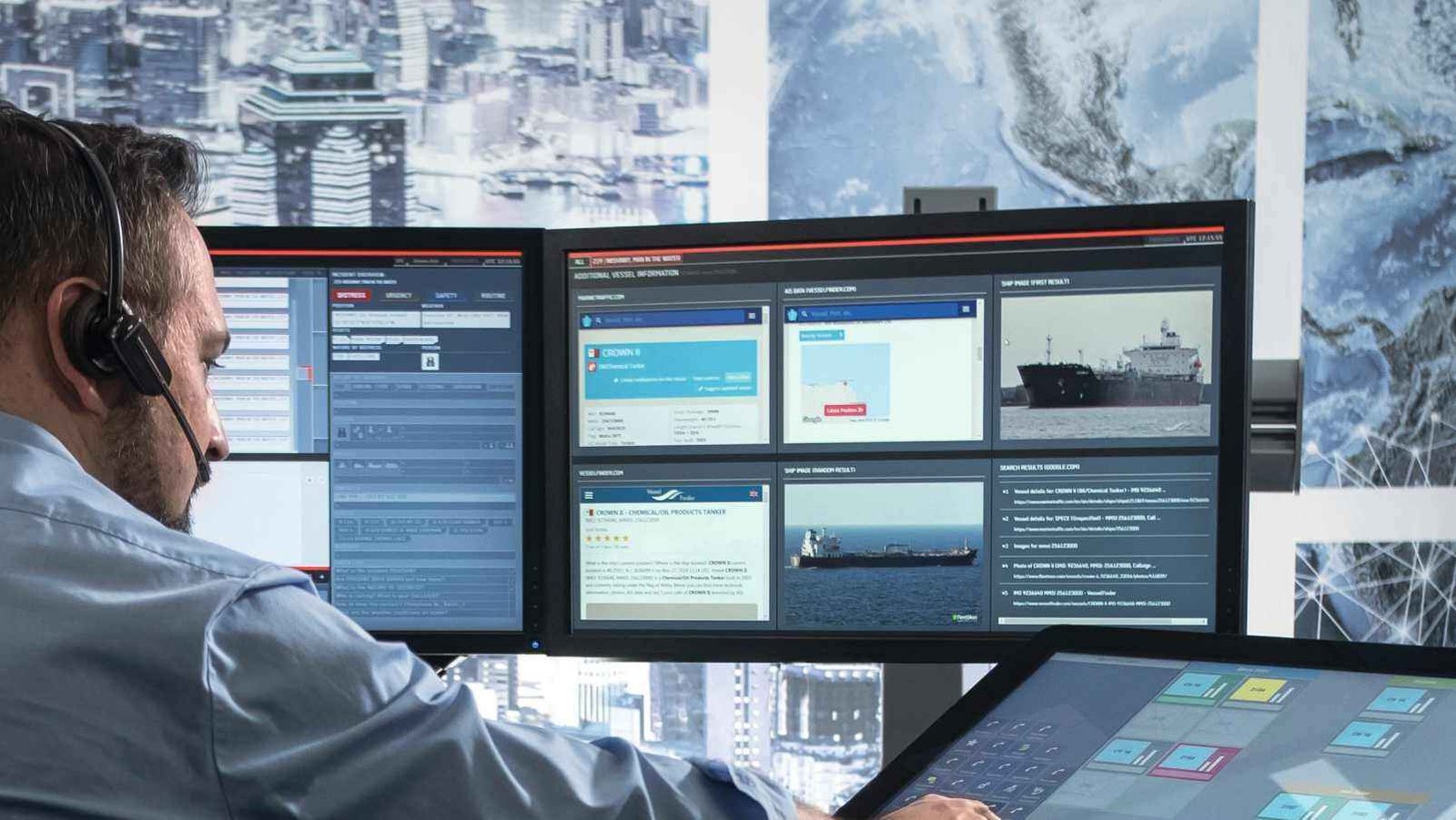 This is Frequentis’ MarTRX communications platform, which is used during rocket launches from Andøya Spaceport. (Photo from brochure/Frequentis AG)
At Andøya Spaceport, the German company Isar Aerospace made history in March 2025:
As the first commercial space company, it launched an orbital rocket from a European base outside Russia. Nine months earlier, it had been announced that NATO’s Innovation Fund had become an investor in the company.
After the first launch of the Spectrum launch vehicle from Bøvågen on Andøya, which ended with the rocket crashing into the sea and exploding, the Chinese woman published a post on LinkedIn.
There it emerges that the MarTRX communications system, which Isar uses at Andøya Spaceport, was developed and supplied by her employer, Frequentis.
The multinational company, headquartered in Vienna, also supplies military aviation communications to the Austrian Air Force, air traffic surveillance to American authorities, a control centre for the Norwegian police emergency communications network, and a turnkey solution worth NOK 200 million for Avinor’s management of air traffic at 14 Norwegian airports, including Gardermoen.
Supplies Command Centres to NASA
In a press release (PDF) on 11 May this year, Frequentis states that it is assisting the Norwegian Coastal Administration (Kystverket) in taking over the coastal radio service from Telenor. The system comprises nearly 500 transmitters at 150 locations along the coast and is coordinated by the Joint Rescue Coordination Centre.
The company also supplies communications systems to a number of NASA command centres in the United States and to deep-space listening stations located in Australia and Spain.
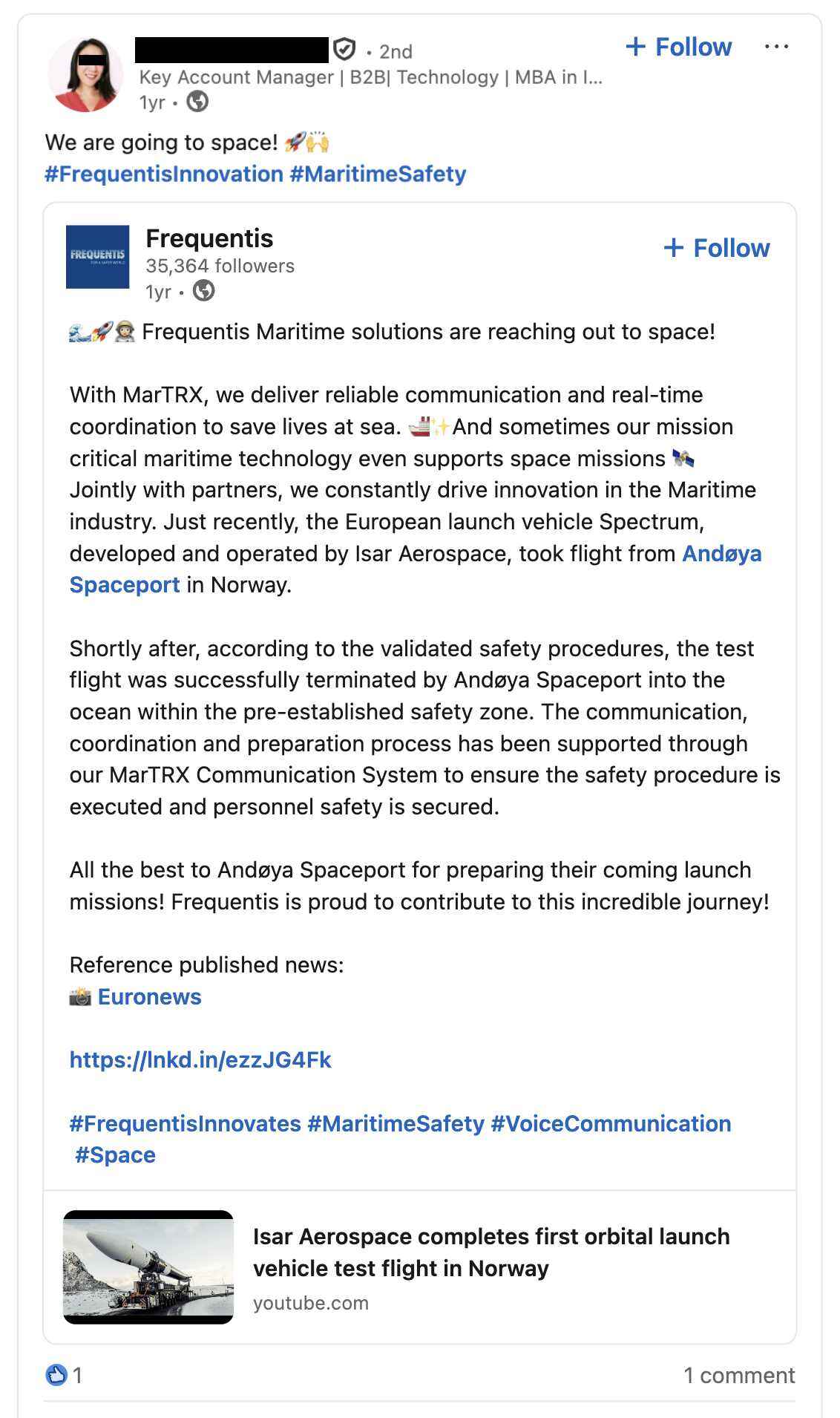 (Screenshot from LinkedIn)
Neither the woman, Isar Aerospace nor Andøya Space has thus far responded to Document’s enquiries. Frequentis states that it is coordinating internally in order to deal with the matter.
Despite repeated requests, it has still not been possible to obtain a response from PST.
– They have quite a lot on their plate these days, says the switchboard operator, referring to the two press spokesmen.
Faulty Vent Valve
Half a year after Spectrum’s first launch, Isar Aerospace stated that one of the problems that destabilised the rocket was a vent valve that had mistakenly been opened by software in the ground command centre, causing cryogenic gases to escape.
The company’s solution was to allow the rocket software to control the valve rather than leaving it to ground-based software.
Andøya Spaceport is located 13 kilometres in a straight line from the Chinese-owned house on Bjørnskinnveien on Andøya. PST believes that the large satellite receiver from China was intended to be transported north to this address.
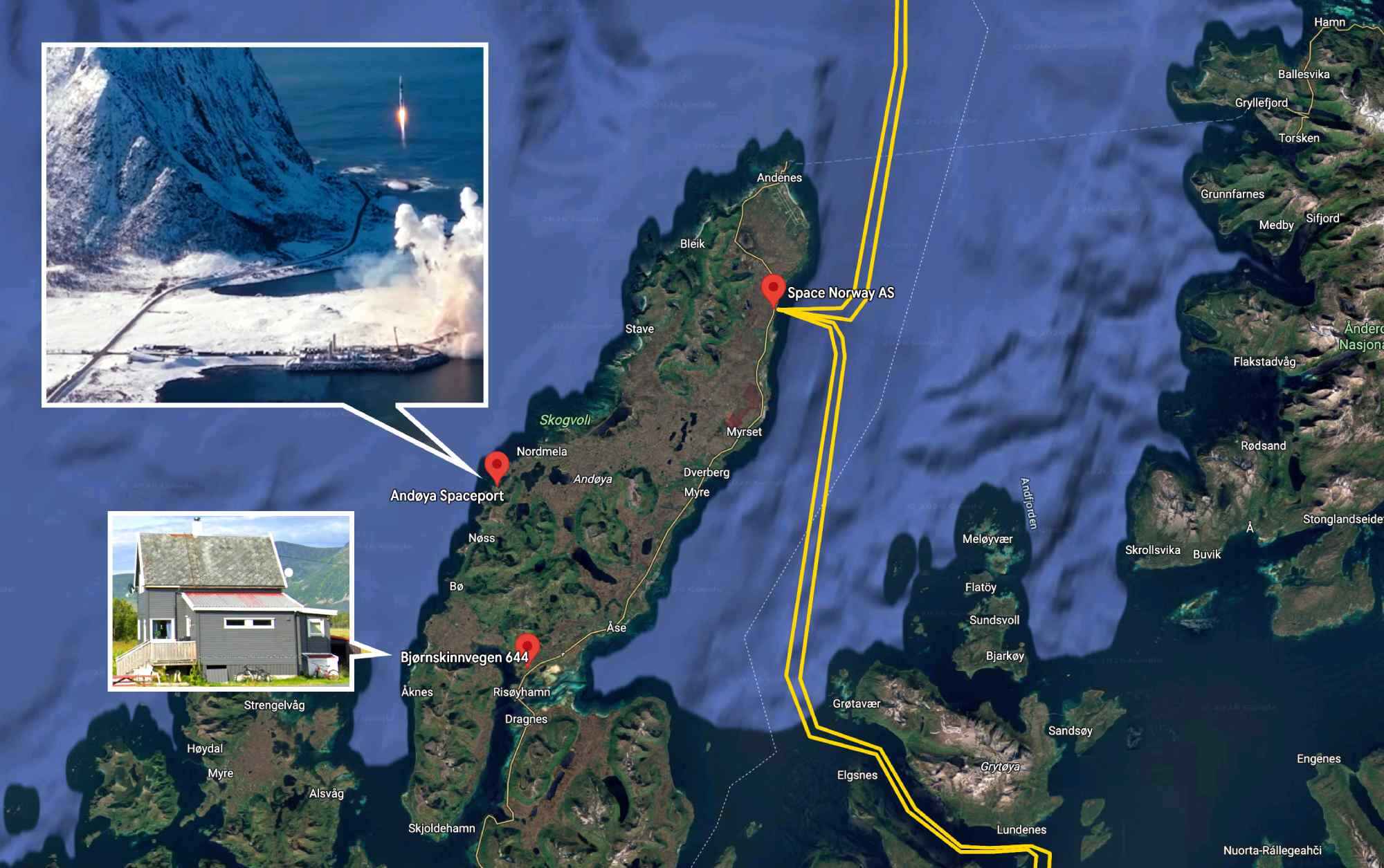 The detached house at Bjørnskinnveien 644 on Andøya, purchased in March this year by the espionage-accused company Karmøy Health Norway AS, lies 13 kilometres in a straight line from Andøya Spaceport. The fibre-optic cables from Svalbard that come ashore at Breidvik (yellow lines) are among a number of potential intelligence and sabotage targets in the area. Space Norway also has two large satellite antennas at the landing point. The sea east and north of the island is used for testing top-secret weapons systems. (Map: Google Maps/Document)
According to PST, the antenna is suitable for receiving data from satellites orbiting over polar regions.
According to a radio communications expert consulted by Document, it is oversized for intercepting telemetry from rockets during launch, but satellite communications are also used in such contexts. In those circumstances, a larger motorised receiver could be relevant.
In January of this year, the Chinese woman appeared to be particularly interested in satellite technology and quantum communications in space. She shared a link to an article in Satellite World that discusses, among other things, AI-based sensor technology for tracking satellites in orbit and “AI-assisted signal processing”.
24 January 2026 was the date on which the container carrying the receiver was shipped towards Norway from the port of Yangshan in China.
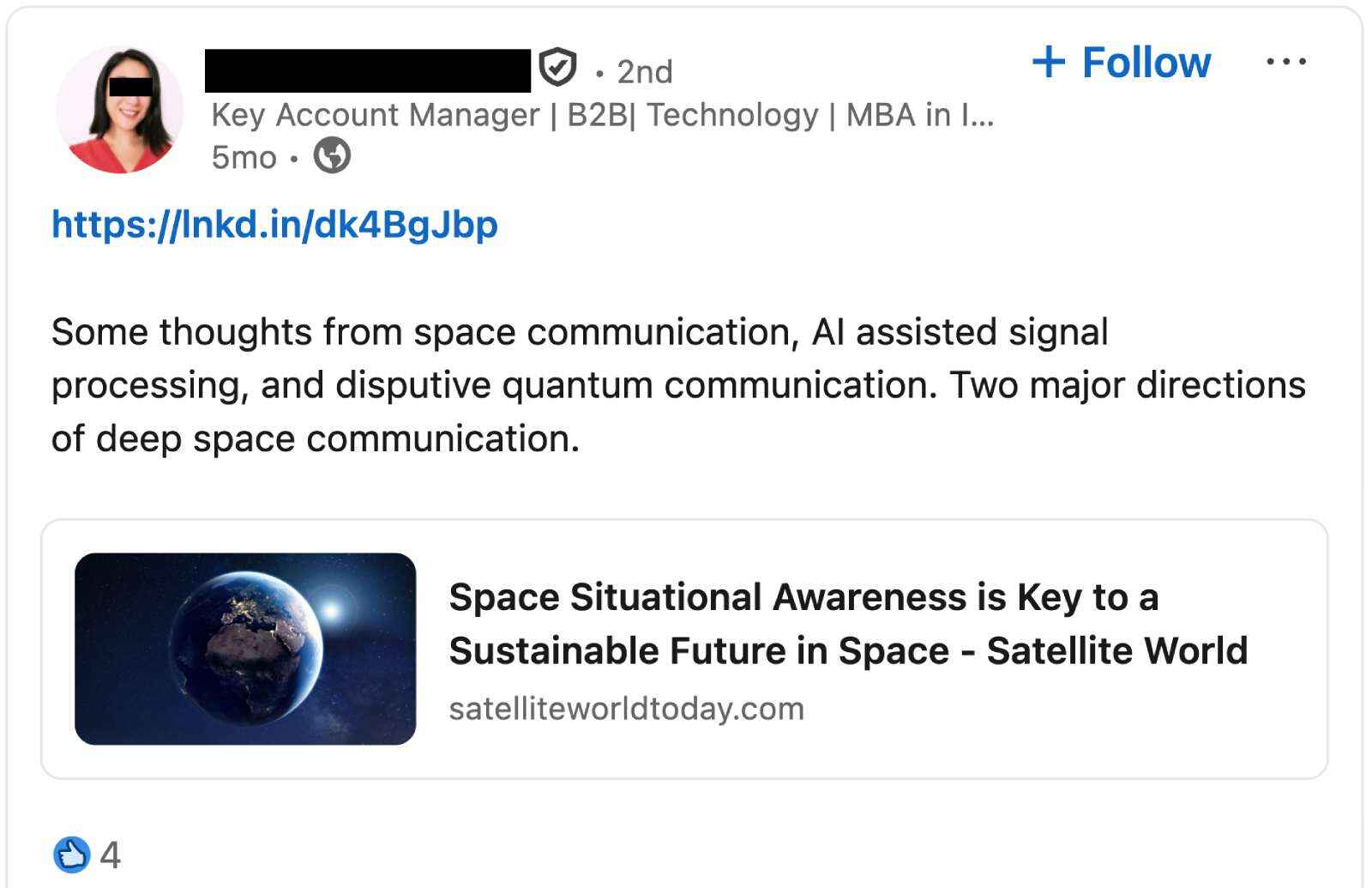 (Screenshot: LinkedIn)
During the same period in which the woman worked for Huawei Norway, a newly graduated Norwegian was hired. He is a graduate engineer from NTNU, specialising in cybersecurity and communications technology.
His master’s thesis concerns the cracking of the GSM network encryption algorithm and the establishment of false mobile base stations.
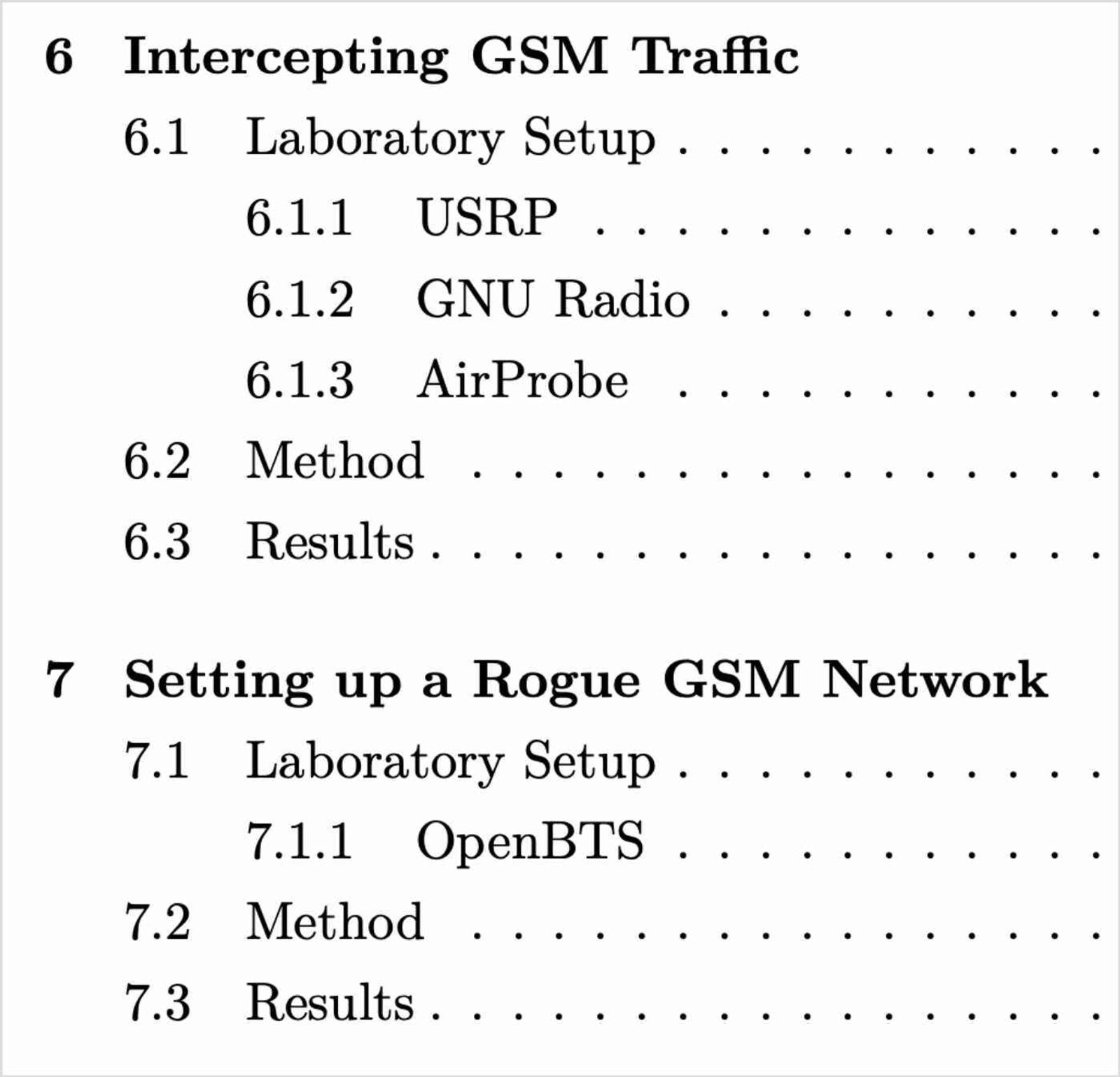 From the table of contents of the master’s thesis from NTNU.
Romance blossomed, and the Chinese woman adopted the Norwegian’s surname. The couple purchased an apartment together in Lørenveien in Oslo in 2018. On social media, the man states that he speaks a Chinese language and is pictured on the Great Wall of China.
Today he works at Netel, a company that provides critical infrastructure within the energy and telecommunications sectors. In 2024, the company received a billion-kroner contract with Telenor to expand the fibre network.
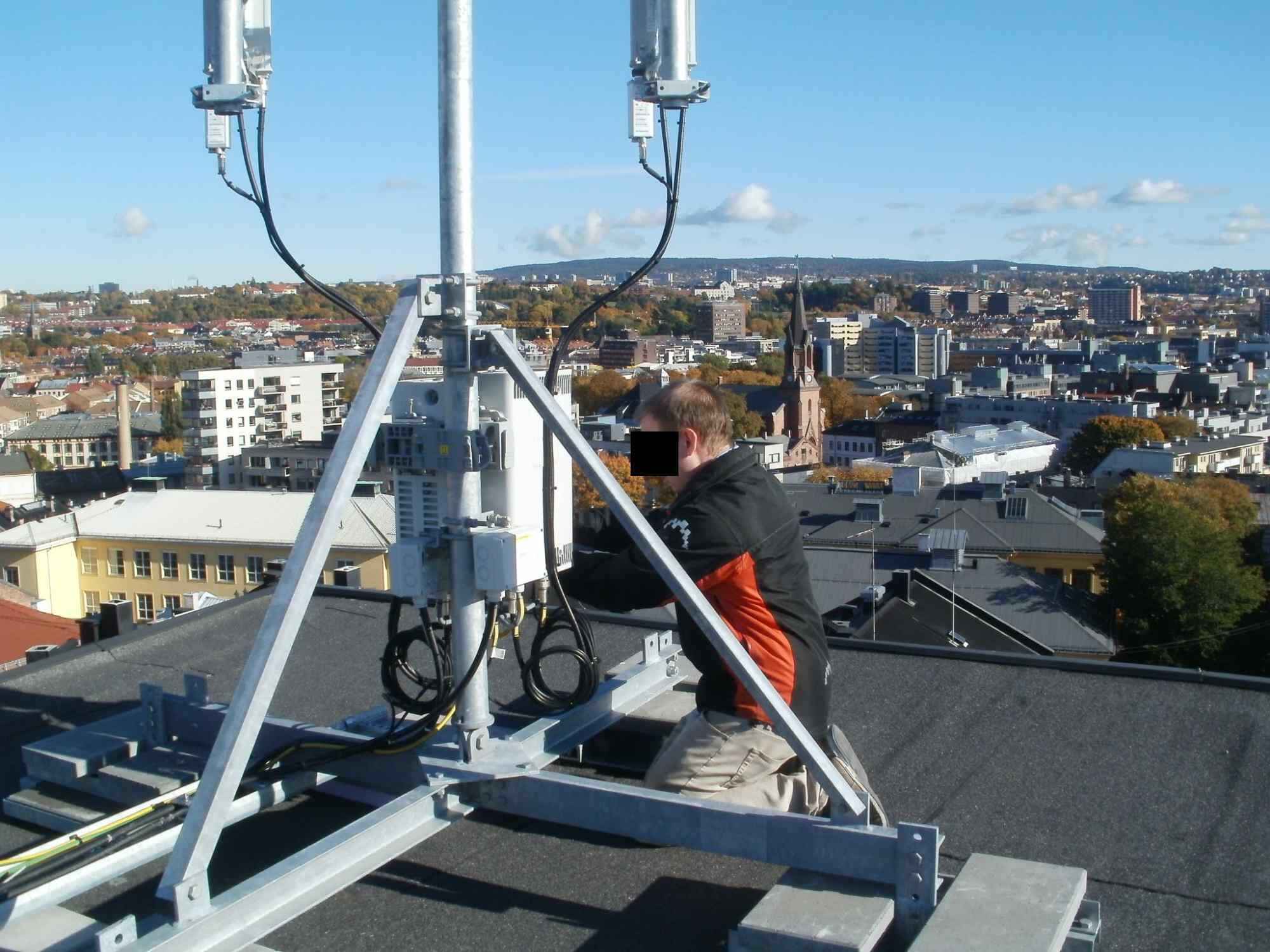 Here, the Norwegian engineer installs a mobile base station in Oslo in 2012 while employed by Huawei Norway. (Photo: Private)
In 2019, PST warned against allowing Huawei and other companies from countries with which Norway has no security cooperation to participate in the construction of security-critical infrastructure such as the 5G network.
Chinese Crypto Giant
In 2014, the woman changed jobs from Huawei to Telia before, in 2018, becoming the public face of the Chinese company Bitmain and crypto-magnate Jihan Wu’s venture in Norway.
We wrote about Wu earlier this year: through a Singapore-registered company, he owns two large data centres in Norway, where cryptocurrency is mined, among other activities.
Datagründere til krig mot Skatteetatens kopiering av mobiltelefoner
Less than a year after Bitmain Norway was launched, the government’s decision to impose the full electricity tax on cryptocurrency mining caused the company to close its Norwegian operations and relocate to Germany.
The Chinese woman then returned to further periods of employment with Telia and Huawei before being recruited by Krefter AS in 2022.
The limited company was established in 2021 by Wei Qiu and Oliver Nilseng Horvei. Horvei has lived in several Chinese megacities and, according to his CV, founded several companies in China while still in his early twenties.
Krefter’s official objective was to establish “green” and “energy-saving” data centres in Norway. It soon became apparent, however, that the primary focus was cryptocurrency mining.
 The detached house at Bjørnskinnsveien 644 is located near a mobile mast along the county road leading to Andøya Spaceport. (Photo: Google)
Intended to Trade in Krill Oil
In the spring of 2023, Wei Qiu moved to Otta when, through the company Krefter SPV 1 AS, he purchased a detached house at Kleivrudvegen 25. The purchase was privately financed. The annual accounts record NOK 1.8 million in debt owed to himself.
Before the title deed was registered, the company changed its name to Merlion Holding AS.
Approximately a year later, the name was changed again, this time to Karmøy Health Norway AS. The company’s purpose was altered to “purchase, market and sell fish and krill oil, as well as other marine products”.
The shares were sold to Wei Qiu’s newly established holding company, Karmoy Health Norway Pte. Ltd. in Singapore.
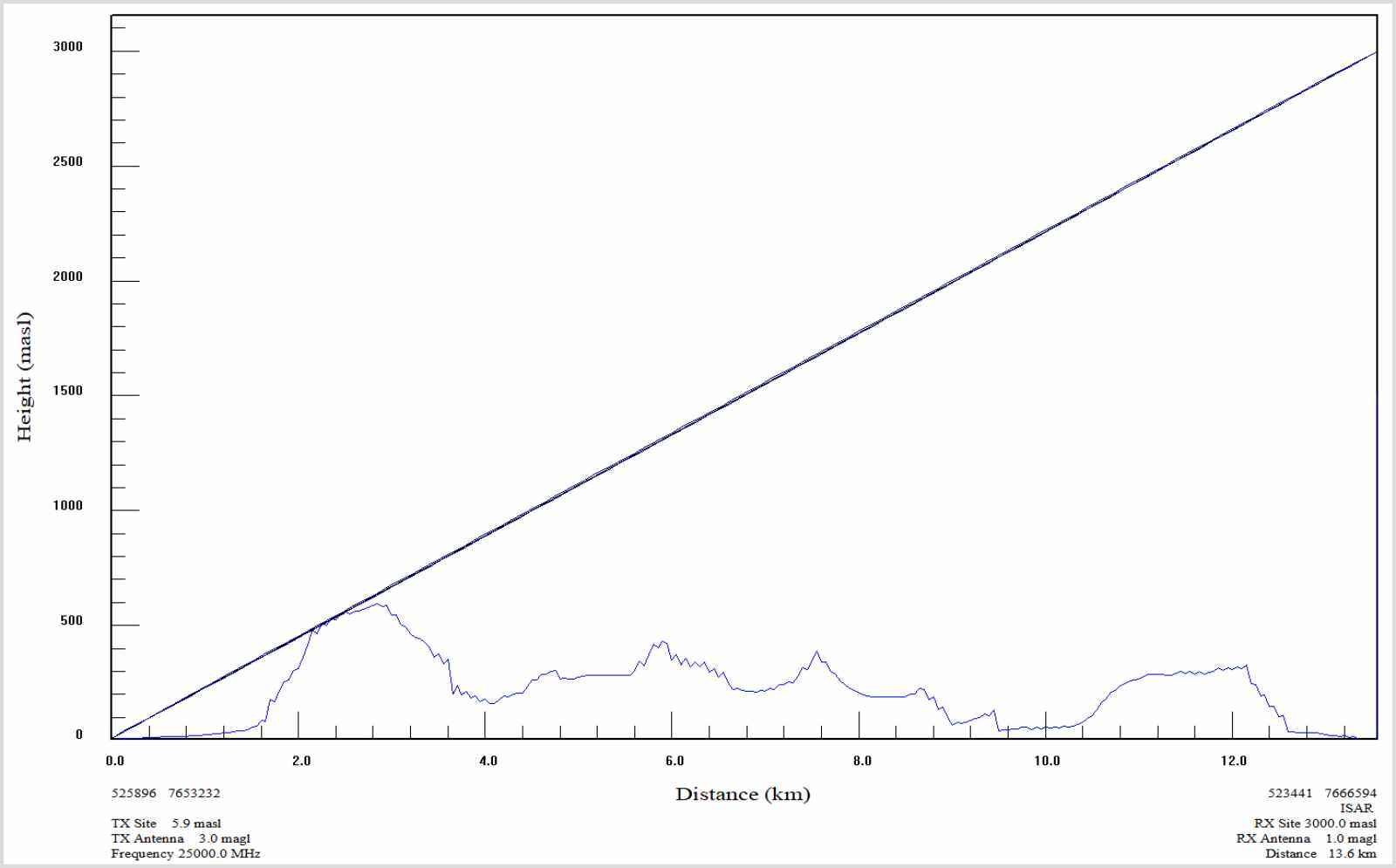 The topographical radio communications coverage profile between Karmøy Health Norway’s detached house in Risøyhamn and the launch pad at Andøya Spaceport shows that the rocket must reach an altitude of 3,000 metres before direct contact is established. (Graphic generated using Aspect Enterprise from ABB)
In May 2025, the property at Kleivrudvegen was resold to a former employee of Krefter, Liang Qiu. The price was NOK 1.75 million. According to Document’s sources, he is Wei Qiu’s cousin.
The 2025 annual accounts show that Karmøy Health Norway still has an outstanding claim of NOK 1.1 million from the sale.
When PST entered this house early in the morning on 7 May this year, nobody was at home. Liang Qiu informed the press that he was on holiday in China.
At around 11 a.m. the same day, the 29-year-old Chinese woman was arrested on Andøya.
At the same time, PST officers arrived at Vågå municipality. Their message was that officials should try to remember details from their contact with Wei Qiu and Krefter AS that might assist the investigation.
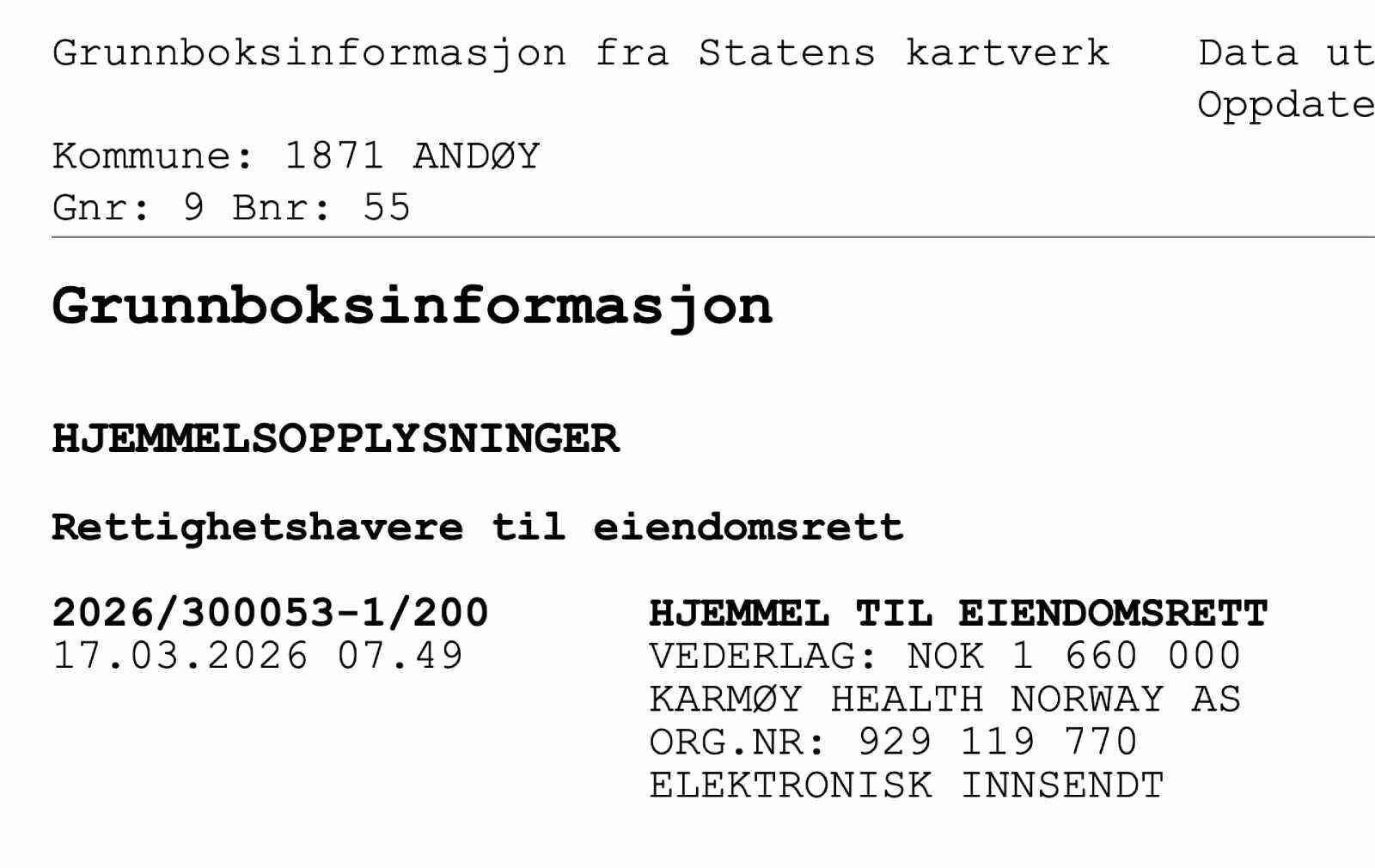 The land register shows that Wei Qiu’s company owns the house at Bjørnskinnsveien 644 in Andøy Municipality, which PST searched on 7 May. (Facsimile: Property Register)
In 2021, Krefter AS had signed an agreement with Vågå Municipality to lease industrial premises and negotiated the purchase of vacant land in the Kolbotn industrial area at Lalm. The company also purchased 52 decares of land from a private landowner.
The capital came from Singapore. The parent company was Grand Technik Pte. Ltd. in Singapore, with Wei Qiu as majority shareholder. Another shareholder is listed as a Chinese citizen. The names indicate that the other shareholders are also Chinese.
Oliver Horvei is listed as holding approximately 1.32 per cent of the shares in this company, which according to its own presentations has built data centres in Asia for major clients such as Google Cloud, Microsoft, Alibaba Cloud and ByteDance (TikTok).
Bitmain and Grand Technik also formed a joint investment company, BMFS Holding Pte. Ltd., with more than NOK 180 million in share capital.
Started Excavation and Construction Without Permission
The data centre venture in Vågå became a chaotic process. The cultural differences were considerable. The municipality and the power company Fjellnett began to question the company’s real intentions and suspected links to China.
PST became involved and held meetings with the municipality in both 2022 and 2023. Several hundred thousand kroner were spent engaging the consultancy firm Ernst & Young (EY) to conduct background checks on the ownership structures in Singapore.
Those involved denied most of the allegations and attempted to obscure the connections to China, Bitmain and cryptocurrency.
– The reports showed an ownership connection between Grand Technik and Bitmain in BMFS Holding Pte. Ltd. on Thursday, 7 July 2022. A new extract from the Singapore register two days later showed that Grand Technik had transferred its ownership stake to a woman who was in a relationship with Wei Qiu, says Vebjørn Haugen, managing director of Fjellnett AS.
It was around this time that the Chinese woman with a background from Bitmain was hired. In an email explanation to Haugen on 11 July, managing director Oliver Horvei acknowledged that the company had also employed two other Chinese nationals from Bitmain.
In late summer 2022, Krefter began construction work without a building permit, as well as illegal groundworks in a forest area, for which the municipality imposed substantial fines.
– They began digging completely arbitrarily, directly across a power cable, in an area that was not even zoned. It was fortunate that the excavator operators were not injured. We gained the impression that they were desperate and under pressure from their investors, says Harald Sve Bjørndal, Mayor of Vågå.
In total, the company is estimated to have spent at least NOK 200 million on land purchases, lawyers, construction work and attempts to obtain concessions and permits, without ever connecting a single computer.
The investors in Singapore eventually withdrew and allowed Oliver Horvei to acquire the remnants around the turn of 2023–24 through the company Ugna AS.
Nor were the 48 containers from China, worth at least NOK 30 million and filled with cryptocurrency mining computers, ever connected. Many of them stood stacked on a plot in central Otta for an extended period before Qiu succeeded in shipping them onwards to Uganda.
Horvei has not responded to Document’s latest enquiry, but previously claimed that PST had cleared him of involvement in the espionage case and that he is not permitted to discuss it with the press.
– Strategically Located Properties
In PST’s National Threat Assessment (PDF) for 2026, the intelligence threat from China is described as significant. Chinese intelligence services have increased their ability to operate in Norway both through cyber operations and through information gathering via human sources.
Individuals who have connections to China through studies, work, friends or family are more vulnerable, since such connections provide the intelligence services with greater opportunities for reward or pressure. In addition, there is a growing trend whereby Chinese intelligence services encourage their sources to recruit their own networks of sources, for example by advertising part-time positions on employment websites or approaching individuals via LinkedIn.
A common feature is that persons recruited indirectly are not necessarily aware that they are reporting to Chinese intelligence. The identity of the client is often concealed; sources are typically told that the client is a think tank, an international company, a consultancy firm or similar.
In the 2024 threat assessment (PDF), PST warned more specifically that Chinese commercial actors “acting on behalf of the Chinese party-state will seek to establish businesses or infrastructure on strategically located properties in the High North”.
Chinese intelligence services recruit Norwegian citizens in order to gain access to sensitive and classified information. […] These are often individuals who have connections to China through studies, work, friends or family.
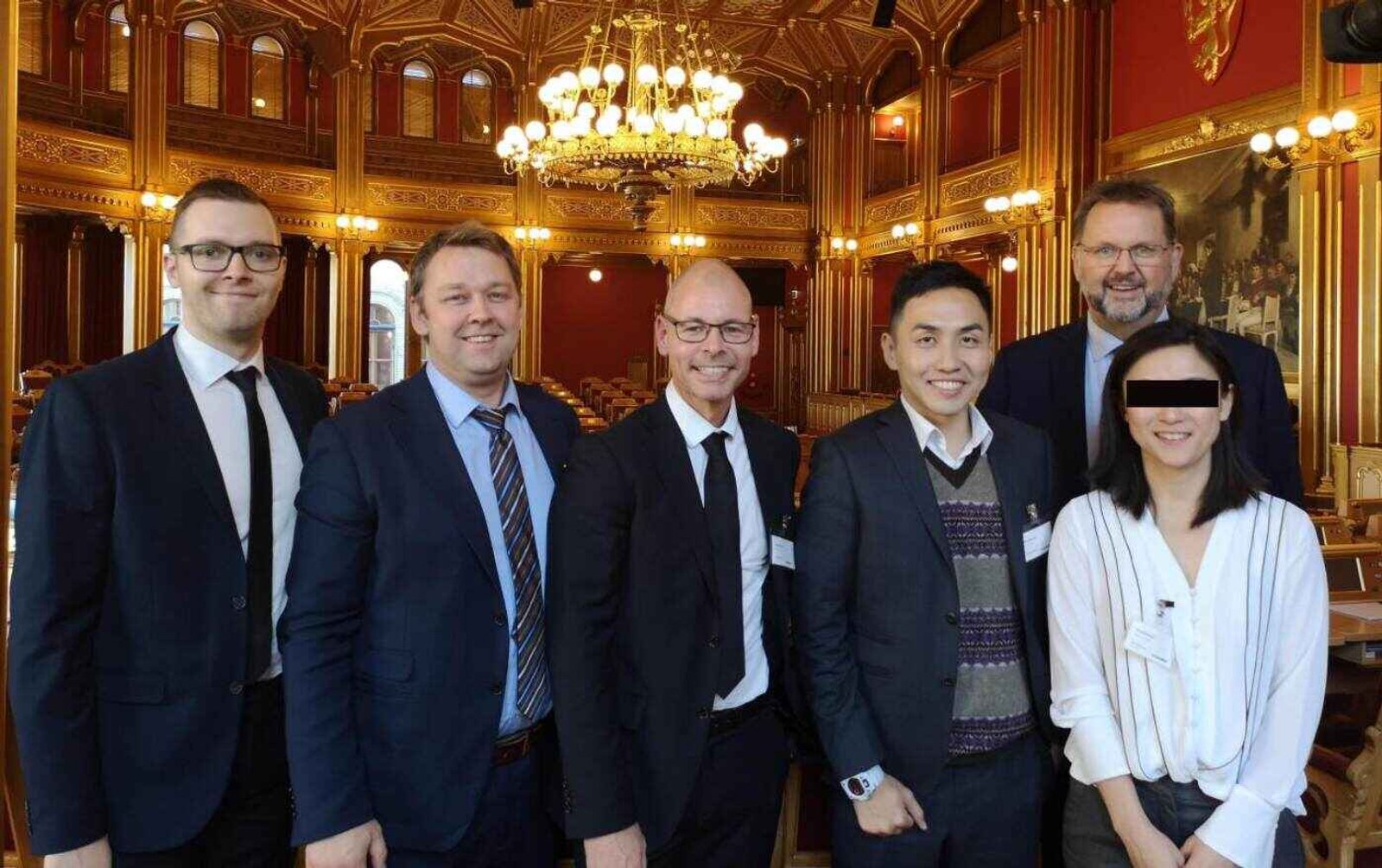 The Chinese woman visited the Storting in 2019 with representatives of her then employer Bitmain, together with Svein Harberg (Conservative Party), deputy chair of the Standing Committee on Scrutiny and Constitutional Affairs (rear right). (Photo: Private)
PST also writes that acquisitions and investments in Norwegian business in order to secure strategic advantages are a widespread method.
Such economic instruments are often lawful, but may constitute a threat to fundamental national interests when viewed collectively.
One of PST’s examples of how lawful economic instruments can threaten Norwegian security is Chinese companies gaining access to Western technology markets:
– Integrating Chinese technology into Norwegian infrastructure gives Chinese manufacturers the opportunity to install backdoors that provide access which is extremely difficult to detect, the threat assessment states.


