

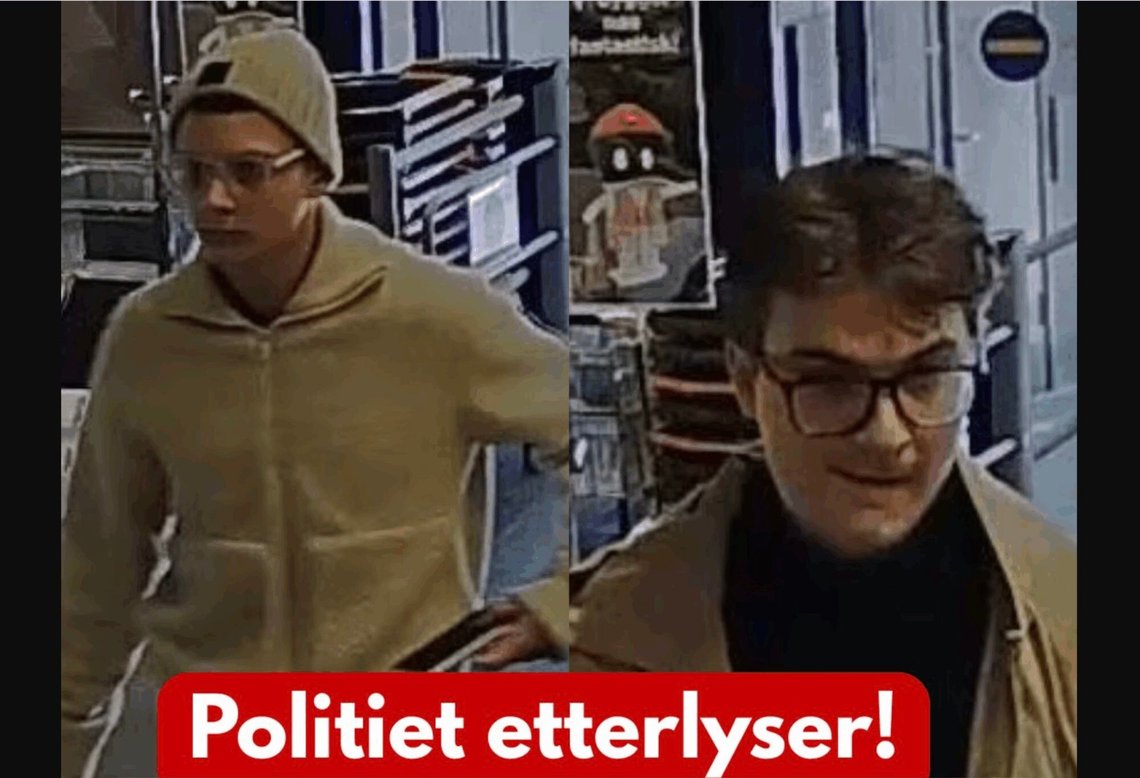


Innlandet Police District has released unredacted surveillance footage and images of two men wanted in connection with a theft from the Power store in Elverum.
The images have been circulated in local media and through the police’s own channels. Both men are white.
This has not gone unnoticed.
Progress Party (FrP) politician Jon Helgheim, who only recently received severe criticism in Norwegian media after sharing an unredacted image of minors with immigrant backgrounds in connection with a violent incident in Bergen, commented laconically on the case on Facebook.
“Hmm… Of course, it is entirely correct and lawful to show unredacted images in certain cases, so I support this. But where is the chorus of outrage claiming that I broke the law now?” writes Helgheim.
The question is not unreasonable. During the disturbances on Constitution Day (17 May) in Bergen, Tromsø and Oslo, where the violence, fights and robberies were committed by youth groups predominantly of immigrant background, no images of the perpetrators were released by the police.
The surveillance cameras existed. The police had the images. They simply were not shown.
In Elverum, where two men are suspected of shoplifting, the threshold appears to be different.
Norwegian police have no public policy explicitly stating that ethnicity should be taken into account when assessing whether images should be released. The criteria normally applied are the seriousness of the offence, investigative necessity and privacy considerations.
That these criteria consistently appear to produce different outcomes depending on who is depicted in the images is an observation on which the police have not yet commented.
Østlendingen, which reported the story, explains the publication as follows:
“The police have issued a public appeal for these individuals using photographs, and we are using the same images that the police have published on their Facebook profile. The police have shared them because they are seeking information about these two individuals suspected of theft. Østlendingen considers it ethically correct to publish the images in order to help obtain information about the case.”


