



The author Michael Shellenberger founded an Amnesty International chapter at his school at the age of 15. Several decades of environmental activism followed, fundraising for rainforest protection and a deep commitment to the climate movement.
This background is crucial to understanding why his criticism of the Left deserves attention.
As he explains in a podcast with Coleman Hughes, the transformation from a critic within the Left to a critic of the Left occurred gradually. First, Shellenberger changed his mind about nuclear power. The discovery that the Left’s opposition to the safest and cleanest form of energy could not be explained rationally opened the door to a larger question:
What is the Left really about?
Children of Rousseau
According to Shellenberger, climate activism, gender ideology and social policy conceal a common underlying logic, which he traces back to Rousseau: civilisation is the problem. All major progressive causes share this underlying hostility towards Western civilisation.
Nuclear power is a particularly good example. The technology is scientifically documented as both safe and climate-friendly, yet the Left opposes it nevertheless. For Shellenberger, this reveals that concern about the climate is of secondary importance. Nuclear power represents advanced Western civilisation, technological mastery and industrial competence, and it is precisely this that provokes opposition.
Shellenberger sees the pattern repeating itself across progressive causes: anti-system, anti-establishment, anti-civilisation. An identity that has long been embedded in popular culture as a kind of default setting for young people.
God Is Dead – Long Live the Climate
The idealistic-religious intensity found in progressive movements is explained by secularisation. Shellenberger draws a classical line from Nietzsche through Durkheim to Weber: when Christianity loses its function as a pillar of society, it leaves behind a vacuum. Human beings continue to seek transcendence and moral meaning, and find it in substitute religions.
The climate movement, the “woke” movement and identity politics function psychologically in precisely this way. They offer consciousness of sin, salvation, enemies and a community of the righteous. This is why it is so difficult to confront these movements with rational arguments. Theology is not easily refuted with statistics.
The Saviour and the Victims
Shellenberger describes a psychological profile that he recognises from his own past: the messianic self-image. The urge to save the world. The need to be recognised for one’s goodness. He openly acknowledges that this need drove his early activism, and he believes it is widespread on the Left.
This has alarming consequences. Shellenberger connects this identity of goodness to a number of cases of political violence from the Left.
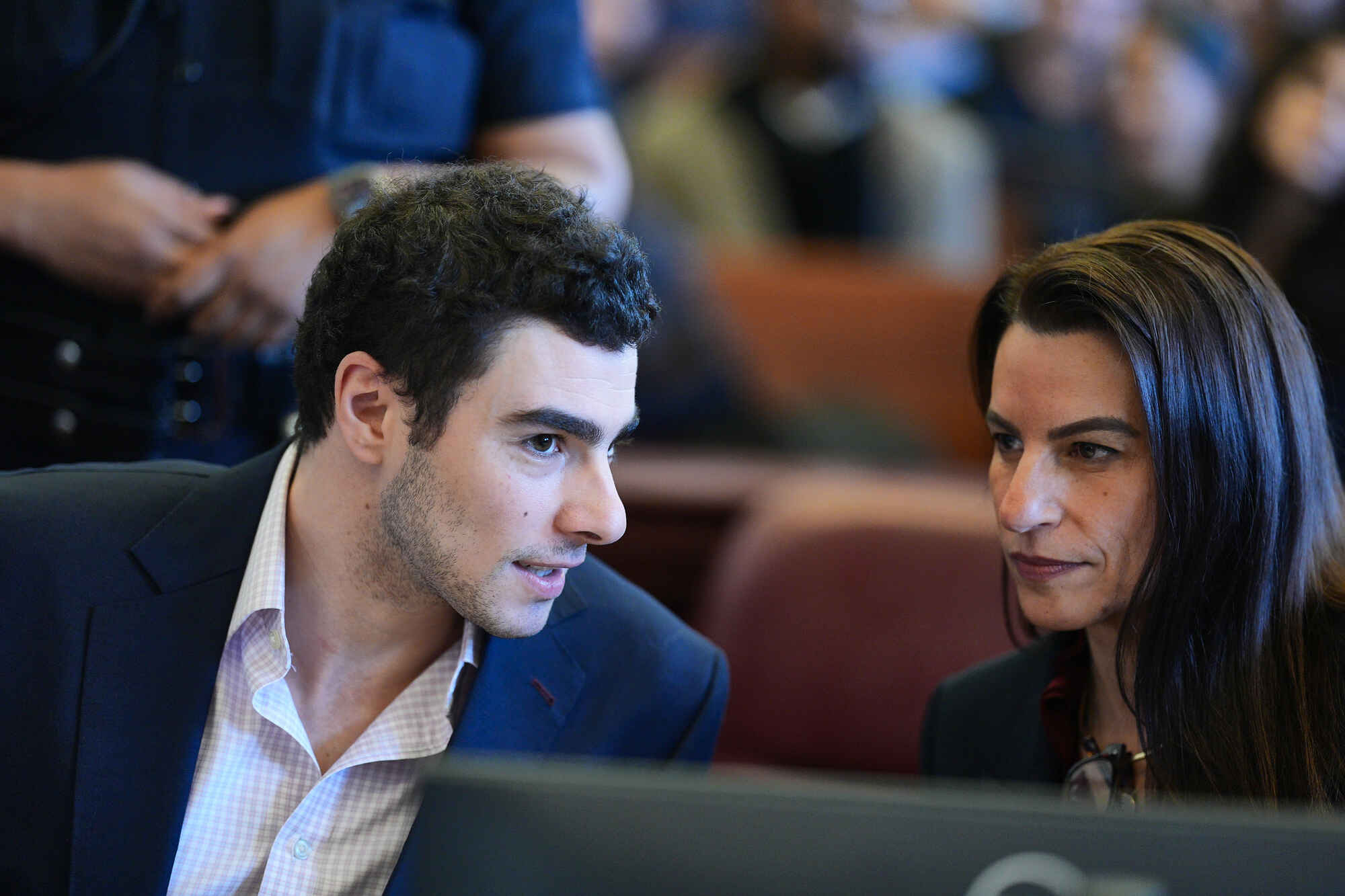 Luigi Mangione appears in Manhattan Criminal Court in New York on 9 December 2025. Photo: Curtis Means / Pool via AP / NTB.
At present, this concerns Luigi Mangione, who shot and killed a senior executive at a major American insurance company, and Cole Tomas Allen, a 31-year-old teacher and engineer from California, who last month attempted to force his way through security at the annual White House Correspondents’ Dinner carrying a rifle, a pistol and knives, with the stated intention of killing officials in the Trump administration, and whose manifesto bears the classic hallmarks of the saviour figure. Shellenberger also points to the assassination attempts against Trump.
The same themes recur in the perpetrators’ manifestos: willingness to sacrifice themselves, the lone hero who acts because no one else dares to, and the conviction that they are sacrificing themselves for a greater cause.
Greta Thunberg is an illustrative, non-violent example, according to Shellenberger. Her famous United Nations speech contains both elements at once: the indignant accusation directed at adults and the tacit acceptance of the role of saviour of the world.
When Children Become Teachers
Shellenberger finds part of the explanation for this way of thinking in progressive pedagogy. Structures are oppressive, the teacher is supposed to learn from the pupil, and the younger generation instinctively possesses truths that older generations have repressed.
Conservatives, by contrast, understand that civilisation is transmission: the accumulated wisdom and experience that one generation passes on to the next. Progressive pedagogy turns this logic upside down and raises a generation to regard inherited norms as chains rather than anchors.
Shellenberger traces this back to Rousseau and the progressive educational tradition. The result is political engagement of great intensity but little ballast.
Money and Power
The Left has won the cultural and political struggle through the patient construction of a spiritual infrastructure. Shellenberger points to George Soros as an example: hundreds of millions of dollars invested over several decades in journalists, NGOs and political campaigns, coordinated around the long-term goal of liberalising criminal justice and security policy and undermining traditional law enforcement.
The Right has comparable resources at its disposal. Particularly technology billionaires who openly express scepticism towards progressivism. But the strategy is lacking, and the response comes too late, is fragmented and lacks coherence.
One side is waging a conscious, long-term campaign. The other is putting out fires.


