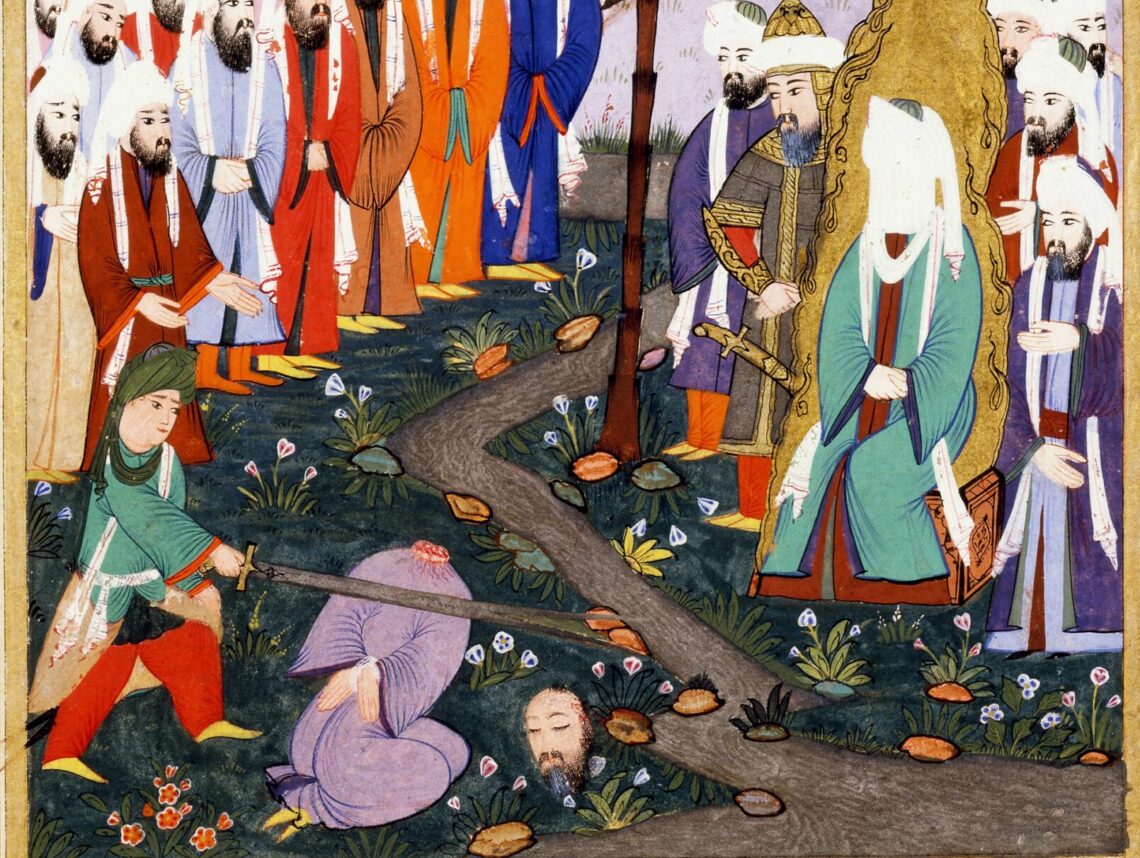
ʿAlī beheading Nadr ibn al-Harith in the presence of the Prophet Muhammad, from the Siyar-i Nebi (Life of the Prophet), Ottoman miniature, Istanbul c. 1594. The David Collection, Copenhagen (acc. no. 5/1985), public domain.
The Qur’an is believed to be uncreated, eternal, and preserved on heavenly tablets (Surah 85:22). According to Islamic belief, it was revealed to Muhammad between 610–632 A.D. and finalized under Caliph Uthman around 652 A.D. Muslims traditionally maintain that the Qur’an has remained completely unchanged for over 1400 years. Therefore, the Qur’an is viewed as a text that is word-for-word and letter-for-letter perfect, identical to its heavenly copy.
Christians, however, do not believe the Bible is uncreated. Rather, Christians believe the Bible was written by human authors inspired by God. It was not sent down from heaven as a completed book but written through divine inspiration over time. Christians hold that the Bible was complete in its original writings, though it has undergone minor textual variations through manuscript transmission. These differences are generally considered small and not affecting core Christian doctrines.
A comparison often made is that Muslims believe about the Qur’an what Christians believe about Jesus. Christians believe Jesus is perfect, while Muslims believe the Qur’an is perfect. The Bible testifies about Jesus, whereas for Muslims the Qur’an itself is viewed as the perfect and sufficient revelation for salvation.
Because of these differing theological claims, manuscript variants carry different significance for Christians and Muslims. To challenge the claim that the Qur’an is a perfect heavenly copy preserved without change, it would theoretically require only a single proven textual error or alteration.
Islam is therefore seen as heavily dependent on the perfect preservation of the Qur’an, while Christianity is viewed as dependent primarily on the perfection of Jesus Christ rather than the perfection of biblical manuscripts.
The Qur’an is said to have been finalized under Uthman in 652 A.D., consisting of 114 surahs, and preserved unchanged until the standardized 1924 Cairo edition based on the Hafs reading tradition, which is the most widely used version today.
Sources for Qur’anic Compilation
Much of the traditional narrative concerning the compilation of the Qur’an comes from the hadith collections of Al-Bukhari (870 A.D.), writing approximately 218–238 years after the death of Muhammad. According to Bukhari, five official copies of the Qur’an were distributed to major Islamic centers: Medina, Mecca, Basra, Kufa, and Damascus.
However, multiple Qur’anic versions and readings emerged in the centuries that followed. Reports exist of Qur’ans differing in the number of surahs (110 versus 114) as well as thousands of textual differences. None of the original 7th-century codices attributed to Uthman survive today in complete form.
All five early Islamic centers remained under Muslim control during this period. Early Qur’anic manuscripts such as the Samarkand manuscript and the Sana’a manuscripts still exist, but they are incomplete and contain textual variations.
By comparison, early biblical manuscripts such as Codex Sinaiticus and Codex Vaticanus from the 3rd and 4th centuries preserve nearly complete copies of the Bible. Additionally, there are hundreds of New Testament manuscripts predating the 7th century.
Development of Arabic Script
Early Arabic manuscripts lacked both dots and vowel markings. At the time, only around 16 letter forms could be distinguished, compared to the 28 Arabic letters recognized today. Dots were gradually added during the 8th century, while vowel markings developed in the 8th and 9th centuries.
Since Arabic pronunciation depends heavily on vowels and diacritical marks, the absence of these features in early manuscripts allowed for multiple possible readings and recitations of the same consonantal text.
According to Islamic scholar Shady Nasser, there were hundreds of Qur’anic reading traditions circulating in the early centuries of Islam. Over time, various reciters and transmitters gained recognition. Among them was Hafs (d. 796), whose transmission later became dominant.
Ibn Mujahid (d. 936) eventually canonized seven accepted readings. Later scholars such as Al-Jazari expanded the recognized readings to nine or ten, while Al-Shatibi discussed additional traditions.
Variants Between Qur’anic Readings
There are reported to be tens of thousands of textual differences between the Hafs reading and other accepted readings of the Qur’an. The Hafs tradition is used by the majority of Muslims worldwide today. A Turkish woman, Hatun Tash has publicly displayed multiple regional Qur’anic editions and translations to demonstrate textual differences between readings used across the Muslim world.
In a well-known discussion with islamic apologist Mohammed Hijab, Islamic scholar Dr. Yasir Qadhi was asked which Qur’an represented the “real” Qur’an. His answer was that all canonical readings are considered authentic within Islamic tradition. Critics argue that this raises questions regarding whether the earliest forms of the Qur’an differed substantially from one another.
Comparisons between the Hafs and Warsh readings reveal thousands of word-level differences, although Muslim scholars typically argue that most variations involve pronunciation, dialect, spelling, or minor wording differences rather than major doctrinal changes.
Earliest Qur’anic Manuscripts
Critics of Qur’anic preservation often point to several observations regarding early manuscripts:
No complete Qur’an manuscript from the 7th century survives today.
Existing early manuscripts are incomplete.
Early manuscripts do not fully agree with one another.
No early manuscript matches the modern 1924 Cairo Hafs text exactly.
Manuscripts contain numerous textual variants.
This leads critics to ask: where is the original complete Qur’an?
Textual researcher Daniel Alan Brubaker has documented manuscript alterations including erasures, insertions, overwriting, corrections, and selective covering in various Qur’anic manuscripts. He argues these demonstrate an evolving textual tradition over time.
The 1924 Cairo Edition
The modern standard Qur’an used throughout much of the Muslim world largely derives from the 1924 Cairo edition. This edition was produced in Egypt to standardize Qur’anic recitation and education after confusion arose from the use of different readings in schools and examinations.
Ali al-Husayni al-Haddad and other scholars selected the Hafs transmission as the official Egyptian standard. Stories persist that alternative school copies were destroyed or discarded, though multiple canonical readings continue to exist and are still printed and used in different regions today.
The Hafs edition later spread widely through Saudi Arabian printing efforts, especially through the King Fahd Complex established in 1982.
Conclusion
Critics argue that manuscript evidence, textual variants, and the existence of multiple accepted Qur’anic readings challenge the claim that the Qur’an has been perfectly preserved without any variation from its original heavenly form. For readers interested in this topic, Daniel Alan Brubaker’s Quranic Manuscripts is frequently recommended by critics as a source documenting textual alterations and manuscript evidence.
According to Islamic belief, the Qur’an is considered the greatest miracle and the most perfect revelation. However, modern textual criticism has made it impossible to believe this anymore. Supporters of Christianity often argue that Christians place ultimate faith not in the perfection of manuscripts but in the person of Jesus Christ. By contrast, they argue that Islam’s claims regarding the Qur’an depend much more directly upon textual perfection and preservation.As a result, debates regarding Qur’anic preservation continue to play a significant role in Christian-Muslim apologetics and interfaith discussions today. Dr. Jay Smith’s research can be found at his youtube channel, Pfander for further investigation.