



These days, many of us are deeply shaken by the way Lillian Gran and her children are being treated by the apparatus of power. On that occasion, I would like to tell a story that lies very far back in time, but which illustrates that abuses of power against individuals are nothing new when it comes to the Labour Party.
The flight to Sweden
My father was a 14-year-old child living in an orphanage who was active in distributing illegal newspapers into people’s letterboxes in 1942. When their network was about to be rolled up by the Nazis, he too was warned and fled to Sweden. After a journey he barely survived, he ended up at the Kjesäter refugee reception centre. From there he was sent around to farms and eventually ended up as a dock worker in Uppsala together with his brother, who had also fled. When the Savoy Hotel in Malmö advertised for waiters, they both applied and obtained positions there.
In March 1945 they were ordered to install bunk beds in all the hotel rooms. When the white buses arrived carrying prisoners from Germany, they stood on the steps dressed in waiter uniforms with freshly ironed cloth napkins neatly folded over their left arms, completely unaware of what awaited them. “We could hear the bones rattling in those who were able to walk under their own power,” they recounted. Long story short: They remained as carers at the hotel until the last patient was discharged in June 1945.
The return to Norway
Both brothers enlisted in what later became known as the Home Guard when they returned to Norway, aged 17 and 18. They wore military uniforms and were ecstatic participants among the crowds at Akershus quay who hailed King Haakon when he and the Queen arrived by boat into the Oslofjord on 7 June 1945.
Two days later they received the order that would change their lives forever and haunt them until their deaths.
“German girls”
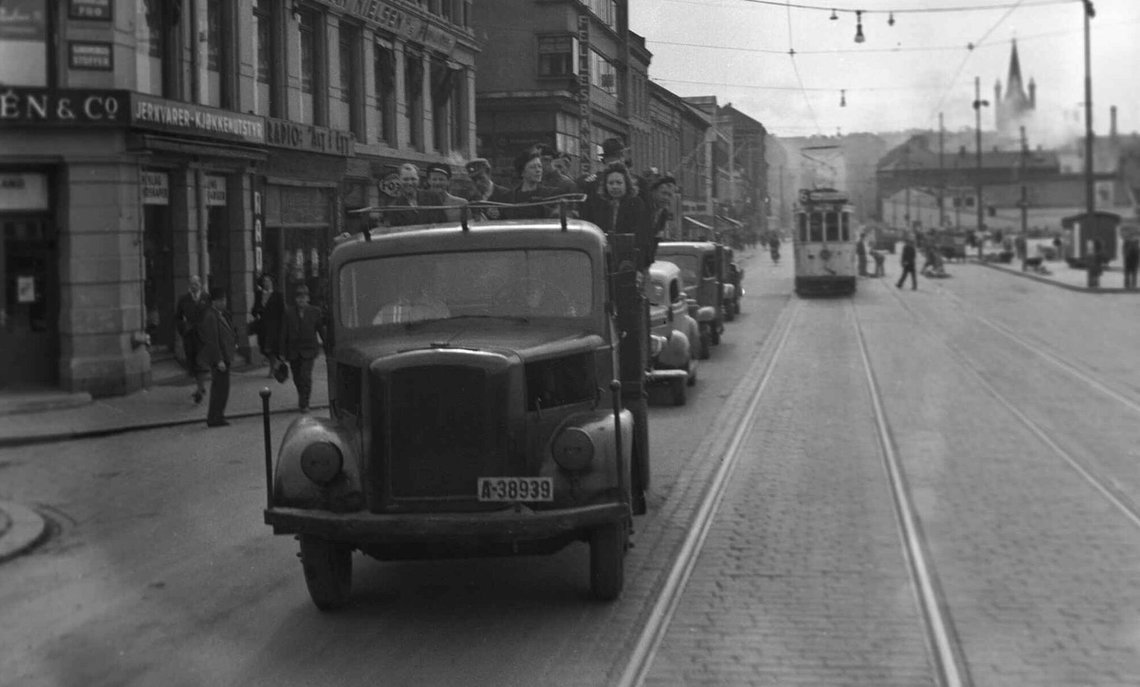
The order was that they were to serve as auxiliaries on open lorries that would collect “German girls” (tyskertøser) from Kampen and other places in Oslo, transport them to Egertorget and abuse them in front of the spectators who had gathered there. They refused. After what they had experienced at the Savoy Hotel in Malmö, abusing any human being was unthinkable to them. They were dismissed on grey paper.
Dismissal on grey paper was a very serious stigma at the time. My father obtained jobs in Oslo, but after only a few days he would be met at the door and told he was not welcome. The apparatus of power had quite obviously informed the employers of his “status”. It was his first experience of being persecuted by the Labour Party’s elected representatives.
The way out
People who received “dismissal on grey paper” after the war had only a few ways of earning a living. One of them was to go to sea. That is how my father ended up with Fred Olsen on a ship in foreign service and did not return to Norway until 1954, equipped with a medal of honour for having saved many people during a shipwreck in the Bay of Biscay.
He got a factory job, married and had children. Later he became a shop steward at the workplace, and in the run-up to the EEC referendum in the late 1960s he was an active and outspoken opponent. In his eyes, the EEC was an attempt to complete Hitler’s ideology of uniting Europe into a great power.
The abuse of power
Long story short once again: My father was placed in a straitjacket and collected by “black Marias”. Black Marias at that time were vehicles from the German era that had been painted over with white paint and red crosses.
He was diagnosed with paranoia and what they called psychopathic traits. For five long years he was forcibly confined behind thick psychiatric walls. When he was released, he chose to keep his head down and simply survive.
The Lund Commission
One would have thought that the Lund Commission’s revelations in 1996 would have made my father feel that he had received a kind of vindication, since he was listed there. But he had long since resigned himself, and merely observed that the “paranoia” for which he had been diagnosed and forcibly institutionalised was a deception he had neither the strength, money nor power to do anything about. And so he died.
We must stop blaming the system.
“The system” is nothing more than an individual with power who lays down directives that the others in the apparatus of power choose to go along with for fear of losing their jobs, standing or position. That was how it was when my father was taken away in a straitjacket when I was a small child, and that is how it is today in Lillian Gran’s case.
“Directives” always come from the top. And it is none other than the Prime Minister’s Office, which today, as on so many occasions before, is the Norwegian Labour Party.


