

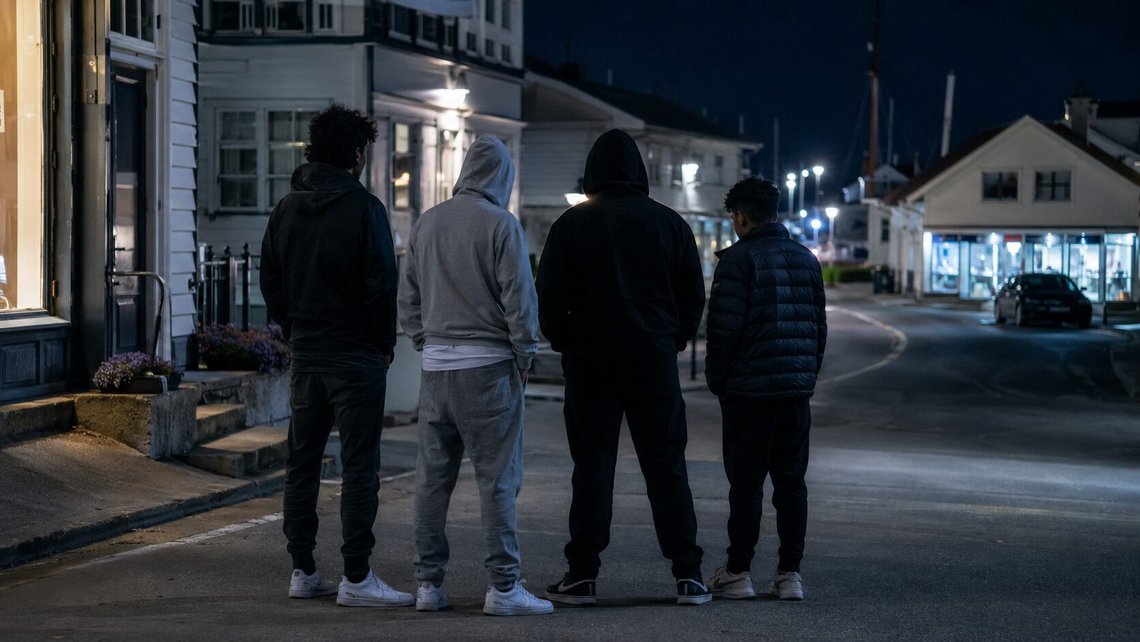


Three videos show four young men of immigrant background repeatedly striking and kicking a man in the head in the centre of Kragerø. The victim was admitted to hospital and suffered extensive injuries. Nevertheless, none of them received a prison sentence.
On the night of Sunday 27 July 2025, “Henrik Larsen” was on his way through the centre of Kragerø to buy a packet of cigarettes at Narvesen. He had been at a wedding and was heavily intoxicated.
In P.A. Heuchs gate he encountered four young men. They were between 15 and 21 years old. All had immigrant backgrounds. All were intoxicated.
What happened afterwards is documented in three videos shown in court.
All names in this case are fictitious. The judgment is subject to anonymisation pursuant to section 130, first paragraph, of the Courts of Justice Act.
Tricked him with fake cocaine
Larsen approached the youngest, Samir (15), and asked whether they had cocaine. Samir and Youssef (16) pretended that they did. They asked how much money he had and how much he wanted.
When Larsen realised they were deceiving him, he became angry. According to one of the defendants, he called them “cunts”. Youssef took the glasses from his breast pocket to irritate him. Larsen waved his arms, pushed Samir and struck Youssef on the arm.
Then the violence began.
Held him down while they hit him
Three films were shown in court. They depict a sequence of events in several phases.
In the first film, Omid (21) holds Larsen’s head down while Dariush (17) strikes him three times in the head area. At the same time, Samir kicks him in the face. Dariush kicks him in the back with a jump.
In the second film, Samir kicks him again. He then throws around 20 rapid punches with both hands while Dariush and Omid hold Larsen down. Youssef follows with his “guard up” and lands one to two additional blows.
In the third film, the violence continues. Samir kicks or stamps on Larsen so hard that he loses his shoe. Omid explained that he struck twice during this phase, but this is not visible in the film.
Only Youssef attempted at one point to stop the others. The court gives him limited credit for this because he had been the “most persistent immediately prior” to the assault.
Hospitalised for three days, neck brace for weeks
Larsen was admitted to hospital for three days. There was suspicion of displacement injuries to his back. He had to wear a neck brace continuously for one week, and thereafter intermittently for six to seven weeks. He suffered considerable pain in his back, neck and face for a couple of months. He was unable to drive for three weeks. He could not run, play squash or take longer walks.
Larsen had an eight-month-old daughter. In the weeks after the assault, he could barely contribute at home. He experienced sleep problems, nightmares and flashbacks. He has not returned to Kragerø since the incident, despite invitations from friends and family. He does not perceive the town as safe.
Document depends on good tips from our readers. Do you have a tip? Send it to our journalist.
No one received a prison sentence
The three youngest received juvenile sanctions lasting nine months. This means the cases are transferred to the Mediation Service, where they are to attempt to agree on what the convicted persons must do to avoid imprisonment. The subsidiary prison sentence is between 50 and 75 days.
Omid received 116 hours of community service.
The court writes that “the clear starting point for offences under section 272 of the Penal Code is unconditional imprisonment” and that “strong general preventive considerations apply with considerable force.” Nevertheless, none of the four received a single day in prison.
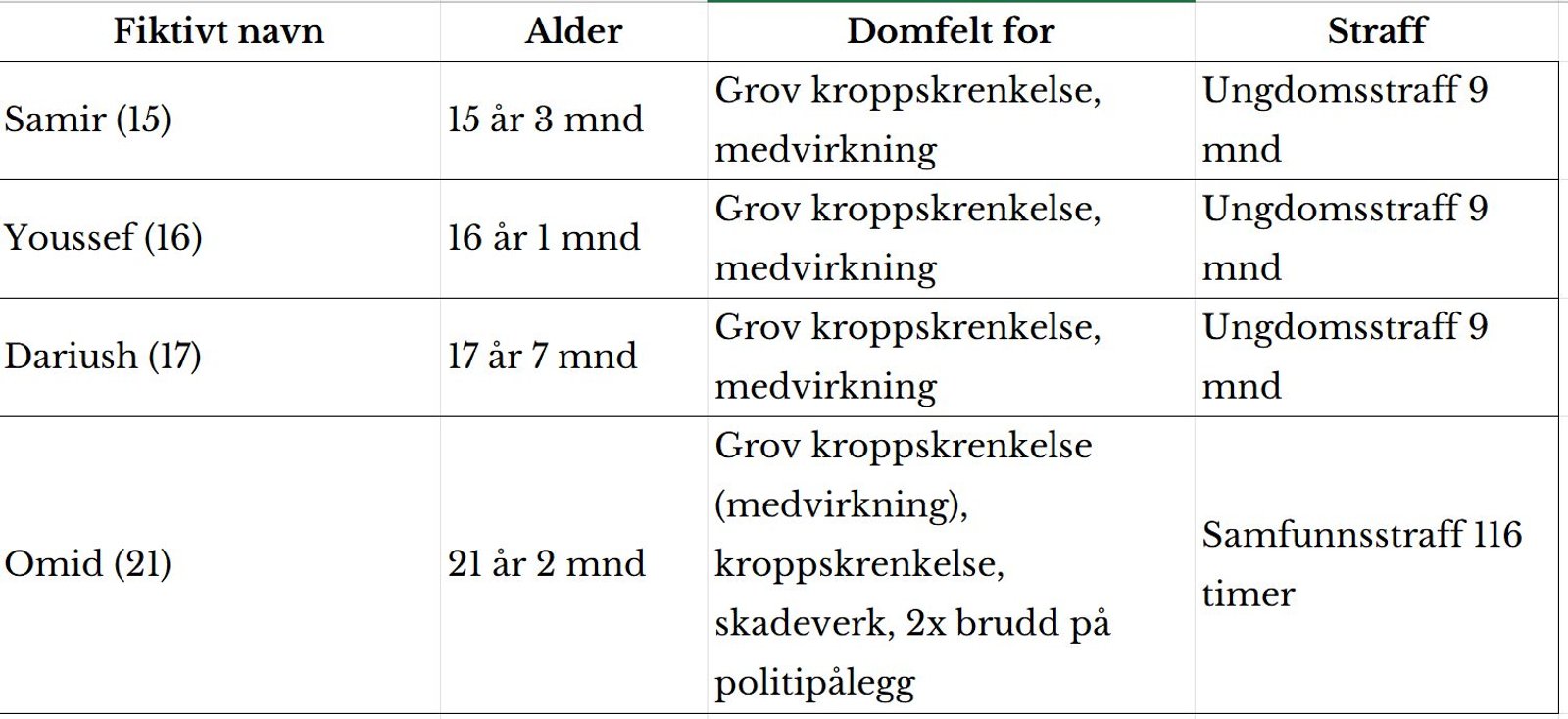 Despite grievous bodily assault, none of them received a prison sentence. Not even the 21-year-old Iranian who had also threatened to kill his own mother.
Omid: Repeat offender with a long criminal record
Omid also faced a separate indictment that the court dealt with in the same case. He was additionally convicted of striking another man in the face with a clenched fist on 17 May 2025 at Kragerø stadium, for criminal damage at his mother’s home where he smashed a window and destroyed a clothes rack, and for violating police orders twice in June 2025.
Four counts in the original indictment against him were withdrawn by the prosecutor. Among these were threats against his mother, where according to the indictment he had said that he would go home, fetch a weapon and shoot her, and reckless behaviour where he threw a knife to the ground and told his mother he would kill everyone.
Omid has previously received fines for bodily assault and has been before the Mediation Service for violence. The court describes that he has experienced “serious trauma and abuse both in his home country and in Norway”, has “significant psychological challenges” and “sleep problems”. A child welfare employee described him as “tough on the outside, but insecure, vulnerable and in need of care.” The risk of relapse into substance abuse and criminality is described as “high” if he is imprisoned.
For all of this combined, he received 116 hours of community service.
Social inquiry reports: “Vulnerable life situation”
For all four convicted persons, the court and the Correctional Service point to vulnerable life situations, integration challenges, substance abuse problems, mental health issues and a need for interdisciplinary follow-up. Samir has “limited residence time in Norway” and “previous burdensome experiences”. Youssef has “conflicts with the police” and “school-related challenges”. Dariush has “connections to a troubled environment” and lives alone with aftercare from the child welfare services. He failed to attend appointments for social inquiry assessments with the probation service.
In all cases, the court places decisive weight on individual preventive considerations. The sentence is intended to help the convicted persons, not to mark a consequence for the victim.
The injured party, Henrik Larsen, received NOK 30,000 in compensation for non-pecuniary damage. Jointly and severally between the four.
The professional judge in the case was Martine Høhrbye, and the lay judges were Stein Erik Amlie and Rebekka Nylund Grindheim.


