



– To “acquire for oneself” refers to the name or reputation one attains through one’s own deeds. This perspective can be transferred to our political decision-makers as an exhortation to acquire for themselves a name that will endure into the future – especially with regard to the struggle against antisemitism and the safeguarding of just and equal treatment of Jews on a par with other fellow human beings.
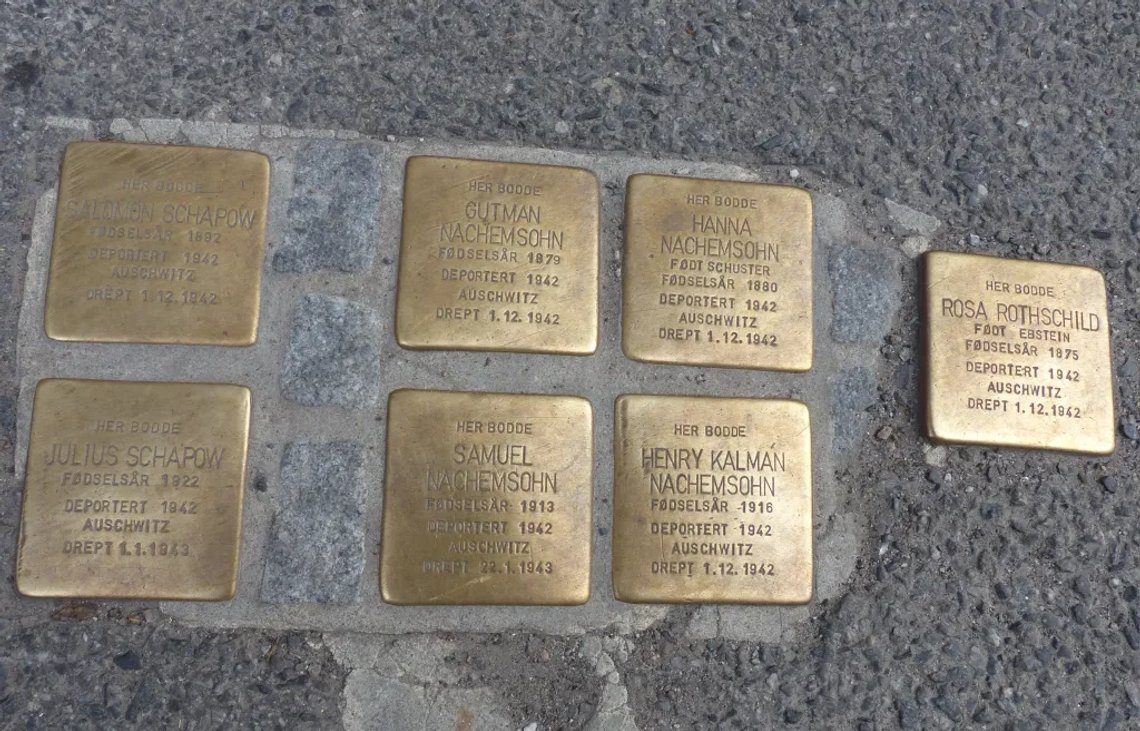
Last week we could read that 11 of the 19 Stolpersteine (stumbling stones) in Brugata in Oslo were once again subjected to vandalism by unknown perpetrators during the night of Monday 11 May. It is not the first time these stones have been desecrated; the same stones were also vandalised in September 2016. Other stones were defaced as recently as last year.
The police’s own experts on hate crime initiated a report on their own initiative, and the case was investigated with a view to determining whether the act fell under the category of hate crime directed against Jews. Unfortunately, the investigation was already discontinued on 18 May. One actor who was quick to comment on the matter on her Facebook page, but who neglected to report the matter to the police, was Oslo’s Mayor, Anne Lindboe (Conservative Party). This leaves us with the question of whether hate crime against Jews is preferably to serve merely as a means of attracting attention on social media, while corresponding acts against other population groups are immediately reported to the police.
The Stolpersteine project was initiated by the German artist Gunter Demnig, with the purpose of establishing individual memorials for each victim of the Nazi Holocaust. Around 100,000 such stumbling stones have now been placed across large parts of Europe. The concept is based on the idea of a stone one may symbolically “stumble” over, and then pause and show respect, so that the victims are not consigned to oblivion. By “stumbling” over the stone and reading the name, the memory of the deceased is reconstructed, thereby preventing the individual from being forgotten.
The idea is undoubtedly a good one, but not everyone agrees with the placement of the stumbling stones in locations where anyone may tread upon them. The scepticism towards stumbling stones as memorials is linked to the perception that stepping on them feels disrespectful, as well as concern regarding their effect in a society characterised by a marked increase in antisemitism. In Munich the project was halted following strong reactions from, among others, the local Jewish community, including the Central Council of Jews in Germany.
For the Jewish community, the stumbling stones represent more than mere memories of individual persons; they serve as guarantors that the victims of the Holocaust are not forgotten. The Jewish Museum in Oslo introduced the project in Norway in 2010. Since then, several hundred stones have been laid from Tromsø in the north to Larvik in the south, in memory of the Norwegian Jews who were murdered. The Jewish Museum in Oslo itself constitutes an important and significant “stumbling stone”; a central site of remembrance, both physically and symbolically. The museum obtained its premises in 2008 in Calmeyers gate, in the synagogue erected by the Den israelittiske congregation in 1920, with Erik Fjeld as architect and decorator. The synagogue was inspired by the Great Synagogue in Frankfurt am Main, and the result demonstrates that the small congregation spared no expense in creating a magnificent building.
The building was used as a synagogue from 1921 until 1942, when the Jews were rounded up and sent to their deaths. Nineteen of the total 28 Jews who lived in the building, many of them children, were deported and murdered in Auschwitz. It was from here that the largest number of Jews were arrested in one and the same place in Norway. Each of the 19 victims has been given a stumbling stone on the pavement directly outside.
Today their memory is being desecrated anew. There is little doubt that forces exist in society which harbour hatred towards Jews, living as well as dead. What will it take for politicians to awaken and realise the gravity of the precarious antisemitism to which we innocently are subjected in this country?
Now that antisemitism has reached levels we Jews have never previously experienced, the protection of Jewish memorials ought to be reconsidered. This may be done, among other things, by implementing Norway’s legislation against hate crime in such a way that it may de facto also apply to those who have Jews as their target.
Here we may mention, among other things, Oslo City Council’s decision that a new action plan “Words Mean Something” against hatred, prejudice and discrimination is to be promoted for a new planning period from 2026–2030. Is the city council courageous enough to ensure that antisemitism is seriously addressed in the plan?
We continually experience harassment from those who dream of a world free of Jews. Can we Jews not at the very least be spared having our names and our memory trampled upon?
Every person has a name
In connection with the stumbling stones, it is meaningful to mention an important poem by the poet Zelda: “Every person has a name”. The poem was published in 1974 and gave its name to the Yad Vashem Foundation’s memorial project “Every Man Has a Name”. It is recited on national holidays and days of remembrance in the State of Israel, including during the reading ceremony of the names of those who perished in the Holocaust.
The year after its publication, the poem was set to music by Hanan Yuval, and first performed by Hava Alberstein on her album “Kmo Tzemach Bar” (Like a Wildflower, 1975). A link to this legendary performance is provided here.
Every person has a name
Every person has a name
given by God and by his parents.
Every person receives a name
from his body, his smile, his fabric.
Every person receives a name
from the mountains around him, from the walls that enclose him.
Every person receives a name
from the stars above him and from the neighbours by his side.
Every person receives a name
from his missteps and from his deepest desire.
Every person receives a name
from those who hate him, and from the love he gives.
Every person receives a name
from his holidays and from his work.
Every person receives a name
from the seasons that shape him, and from the blindness he bears.
Every person receives a name
from the sea that surrounds him –
and from the death that in the end gives him a final name.
(Zelda, 1974)
The fundamental structure of the poem is a dialogue with the Jewish sages’ Midrash, in which the following is conveyed:
“There are three names given to a person: One which his father and mother give him, one which the world gives him, and one which he acquires for himself. Best of all these is the name a person acquires for himself.”
To “acquire for oneself” refers to the name or reputation one attains through one’s own deeds. This perspective can be transferred to our political decision-makers as an exhortation to acquire for themselves a name that will endure into the future – especially with regard to the struggle against antisemitism and the safeguarding of just and equal treatment of Jews on a par with other fellow human beings.


