



Islamopopulism is marching across Europe while politicians and media look the other way. A new British report shows that large groups of Muslim voters support bans on Quran burnings, the introduction of gender segregation, and in some cases even violence — while both old and new political parties compete for their votes.
Islamopopulism. If you are not already familiar with the term, now is the time to start Googling it. A recent British study suggests that Europe will soon have to confront the consequences of Islamopulism in everyday life.
The findings presented in the report Understanding Islamopopulism – Views of Concern should send chills down the spine of every European. Yet the silence is striking. Not a word in our media, no debate in Riksdag or Storting, not even in the European Parliament. Ask a random passerby in Stockholm, Oslo, or Copenhagen, and you will probably get nothing more than a puzzled look in return. Islamo-what..?
ChatGPT defines “Islamopulism” as follows:
“Islamopopulism is a form of populism in which Islamic identity, religious language, or Muslim issues are used to mobilize ‘the people’ against perceived elites, threats, or opponents.”
The report was published by Britain’s largest think tank, Policy Exchange, and in the foreword the authors explain its purpose:
“Policy Exchange’s programme is dedicated to understanding Islamopopulism: its goals, its methods and from where it draws its supporters. Such scrutiny has hitherto been turned upon right- and left-populism, but to a much lesser degree on Islamopopulism. What does Islamopopulism want? How far does it fit the classic populist template? How much does it reflect the actual views of British Muslims? Are the independent candidates really independent, or are they working together? Is TMV a ‘Muslim Momentum’, a central organising body akin to the Jeremy Corbyn fan club? What links has the movement to Islamism and other movements hostile to democratic values? What are the issues, values and policies they are seeking to advance, and how far do they align with the views of the majority in this country?”
Today, around four million Muslims live in the United Kingdom, and until quite recently eight out of ten voted Labour. But something has changed: movements such as TMV [The Muslim Vote is a British campaign supporting parliamentary candidates in constituencies with significant Muslim electorates; editor’s note] and Vote Palestine are campaigning among the country’s Muslims to persuade them to abandon Labour and instead vote for parties such as the Green Party and Your Party — with considerable success.
Hundreds of Muslims recently won seats in British local elections. Sadiq Khan has governed London as a Muslim mayor since 2016, while Manchester and Birmingham are represented by Muslim ceremonial mayors.
The positions are advancing, and the old parties are competing to adapt to the growing voter bloc.
In Sweden, the process has not progressed as far, but we are seeing parties such as Partiet Nyans, Enhet, Visionspartiet, Enighetspartiet, and Framtidens Vänster emerge. They all have one thing in common: they are Islamopopulist parties, targeting dissatisfied, demanding Muslim voters who traditionally support Sweden’s Social Democrats, Left Party, Greens, and Centre Party — a voter group those parties are desperately fighting to retain at any cost.
So what do these Islamopopulists want?
Understanding Islamopopulism surveyed the views of 1,006 Muslim voters. Through numerous charts and characteristically restrained British phrasing, values emerge that, from a Western European democratic perspective, are deeply alarming:
- 85% said their religious identity is important to their personal identity.
- 63% want desecrating the Quran to be criminalized.
- 59% support introducing a tax to rebuild Gaza.
- 56% described their religious identity as “very important.”
- 52% want depicting Muhammad to be criminalized.
- 48% want all Israeli-produced materials banned from British healthcare.
- 45% believe Jews have too much influence over the media.
- 32% support gender segregation in public spaces.
- 26% want dogs banned from public places.
- 25% say views on Israel–Gaza determine which party they vote for.
- 25% view Hamas positively.
- 24% believe violence is acceptable if someone displays an image of the so-called prophet (17% said they were unsure, and 10% declined to answer).
- 23% view the Islamic Revolutionary Guard Corps positively.
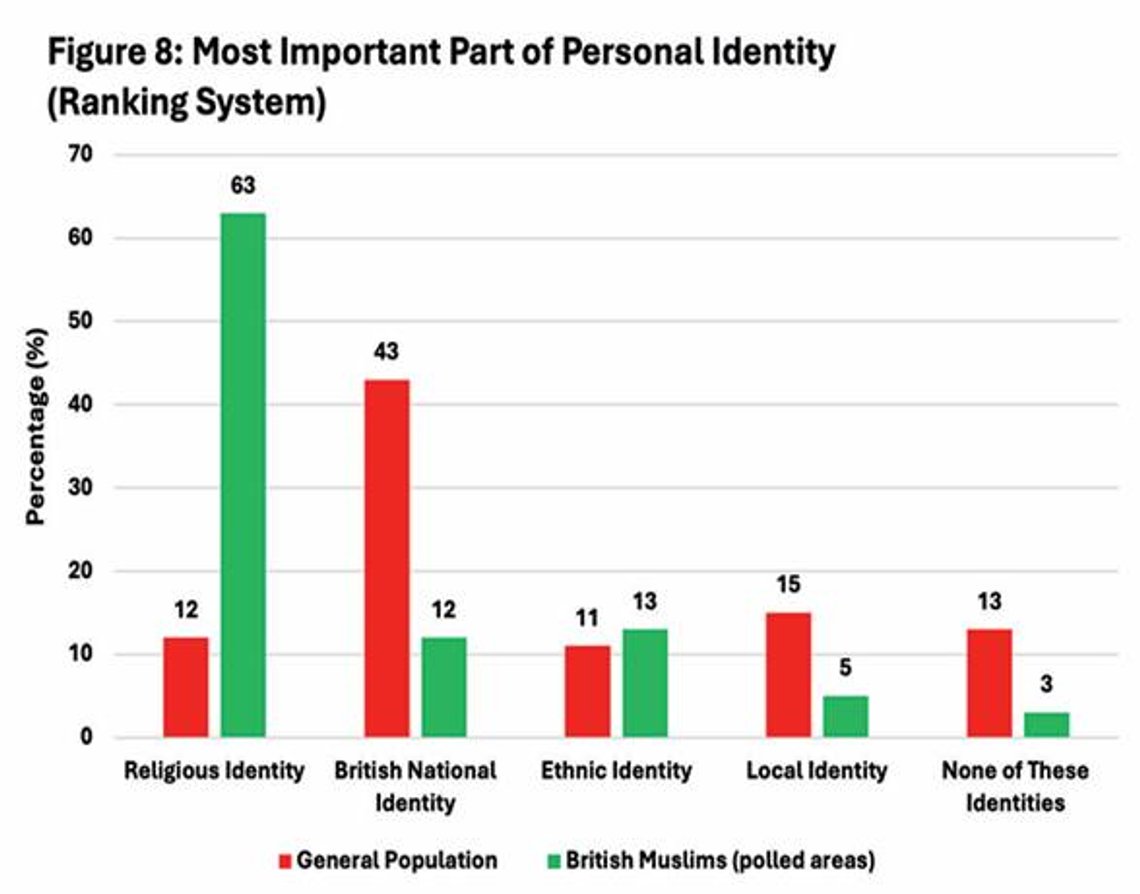
The differences between the Muslim group and the rest of the population are most evident in three areas: views on their own identity, attitudes toward Jews, and the right to depict the so-called prophet.
We do not know what the situation looks like in our own countries. Sweden and Norway are not prepared to conduct equivalent studies, but there is little reason to believe the results would be substantially different here.
We therefore need to ask ourselves what the future looks like in nations where demographics and continued immigration increase the share of voters holding similar views — voters whose support both old and new political parties are competing to win.
The report’s central message is therefore this: Islamopopulism is a force that must be reckoned with — and confronted while there is still time.
Islamopopulist parties in Sweden:
Partiet Nyans (The Party Nuance): Founded in 2019 by Mikail Yüksel after he was expelled from Sweden’s Centre Party due to alleged ties to the Turkish Grey Wolves. The party strongly profiles itself around issues concerning discrimination against Muslims, criticism of Sweden’s social services, and opposition to Quran burnings. Nyans has often been described as an identity-politics-oriented and Muslim-focused party.
Enhet (Unity): Founded in 2020 by former Social Democratic politician and imam Ahmad Al-Baldawi and presents itself as a party for “diversity and inclusion.” The party has focused on issues such as Islamophobia, Palestine, and minority representation in Swedish politics.
Visionspartiet (The Vision Party): Founded in 2021 by Rene Leon Rosales, a former Social Democratic local politician in Malmö. The party has strong roots in immigrant-dense communities and focuses on social justice, segregation, and minority issues. It has particularly sought to attract Muslim voters who feel betrayed by established left-wing parties.
Enighetspartiet (The Unity Party): Founded in 2025 by former Social Democratic MP Jamal El-Haj after he was urged to leave the Social Democrats. El-Haj had, among other things, participated as a speaker at a pro-Palestinian conference with alleged links to Hamas. The party says it focuses on international solidarity, equality, and issues engaging Muslim voters.
Framtidens Vänster (The Left of the Future): Founded in 2025 by former Left Party MPs Lorena Delgado Varas and Daniel Riazat following their conflict with the Left Party. The party emerged from activist circles and seeks to combine radical left-wing politics with strong identity-political profiling and support among younger and immigrant voters.


