

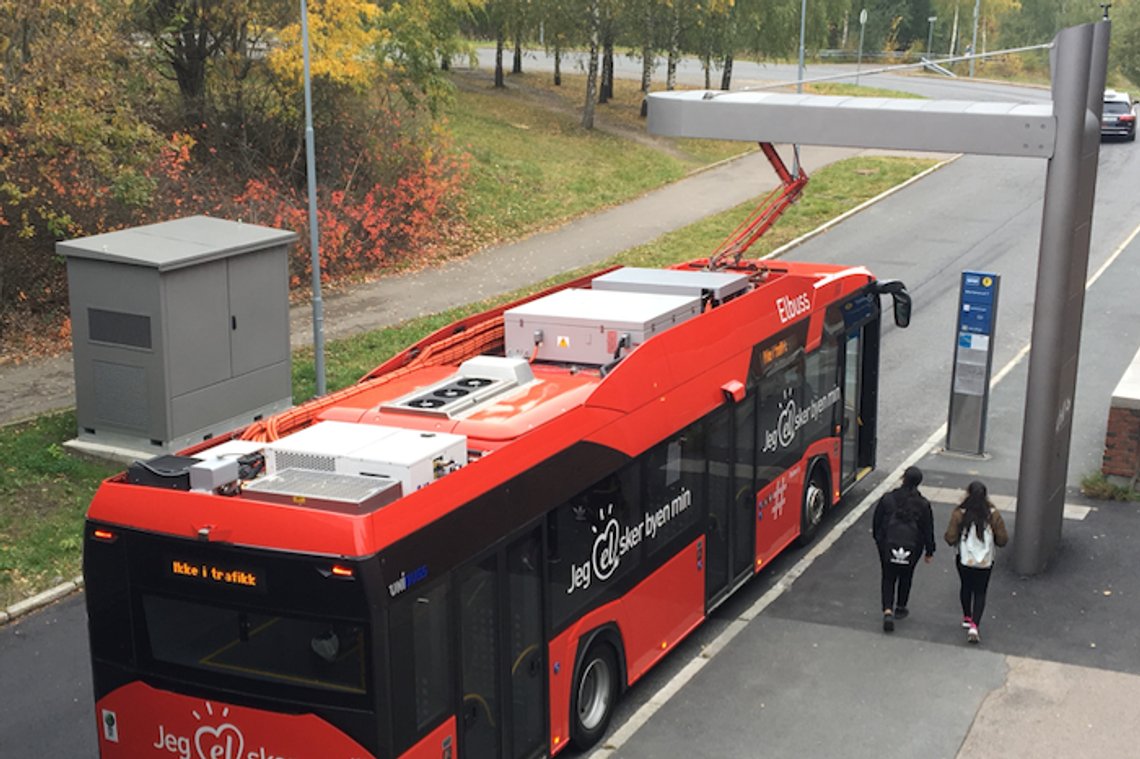


Transport Councillor Marit Vea (Liberal Party) wants to shatter the myth that the electric buses do not function.
New calculations from Ruter are intended to show that electrification pays off, and in an interview with Avisa Oslo the councillor points out that lower fuel costs make Oslo more robust against price shocks in the energy market.
There is, however, a problem with the calculation: It does not include the investment costs.
Ruter purchased 70 electric buses in 2019, for NOK 479 million. They were displayed with great festivity at Rådhusplassen. With charging infrastructure and operation, the bill rose to NOK 850 million, corresponding to one billion 2026-kroner. All of these buses have now been withdrawn from service, partly because the charging systems became outdated and partly because they did not satisfy new safety requirements.
Avinor purchased 13 of them for use at airports. Forty-one were sold to a Norwegian acquirer which resells them to the European market.
For the new contracts entered into from 2022 onwards, Enova contributed up to NOK 125 million solely for charging infrastructure at two bus depots. One single contract for the Inner City with 180 buses has a total contract value of NOK 7.2 billion over 14 years.
– We have not changed the bus fleet primarily in order to save money, but because we are to achieve the climate targets. Nevertheless, we now see, with a fossil crisis, which the world is experiencing, that it pays off as well, says Transport Councillor Marit Vea (Liberal Party).
The operational problems at the time, however, did not take long to appear. When the winter of 2023 arrived with sub-zero temperatures, the buses collapsed. More than 1,000 departures were cancelled at the worst point during a single day. Ruter had to bring back old diesel buses. They called it a “shortage of vehicles”, but the truth was that it concerned electric buses that would not start, would not take charging, or had lost too much range to remain in scheduled service.
A structural problem moreover makes the calculation even more demanding. Electric articulated buses have room for 104 passengers, compared with 127 in a corresponding diesel bus. Shorter range and charging requirements moreover require more buses to cover the same route. According to Ruter’s own calculations, one needs 10 to 12 per cent more buses when transitioning to electric buses.
Independent analyses have suggested that the figure may be far higher in practice.
The fuel savings Vea now highlights therefore cover a small part of the total cost picture.
– When one is an early adopter of new technology, one must bear the investment cost of that technology, says the councillor.
TØI researcher Jørgen Aarhaug agrees that the electric buses will become relatively cheaper going forward. But the billions that have already been spent – and the buses that have already been scrapped – are not included in the calculation Vea presents as proof that the myth has been shattered.


