

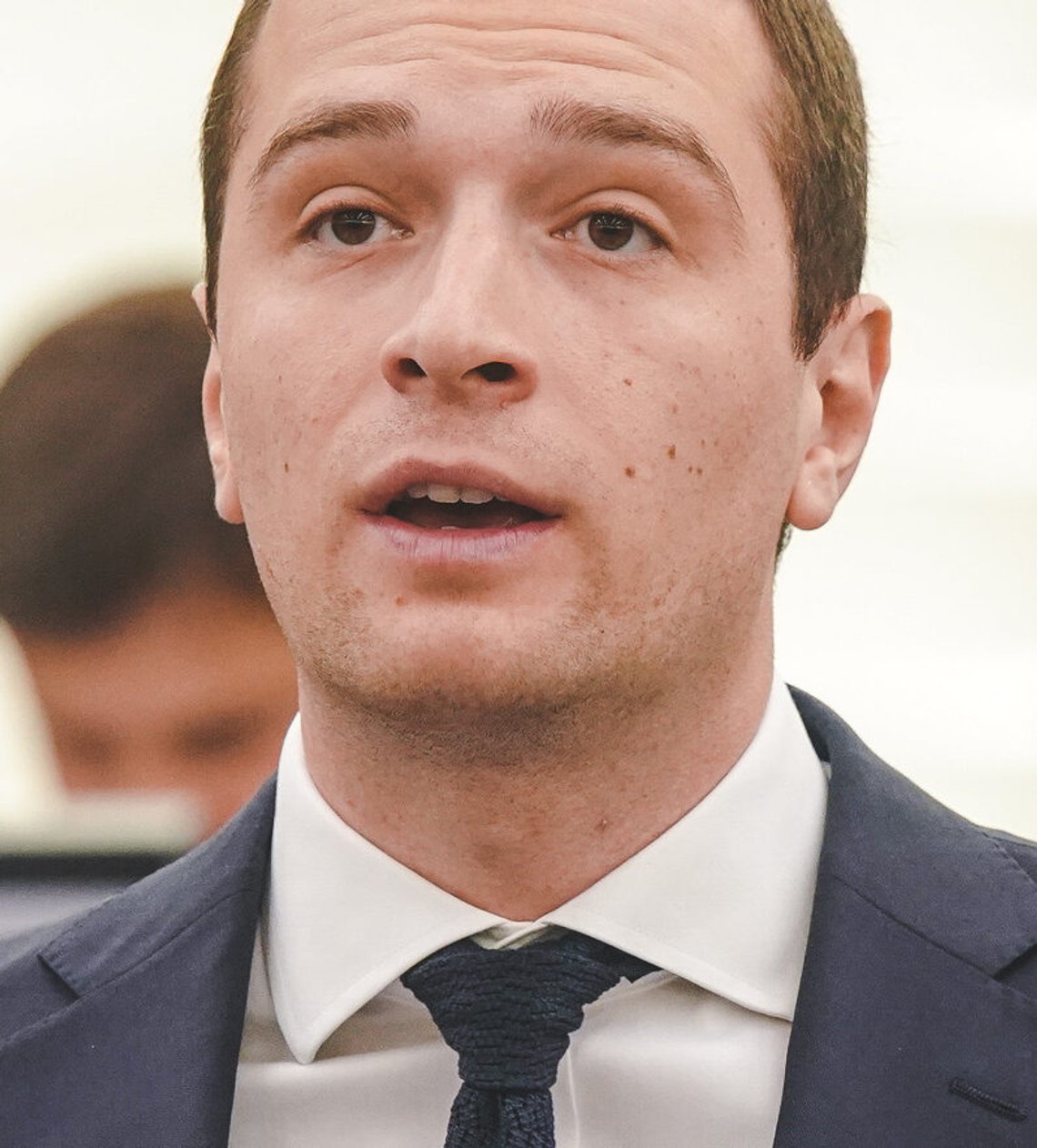


There will be a presidential election in France in 2027, and opinion polls are already indicating that Jordan Bardella, Marine Le Pen’s successor as the leading figure of Rassemblement National (RN), would win the election regardless of who becomes his opponent in the second round.
In an interview with the German newspaper Frankfurter Allgemeine roughly a year before the election, Bardella signals major changes in French politics should he become president.
Bardella extends a kind of hand to Europe’s old Right as he praises Germany’s Chancellor Friedrich Merz (CDU) on migration policy and on “the question of reducing bureaucracy and the necessity of building a competitive Europe”, but he also marks out differences, above all in climate policy:
As leader of the largest opposition group in the European Parliament, I am waging a political struggle against the Green Deal and against the European Commission under the leadership of Ursula von der Leyen, which is partly responsible for Europe’s economic decline. In migration policy as well, I agree with the Federal Chancellor. Germany has reintroduced border controls, which have a deterrent effect. France and Germany could, in this matter, together with the support of Italy, envisage renewed cooperation.
Bardella is not opposed to immigration, but wants it to benefit France:
We bring in people with low qualifications and allow our brightest minds to emigrate. We want France to remain open to those who come to us with the willingness to work and contribute to economic success. We are striving for a restrictive shift in immigration policy.
What would this look like concretely?
Our national legislation must take precedence over EU legislation in immigration policy. Those born in France should no longer automatically receive citizenship. Asylum applications should be processed at embassies in the applicants’ home countries. Foreign criminals must be systematically deported. Therefore, we will first organise a referendum on immigration and introduce preferential rights for French citizens with regard to social assistance.
Bardella does not allow himself to be affected by the reporter’s objection that such measures would be contrary to EU law:
The referendum will result in the new immigration law receiving constitutional status, which stands above EU law. At the same time, we will remain within the European legal framework, just as Denmark negotiated opt-out clauses in matters of security and immigration.
In this way France can protect itself from the liberal immigration policies of other EU countries, Bardella believes:
We will demand a reform of the Schengen area in the EU Council. Freedom of movement should be reserved for EU citizens. It is unacceptable that the Spanish Prime Minister, without prior consultation, grants residence permits to half a million illegal immigrants, who may then move freely throughout all other EU countries within the Schengen area.
Bardella, however, distances himself from AfD in Germany:
Are you, like AfD, in favour of remigration?
Many of AfD’s positions are incompatible with our principles. We have had political disagreements, which we have expressed clearly. AfD does not sit in the same parliamentary group as us and is not an alliance partner at the European level.
Bardella nonetheless acknowledges that “AfD has succeeded in getting CDU/CSU to change course on migration policy”.
Von der Leyen ought to resign, he believes:
It would be beneficial if European Commission President von der Leyen were to resign. She bears a very large share of responsibility for the economic weakening of Europe, whether in relation to the green ideology of “degrowth”, the phasing-out of combustion engines, or the dismantling of nuclear power.
Von der Leyen is completely incapable of defending European interests, Bardella says.
He also signals national precedence in energy policy:
We want to withdraw from the price regulations in order to ensure that France can establish a French electricity price. Exactly as Germany did a few weeks ago for its industry. We also want to exploit fully our competitive advantage through low-CO2 nuclear power. Germany has chosen differently, also under pressure from the lies of the Greens.
He has no fondness for wind power:
Wind turbines are today massively subsidised. Slightly more than eight billion a year goes from the state budget to wind power and solar modules from China. I am fundamentally in favour of renewable energy, but at present there are efficiency problems. Wind turbines stand idle a quarter of the time. During the rest of the time, the electricity cannot be stored, so it is sold abroad at low prices. Wind turbines disfigure the landscape. In addition, they reinforce dependence on foreign powers such as China.
In defence policy, Bardella would withdraw France from NATO’s command structures as soon as the war in Ukraine is over, following the model previously adopted by President Charles de Gaulle in his time.
Bardella rejects the idea that, at 30 years old, he is too young to become president:
I have heard that often, but perhaps in five years it will already be too late. France stands at a turning point. In five years there may no longer be any automotive industry or agriculture, and drug cartels may rule our cities. Macron was elected when he was 39 years old. He has been a bad president, but that is not due to his age. I regard being 30 years old in these times as a strength.


