

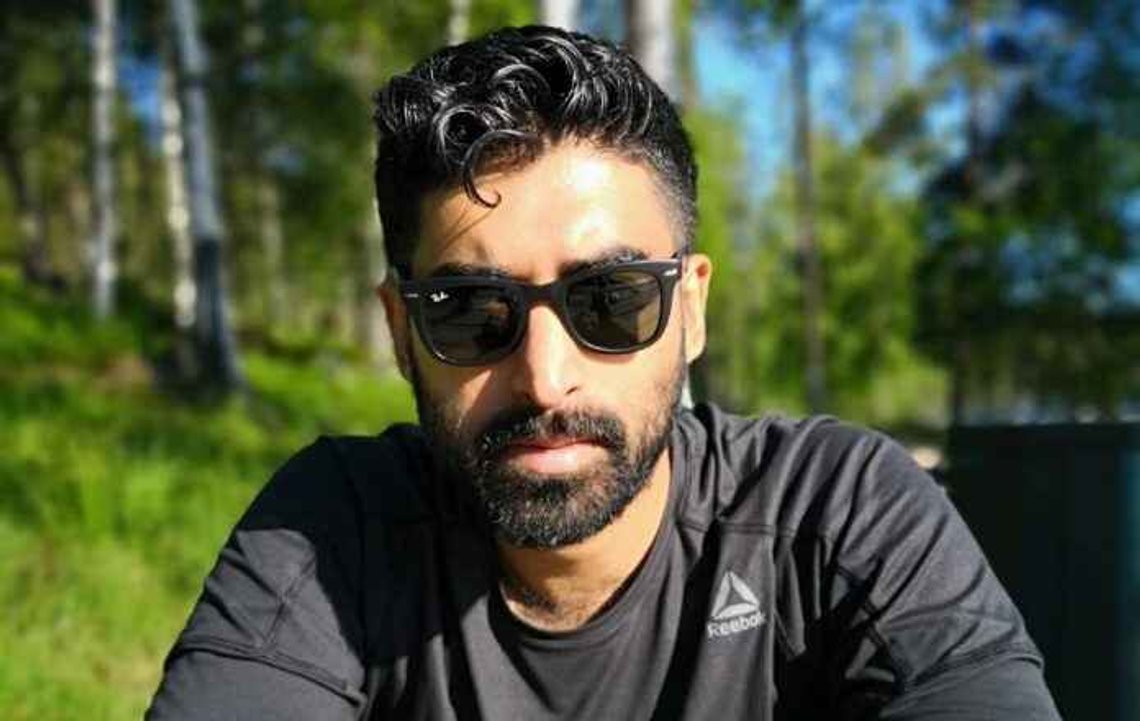
Qasim Ali believes that Pakistanis arrived in a Norway undergoing change – and contributed greatly to building the country. He uses well-known old tricks.
Qasim Ali is the leader of MINORG, and describes the first Pakistanis who arrived in Norway as labour immigrants.
– The first Pakistanis did not come as refugees from a broken country, but as labour immigrants. Many travelled abroad to earn money, support family and send capital home, he says to Utrop.
But this does not accord with reality: The first Pakistanis arrived in Norway on tourist visas or similar and had no job awaiting them. Then they simply remained after their residence permits had expired.
This took place in the late 1960s and early 1970s, and virtually none of those who arrived were sought after in the Norwegian labour market. Ali writes that many of the Pakistanis who arrived in Norway took heavy work in factories, transport, industry and service occupations. Ali believes that they took jobs, paid tax, established families and contributed to society, while Norway itself became richer.
Furthermore, Ali writes about the oil adventure that was in the process of beginning during this period. In a strange manner, he attempts to give the Pakistani immigrants credit for this, because of a geologist from Iraq!
As an example of immigrants’ contribution to Norway, Ali highlights Farouk Al-Kasim.
Al-Kasim came to Norway in 1968 and assumed a central role in the development of Norwegian oil administration.
Was Ali unable to find a single Pakistani role model? Did he have to search in Iraq? Al-Kasim appears to have been both a skilled geologist and a decent fellow, but his significance for Norwegian oil history is probably exaggerated, for natural reasons. In any case, he is not Pakistani.
– My main point is that the history of Pakistani labour immigrants should not be reduced to gratitude or burden, says Ali.
Once again: What do Pakistanis who arrived on short-term visas have to do with an Iraqi geologist?
Qasim Ali knows all the tricks, and uses the ridiculous comparison with approximately 800,000 Norwegians who emigrated to the United States.
– People travelled abroad to find work, dignity and a better future. Entirely understandable. Exactly as many Pakistanis later did in Europe.
But the comparison is completely absurd. There was no welfare state that received the Norwegian immigrants to the United States; they had to manage on their own in order to survive. If this had been the case in Norway when the Pakistanis streamed into Norway, probably more than 90 per cent of them would never have chosen that journey.
Almost no Pakistanis chose to settle in Hungary, Poland or Portugal. Why not? The answer is obvious: There was no free money to be obtained there.
Ali believes that Pakistani immigration has been given a disproportionately large place in the integration debate.
– Why are Norwegian-Pakistanis often expected to have their own spokespersons and constantly explain their belonging, while other immigrant groups are more rarely discussed in the same manner? he asks. He also asks why certain groups, particularly Pakistanis and Somalis, more often have to prove loyalty and belonging in Norway.
Most genuine Norwegians are not interested in Pakistani or Somali spokespersons. We have learned that this always ends up with radical imams who absolutely do not speak for the entire milieu.
But one can still oppose immigration from these countries, even without Salafist spokespersons. One can simply take a look at the crime statistics and the state budget.
It is also interesting that we have experienced Pakistanis pretending to be Afghans in order to obtain refugee status in Norway. The fraud is obvious and well known, but the countermeasures are small and pitiful.
(Link to article in Norwegian: Massive asylum fraud has awarded Pakistanis unlawful residence in Norway:)
Massivt asyljuks har gitt pakistanere urettmessig opphold i Norge
And is it not the case in today’s Norway that those who are critical of mass immigration are the ones subjected to the most harassment by gutmenschen such as AUF leader Gaute Skjervø, and constantly described as racists and fascists?
Incidentally, is one still “young” after turning 32 years old? Does nobody become an adult at the normal age any longer?
Skjervø is a classic example of these modern politicians who have never had an ordinary job, only publicly financed assignments. He has “worked” as a youth worker in Trondheim municipality, an intern at the Ministry of Foreign Affairs and as an adviser at Framtiden i våre hender.
But Skjervø has of course not completed military service, a public duty which he evidently did not find appealing.
Ali believes that prejudice, identity politics and click bait may characterise public debate. His own prejudices he evidently regards as off limits. He himself has shown support for extreme Islamist organisations such as Islam Net and Profetens Ummah.
Qasim Ali believes that Pakistanis made a major contribution to building the Norwegian welfare state. If so, they built it to a large extent out of self-interest, since they work so little, compared with ethnic Norwegians. After all, most of the expenses of the welfare state are financed by ethnically Norwegian tax slaves, and a large portion of their tax money ends up in the pockets of the immigrant population.
Has the Pakistani milieu already squandered all the money from the taxi fraud case from approximately 24 years ago? Or perhaps the profits have been sent to the homeland, where many so-called Norwegian-Pakistanis build veritable mansions for a modest sum, to a great extent financed by Norwegian taxpayers or other victims of outright fraud.
For the sake of good order: For many decades I have had several friends who are Pakistanis, and many of them are people I deeply respect. It is these activists, whom Qasim Ali represents, that there is reason to dislike.
Ali’s background is unknown to me; I cannot even manage to find his ethnic background in my online searches. The search results indicate a background connected to the Pakistani milieu in Norway, but provide no specific information about where he was born.


