

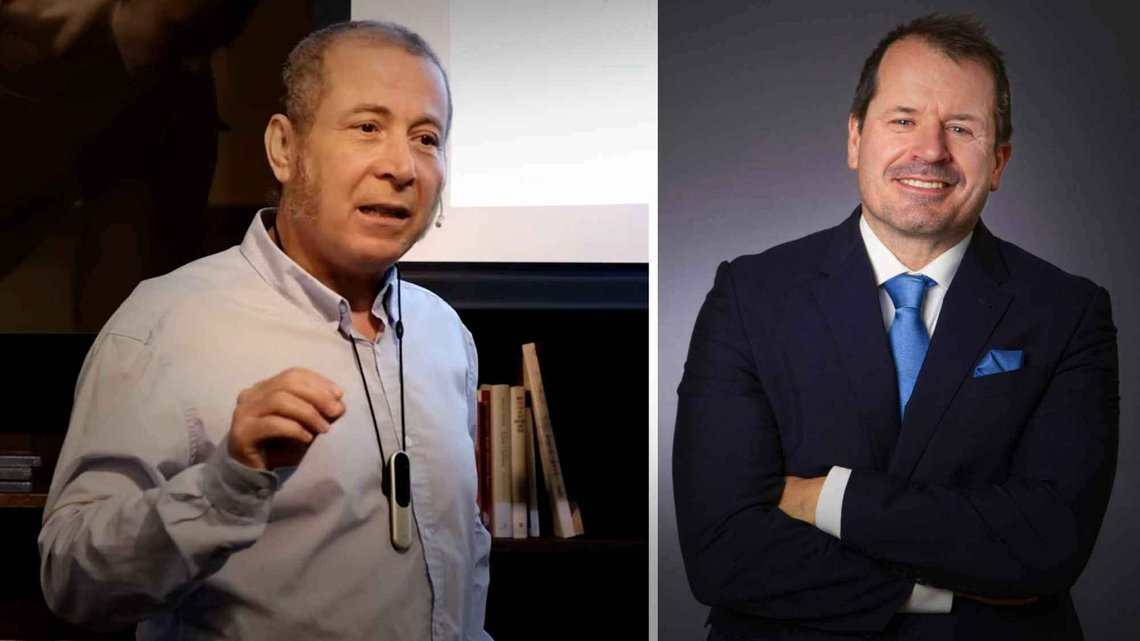
Prominent jurists believe that NTNU professor Bassam Hussein’s statement about the 7 October massacre is protected by freedom of expression. Eirik Vinje, partner and lawyer at Garmann, Mitchell & Co Advokatfirma AS, disagrees.
Professor of law Anine Kierulf, researcher in constitutional law, human rights and freedom of expression at the Department of Public Law at the University of Oslo, stated this week to Subjekt that praise of terrorist actions in the past, that is to say expressions of opinion about something that has already happened, is a type of expression of opinion that it is lawful to hold and express.
 Professor of law Anine Kierulf at the University of Oslo. (Photo: Private)
In the podcast Takk og lov, she reviewed the same topic in December 2023.
She flatly rejects that Hussein’s statement is hateful.
– Even though it can clearly be perceived as hateful, this is what we call glorification of violence.
The prohibition against glorification of violence was repealed when the new Penal Code entered into force in 2015. Convictions for incitement to violence and incitement to terrorism under Penal Code § 136 always concern actions that have not yet occurred.
Tribal interpretation emphasised
According to Kierulf, the context is essential. In line with precedent established in the Supreme Court judgment concerning “psychological complicity” in hateful speech against Hans Jørgen Lysglimt Johansen, delivered in March this year, praise of criminal acts directed towards a particular milieu of persons may be assessed as incitement if the recipients – the milieu – may perceive it in this manner.
– This opens for a more precise and adapted interpretation of how particular audiences may reasonably be assumed to understand the statements. Since we live in a time with increasingly fragmented publics, with tendencies towards “tribal language”, and where some potentially unlawful expressions – incitement to terrorism, threats, incitement to violence, hate speech – are put forward in such publics, this statement in the judgment may have significance, also for future cases, Kierulf wrote in an e-mail to Document when we asked her to comment on the judgment.
– This means that the evidentiary question is no longer necessarily “what will the average person perceive this statement as”, but rather “what will the left- or right-wing extremists, Islamists, neo-Nazis or other particular audiences that are usually exposed to this type of statement reasonably understand them to mean, in context”.
Transferred to the NTNU professor’s praise of Hamas’ terrorist massacre, the question may therefore be how Hussein’s own “tribe” of, for example, Palestinians and Palestine activists perceived the statement. And not how it is interpreted by the public at large.
– Conditions not fulfilled
Kai Spurkland, director of the Norwegian Institution for Human Rights, also believes that Hussein’s statement is not covered by Penal Code § 185.
He says to NRK that the condition that the statement must be directed at persons with certain skin colours, ethnic and national origins, religion/belief, sexual orientation, gender identity or functional ability is, in his view, not fulfilled.
 Eirik Vinje. (Photo: Garmann, Mitchell & Co Advokatfirma AS)
Lawyer Eirik Vinje writes that it is a “dubious assumption” that several people take it for granted without further consideration that Hussein’s statement falls within freedom of expression.
– In my view, much may indicate that it is an incitement, he writes in a comment. He believes Kierulf has too narrow an understanding of what may be regarded as incitement to terrorism under Penal Code § 136.
Vinje points to the fluid boundary between glorification of terrorism and glorifications that go so far that they must be understood as incitements to carry out terrorist acts.
In the NTNU professor’s case, Vinje believes that the glorification went too far.
– Everyone who has had children or dogs knows that praise is the most effective incitement that exists, he comments, and reminds readers that the legislation imposes no formal requirements on the formulation of an incitement to terrorism.
Vinje also points out that it is not the technical and linguistic meaning that is decisive under Norwegian criminal law. What is decisive is the actual message.
In the assessment of whether praise of a past massacre is to be regarded as incitement to terrorism, regard must, according to case law, be had to how current the matter is.
It would be in poor taste, but legally unobjectionable, to praise Norwegian Vikings’ plundering of Lindisfarne in 793; present-day Norwegians have neither sufficient motivation nor practical opportunity to repeat such a thing.
In this case, however, it concerns celebration of a recent terrorist attack in an ongoing conflict. Random Jews are continually being murdered in Europe, most recently last week in England.
In Norway, Jews do not dare to display their identity publicly, and even the Jewish kindergarten is under armed police protection. It is an extremely explosive situation, in which all Norwegian Jews are in greater or lesser danger of their lives. And the professor’s statement is obviously suited to inflaming potential terrorists.
Vinje refers to case law from the European Court of Human Rights in Strasbourg (ECtHR), which indicates that the statement is not protected by freedom of expression:
In France in 2008, a Basque caricaturist was convicted for a drawing about 9/11, with the caption “We all dreamed of it… Hamas did it”. The ECtHR concluded that it had to be regarded as incitement to violence not protected by Article 10 on freedom of expression in the European Convention on Human Rights (ECHR).
– Entirely incompatible with the position
Vinje also believes that an employee cannot express himself publicly in a manner entirely incompatible with the position he holds. He believes much indicates that the Norwegian state, as Hussein’s employer, has a human-rights obligation to dismiss him:
Under Article 14 of the ECHR, minorities, including Jews, have a right to participate in society without discrimination. It is obvious that Jewish students cannot be entrusted to a professor who proclaims that it is beautiful when they are murdered. It is equally obvious that Jews have the same right as everyone else to study and conduct research at NTNU. They cannot do so as long as Hussein remains in the position.
One may also ask whether a person with such rabid opinions should be permitted to hold a professorship in mechanical engineering, where he can obviously acquire relevant expertise for terrorism and warfare.
Vinje believes it is obvious that a person with ties to Russian authorities would have been excluded from a corresponding position under security legislation.
– There is no reason why potential terrorists should be allowed to develop methods of terrorism at the state’s expense, he writes, calling Hussein a “monster in academic camouflage”.
– Hung out to dry over an adjective
Hussein himself comments on the matter on his own blog, and portrays himself as a victim under the title “Vi tar han” (“We’ll get him”). There he writes that the media storm is “orchestrated”.
– I am being hung out to dry in almost all the national newspapers over an adjective that was used in an open lecture, without the newspapers conveying or illuminating the full picture, the whole story, he writes.
I have clarified that the adjective was used to underscore the significance and context surrounding an event (7 October) viewed from the perspective of a colonised and oppressed people – the Palestinian people.
I gave the lecture as a Palestinian in order to illuminate the Palestinian perspective […]. The word was used to highlight the strategic implications of the event, particularly linked to the future of the Palestinian people, as well as the broader consequences for the region and the power structures in West Asia.
Hussein writes that he described, from his own perspective, “what this day has done to Israel’s self-image as an invincible power in West Asia”.
– The choice of adjective was unfortunate. In hindsight, I could also have chosen another word, he writes.


