

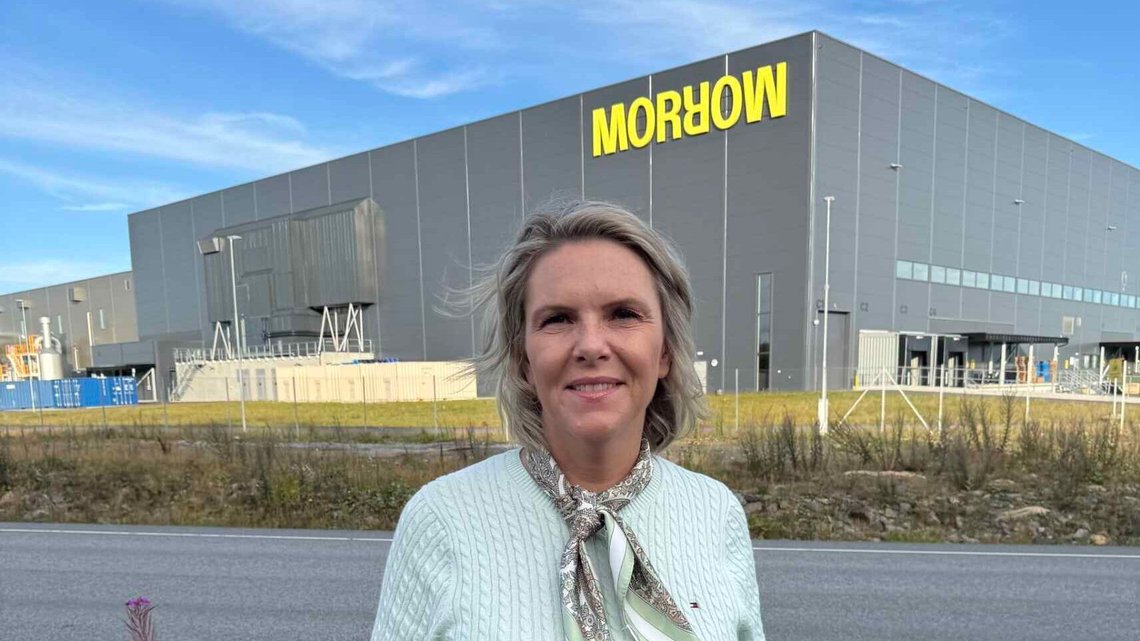
The bankruptcy of the battery company Morrow entails losses for owners and creditors amounting to nearly NOK 5 billion. The state and the municipalities are left as the major losers. That is to say: The bill has already been sent to the taxpayers, in the form of taxes and duties.
The bankruptcy of the battery company Morrow is the third major battery bankruptcy in the Nordic countries. First the battery company FREYR disappeared. Then the Swedish Northvolt. Now it is Morrow’s turn to go to the bankruptcy court.
– This is what Morrow will do differently, stated Morrow chief executive Lars Christian Bacher in the wake of the bankruptcy of Northvolt. That was on 27 September 2024, while they had a loan application for NOK 1.5 billion pending with Innovation Norway (Innovasjon Norge).
But shortly after the loan facility was granted, Morrow had to downsize. Sixty people lost their jobs. Bacher described it as taking strategic measures.
– It is right and important that we take these measures in order to increase security for the remaining jobs. With around 180 employees, we will still be a major private employer in Agder, he stated to E24.
 What did Morrow chief executive Lars C. Bacher know? Photo: Terje Pedersen / NTB
Private employer?
But the main weight of ownership and almost all credit are in public hands.
For the two largest private owners – Siemens and ABB, with a combined 26 per cent of the shares – the prospects of equipment deliveries were probably what proved most tempting, given the active industrial policy of the Solberg and Støre governments. The third largest private owner, Bjørn Rune Gjelsten, through Noah AS, which owns 5.8 per cent, had not participated in the capital increase of EUR 48.4 million in May 2024, but allowed himself to be diluted.
Thus it is the Norwegian taxpayers who have taken the greatest hit, through the state and the municipalities.
In total, NOK 3.3 billion in injected equity capital has been lost. In addition, loans, guarantees and public grants amounting to more than NOK 1.6 billion have been swept away in the undertow.
Å Energi and Nysnø Klimainvesteringer
The largest shareholder in Morrow is the energy company Å Energi, with 49.9 per cent of the shares. Chair of the board of Å Energi, and the person ultimately responsible for the company’s strategic investment in renewable energy, which also includes the failed solar energy company Otovo, of which only crumbs remain on the Oslo Stock Exchange, is Maria Moræus Hanssen.
 Chair Maria Moræus Hanssen has lost NOK 1.9 billion for Å Energi.
Photo: Lise Åserud / NTB
The largest owner in Å Energi is Statkraft, with 32.6 per cent. The second largest owner is Drammen municipality, with 13.2 per cent direct ownership, in addition to 26 per cent ownership in Vardar, which owns 4.3 per cent, and which is otherwise owned by a number of Buskerud municipalities, as well as Asker municipality. The remaining 49.9 per cent of the ownership is distributed among the municipalities in Agder county.
The second state owner is Nysnø Klimainvesteringer, with 2.2 per cent. This company is headed by former weather presenter Siri Kalvig. This means that the state, through Statkraft and Nysnø, together with various municipalities, owns 52.1 per cent of the shares. These shares now have a value equal to zero.
 Weather presenter Siri Kalvig, chief executive officer of Nysnø Klimainvesteringer, has lost more than NOK 80 million in state funds.
Photo: Carina Johansen / NTB
With the bankruptcy, the state and municipalities have lost NOK 1.7 billion on the shares.
But the losses for Å Energi and Nysnø do not stop there. They are also loan guarantors.
Innovation Norway and Siva
Innovation Norway granted a loan facility of NOK 1.5 billion to Morrow in December 2024. It consists of three parts. NOK 400 million from Green Industrial Financing (Grønn industrifinansiering), NOK 500 million guaranteed by the owners, and NOK 600 million that was not drawn down, owing to the lack of guarantees from the owners. Ergo, NOK 900 million is exposed.
Å Energi accounts for half of the owner guarantee – NOK 250 million. This means that Å Energi alone has lost NOK 1.9 billion on Morrow. Siri Kalvig’s Nysnø can record a loss of more than NOK 80 million.
– The loan of NOK 400 million is secured by liens on current and fixed assets, writes senior adviser at Innovation Norway, Kjetil Storkmo Bergmann, in an email to Document.
But first the employees must receive wages and holiday pay during the notice period, in addition to suppliers having their claims.
It may happen that the state, through Innovation Norway, encounters itself at the door through the state property company Siva, since Siva has invested in Morrow’s factory building in Arendal. Morrow does indeed lease the building on commercial terms. But the risk for Siva (the state) depends on how long the building will stand vacant, and whether a corresponding tenant arrives at all.
In addition, Morrow has received public grants through the policy instrument apparatus in Norway and the EU amounting in total to NOK 202 million.
Ergo, more than NOK 1.6 billion in loans may be regarded as lost. Together with injected equity capital of NOK 3.3 billion, the total loss amounts to nearly NOK 5 billion.


