

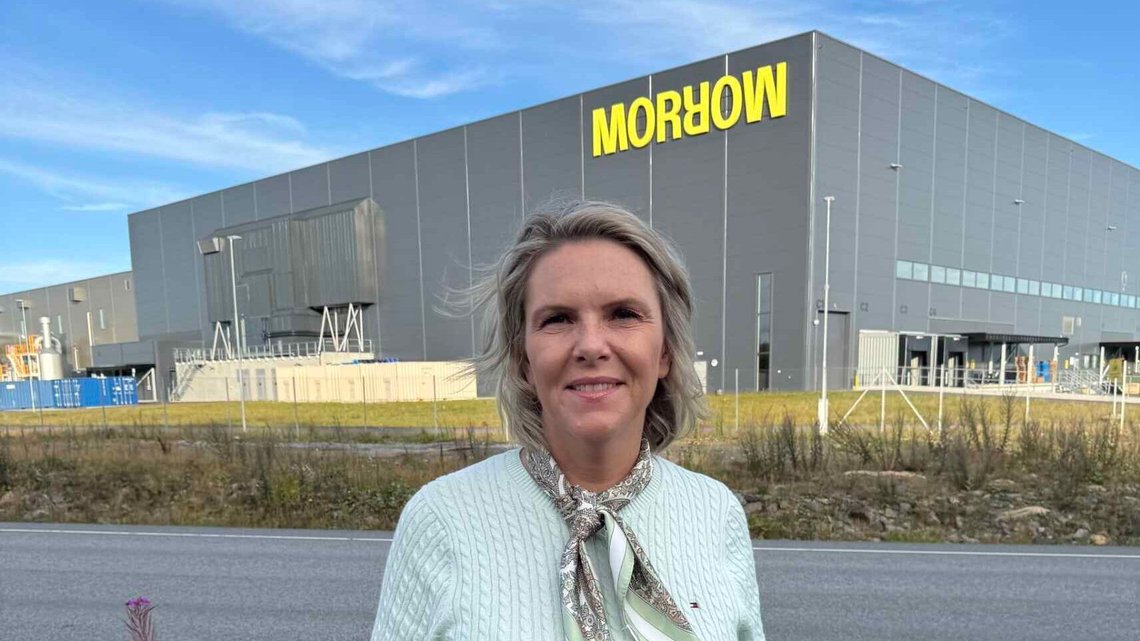
The battery factory Morrow Batteries in Arendal has filed for bankruptcy. Progress Party (FrP) leader Sylvi Listhaug demands that the government immediately account for how many billions of taxpayers’ kroner have been lost in the fiasco.
The board of Morrow Batteries ASA decided on Wednesday to file for the company’s bankruptcy. Corresponding decisions were made in the subsidiaries Morrow Technologies AS and Morrow Industrialization Center AS. An administrator is expected to be appointed by Agder District Court.
The factory was officially opened by Prime Minister Jonas Gahr Støre (Labour / Ap) on 16 August 2024. Barely three months after the ribbon-cutting, Morrow requested a state loan of NOK 1.5 billion. The loan was granted by Innovation Norway in December of the same year.
“We warned in the strongest terms, and unfortunately FrP was once again proved right,” Listhaug writes in a post on Facebook.
She believes the government acted against its better judgement when the loan was granted, and that the Prime Minister must personally be held accountable for the billion-kroner loss. The FrP leader describes the entire project as a castle in the air and believes that the core of the Labour Party’s climate policy has imploded with the bankruptcy.
Here is the entire post:
https://www.facebook.com/plugins/post.php?href=https%3A%2F%2Fwww.facebook.com%2Flisthaugfrp%2Fposts%2Fpfbid034gcSEwRf45HTfRgLPnbpAfCYsRmugXpeHu5qmNSZUHLVLdy5zf5PafZ7QJv4D2r9l&show_text=true&width=500
More than four billion public kroner
The total public exposure to Morrow exceeded four billion kroner even before the bankruptcy, according to a review published in Fædrelandsvennen in March.
Innovation Norway has contributed NOK 354 million in grants and a loan facility of NOK 1.5 billion. Of the loan, NOK 400 million came through the Green Industrial Financing scheme, while the remaining NOK 1.1 billion was given on commercial terms. The loan terms have been kept secret.
The state-owned property company Siva has invested NOK 542 million in the factory building itself, Morrow states in the press release on the bankruptcy. The state-owned climate investment company Nysnø invested NOK 85 million in equity capital.
The largest owner was the power company Å Energi, which is owned 55 per cent by municipalities in Agder and Buskerud and 45 per cent by Statkraft. The company had invested around NOK 1.3 billion in equity capital and provided a guarantee of NOK 250 million for parts of the Innovation Norway loan. The main shareholder wrote the entire investment down to zero in its fourth-quarter report in February.
Arendal Municipality has spent at least NOK 263 million on plots and infrastructure Morrow never used, NOK 10 million in shares and a loan of NOK 63 million to prepare a site for a planned second factory. In addition comes the so-called Battery Road (Batteriveien) from the E18 to the industrial area, estimated to cost around NOK 650 million and financed as a joint undertaking between the municipality, Agder County Municipality and the state.
Bellona and SV rejected the warnings
When Listhaug in December 2024 warned against the state loan, she was met with strong reactions from the project’s supporters.
Bellona leader and Morrow shareholder Frederic Hauge believed the FrP leader was scaring away international investors who were curious about the Norwegian battery initiative. SV’s business policy spokesperson Kari Elisabeth Kaski also rejected the criticism, called the allocation an SV breakthrough and claimed that Listhaug was lying when she said the money came at the expense of schools and elderly care.
Minister of Trade and Industry Cecilie Myrseth (Ap) repeatedly denied that Morrow was receiving preferential treatment, and referred to Innovation Norway making its own assessments. The Prime Minister’s Office has so far not commented on the bankruptcy.
In the board’s press release, Morrow points to overcapacity in the global battery market, price pressure, increased capital costs and delays in the industrialisation phase. Attempts to secure a new industrial investor did not reach the finish line within the timeframe allowed by liquidity.
In April, Morrow entered into an agreement with a German actor in the defence industry, and the company also had a long-term supply agreement with the Finnish company Proventia Oy. It was not enough.
Investor Øystein Stray Spetalen warned already in autumn 2024 against giving a state loan to Morrow. He pointed out that it is scientifically and commercially unrealistic for a battery factory in Arendal to be able to compete against Chinese manufacturers and industrial giants with several decades of technological advantage. Even Chinese actors are struggling with profitability in the industry.
Warning sign for offshore wind
Listhaug believes the bankruptcy is a powerful warning sign against corresponding prestige projects in the government’s portfolio. She points to the government’s roadmap for a green industrial boost from 2022, which envisaged NOK 60 billion in public investment by 2025, including in offshore wind, hydrogen, solar power and mineral extraction.
Then Minister of Trade and Industry Jan Christian Vestre (Ap) launched the battery strategy at FREYR Battery in Mo i Rana in June 2022 and stated that the Norwegian battery value chain could have a turnover of at least NOK 90 billion by 2030. In practice, barely a single commercial battery has been produced in Norway. FREYR has also put its plans on ice and is attempting to sell its factory building.
For the FrP leader, the Morrow bankruptcy is the final confirmation that the state should not pick winners – and a warning that the next billion-kroner bill may come from the offshore wind initiative.


