

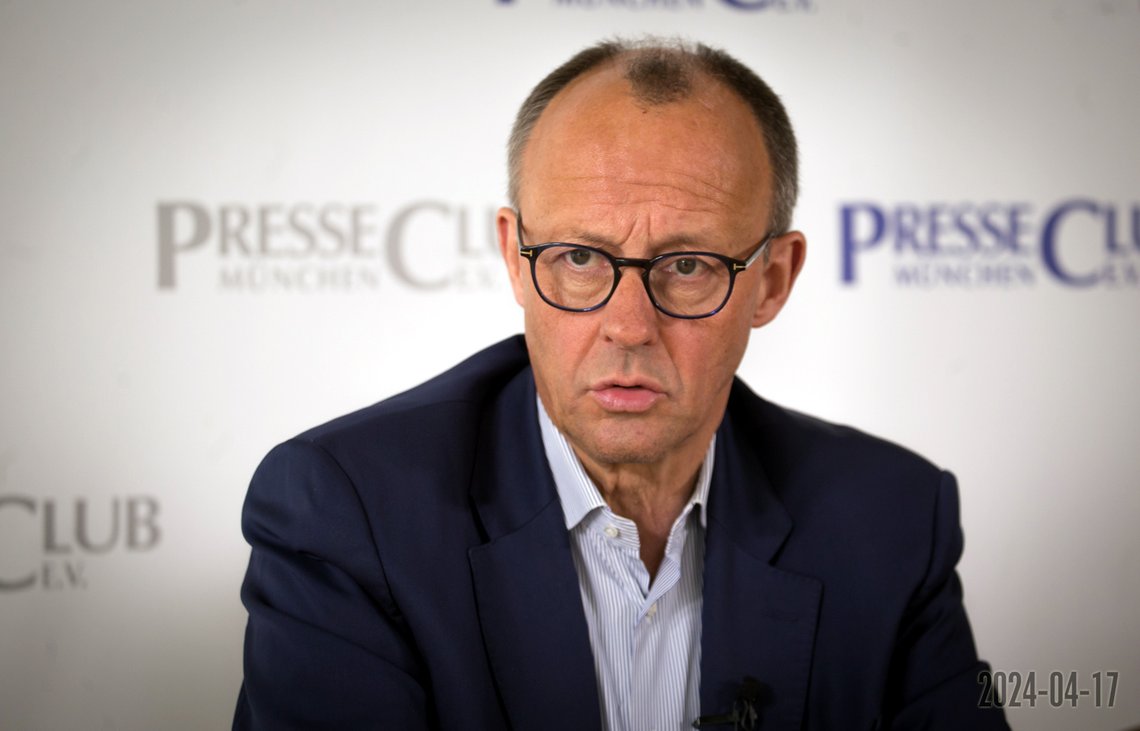
Friedrich Merz is steadily losing support. He is now not the most popular politician even among his own voters in the CDU/CSU.
Germany’s Federal Chancellor Friedrich Merz (70) is now the country’s least popular party leader, according to the latest politician ranking conducted by Insa for the newspaper Bild.
Merz has fallen from 18th to 20th place, thereby occupying last place for the first time. The loss of support among his own in the Union parties CDU/CSU is particularly striking.
Among CDU and CSU voters, Merz now ranks near the bottom. Defence Minister Boris Pistorius achieves better results, as do other CDU/CSU politicians, such as Interior Minister Alexander Dobrindt and CDU Secretary General Carsten Linnemann.
Pistorius retains first place as Germany’s most popular politician.
The full table is as follows:
- Boris Pistorius (SPD): 4.9
- Cem Özdemir (Alliance 90/The Greens): 4.1
- Hendrik Wüst (CDU): 4.1
- Markus Söder (CSU): 4.0
- Wolfgang Kubicki (FDP): 3.9
- Alexander Dobrindt (CSU): 3.9
- Julia Klöckner (CDU): 3.8
- Alice Weidel (AfD): 3.7
- Carsten Linnemann (CDU): 3.7
- Sahra Wagenknecht (BSW): 3.6
- Lars Klingbeil (SPD): 3.5
- Franziska Brantner (Alliance 90/The Greens): 3.5
- Ines Schwerdtner (Die Linke): 3.5
- Bärbel Bass (SPD): 3.5
- Tino Chrupalla (AfD): 3.4
- Heidi Reichinnek (Die Linke): 3.4
- Katharina Dröge (Alliance 90/The Greens): 3.4
- Katherina Reiche (CDU): 3.1
- Jens Spahn (CDU): 3.0
- Friedrich Merz (CDU): 2.9
The assessment in the table ranges from 0 (very poor) to 10 (very good) and shows the average of how respondents evaluated the politician.
Among Union voters, Merz’s support is weak. He manages only fifth place with 55.1 points, behind Söder (63.6), Pistorius (59.9), Wüst (57.1) and Dobrindt (56.1).
According to the survey, only 10 per cent of respondents assess Merz positively (8 to 10 points), while 58 per cent give a negative assessment (0 to 4 points).
Other politicians are also losing support: Alternative für Deutschland’s Alice Weidel, who is one of two leaders of AfD, goes from 6th to 8th place. Co-leader of the left-wing party Die Linke, Heidi Reichinnek, falls from 11th to 16th place. The Social Democrats’ SPD Vice-Chancellor and Finance Minister Lars Klingbeil falls from 9th to 11th place.
Record-high dissatisfaction with the Merz government
In general, dissatisfaction with Merz and his government is at a record high. The coalition government between CDU/CSU and SPD has never been more unpopular.
A survey by the same institute Insa earlier in April showed that 70 per cent of those entitled to vote are dissatisfied with Merz’s performance. Only 21 per cent are satisfied.
Once again, dissatisfaction is also high among the voters of the governing parties. 69 per cent of SPD voters and 56 per cent of CDU/CSU supporters are dissatisfied with the coalition’s performance. And only 28 per cent of SPD voters and 49 per cent of CDU/CSU supporters are satisfied with Chancellor Merz.
Merz is particularly unpopular in the east, where only 12 per cent approve of the job he is doing, while 80 per cent are dissatisfied.
“It is unlikely that the Chancellor and the coalition will succeed in fundamentally reversing this trend,” said Insa head Hermann Binkert to Bild am Sonntag, which published the survey.
Germany’s weak economy likely contributes strongly to the government leader and the governing parties being pushed so far down the list. The same likely applies to rising crime, which to a large extent is a consequence of the massive immigration to Germany in recent years.
This began when Merz’s party colleague and former Federal Chancellor Angela Merkel opened the floodgates with her Wir schaffen das during the European migrant crisis in 2015, when large parts of the Middle East and North Africa suddenly became Syrians in order to gain access to the European welfare states.
It is also entirely possible that some Germans, particularly in the east, dislike that Merz repeatedly criticises Germany’s most important ally, the USA, particularly after the war against Iran began.
In the latest opinion polls, AfD has been Germany’s most popular party.


