

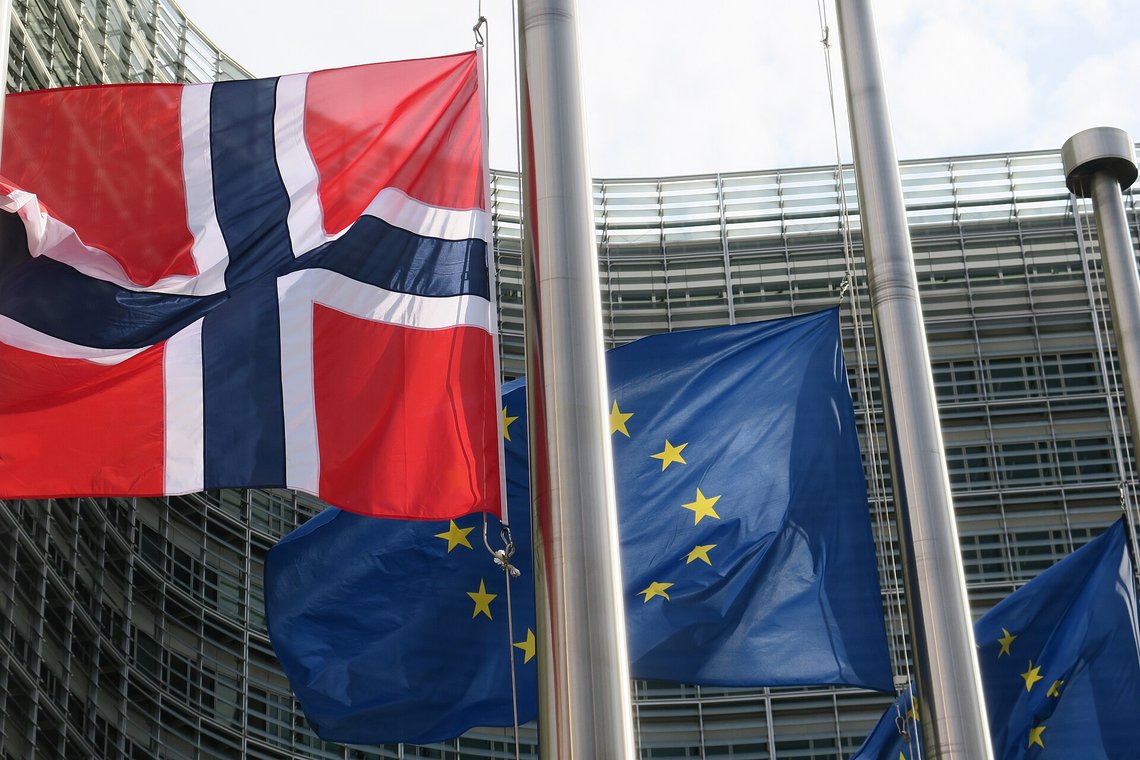
Support for Norwegian EU membership is rising among those who still vote for the Labour Party.
A recent poll shows that almost every other Labour voter now wants Norway to enter the Union. At the same time, No-side veteran Trond Giske warns that this is not due to increased enthusiasm, but to the party having lost its most critical voters.
The poll was carried out by Sentio for Klassekampen and Nationen in April. It shows that 46 per cent of Labour voters would vote Yes to the EU in a referendum, while 36 per cent of the party’s voters would say No.
Trond Giske believes that the figures give a false picture of the situation in the party. He points out that the Labour Party has lost a very large number of voters to both Rødt and FrP in recent years. Giske calls these near-voters. These are people who are often sceptical of globalisation, and thus of the EU.
— It is, of course, clear that when Labour is polling fairly low and has lost many voters both to Rødt and FrP, then it is probably mostly EU sceptics who have disappeared, Giske says to Klassekampen.
He believes the party is now dominated by highly educated globalists in the big cities. These are voters who are positive towards the EU. Giske therefore believes that this is not a matter of an actual shift in sentiment in the population as a whole.
The poll also shows that 50 per cent in Høyre would have voted Yes to the EU today, but among Venstre as many as 68 per cent answer that they would vote Yes, making them the country’s most EU-friendly party. MDG follows close behind, with a Yes share of 62 per cent.
At the other end of the scale we find Senterpartiet and Rødt, where opposition remains massive. Among Centre Party voters, as many as 82 per cent say No to the EU, while the figure for Rødt is 78 per cent.
Around 30 per cent of FrP voters state that they would vote Yes to the EU now.
The EEA Agreement is losing support among the people
Even though the Yes side is growing internally in the two largest parties, opposition remains strong in the population generally. Only 31 per cent of all those questioned in the poll say Yes to the EU. At the same time, the poll also shows that support for the EEA Agreement is falling dramatically. In May 2022, 65 per cent of the population supported the agreement, while the figure is now down to 49 per cent.
Giske believes that this is due to issues such as electricity prices and the dispute around ferroalloys this winter.
— We do see how some individual issues create trouble in the EEA, says Giske.
The leader of Europabevegelsen, Trine Lise Sundnes, disagrees with Giske’s analysis. She believes that the falling support for the EEA shows that people see that the agreement is no longer sufficient for Norway. She believes that voters in the Labour Party are now going ahead of the leadership and demanding full membership. Sundnes believes that Norway should sit at the table where the decisions are made.
Neither Prime Minister Jonas Gahr Støre nor Foreign Minister Espen Barth Eide has so far commented directly on the new figures.


