

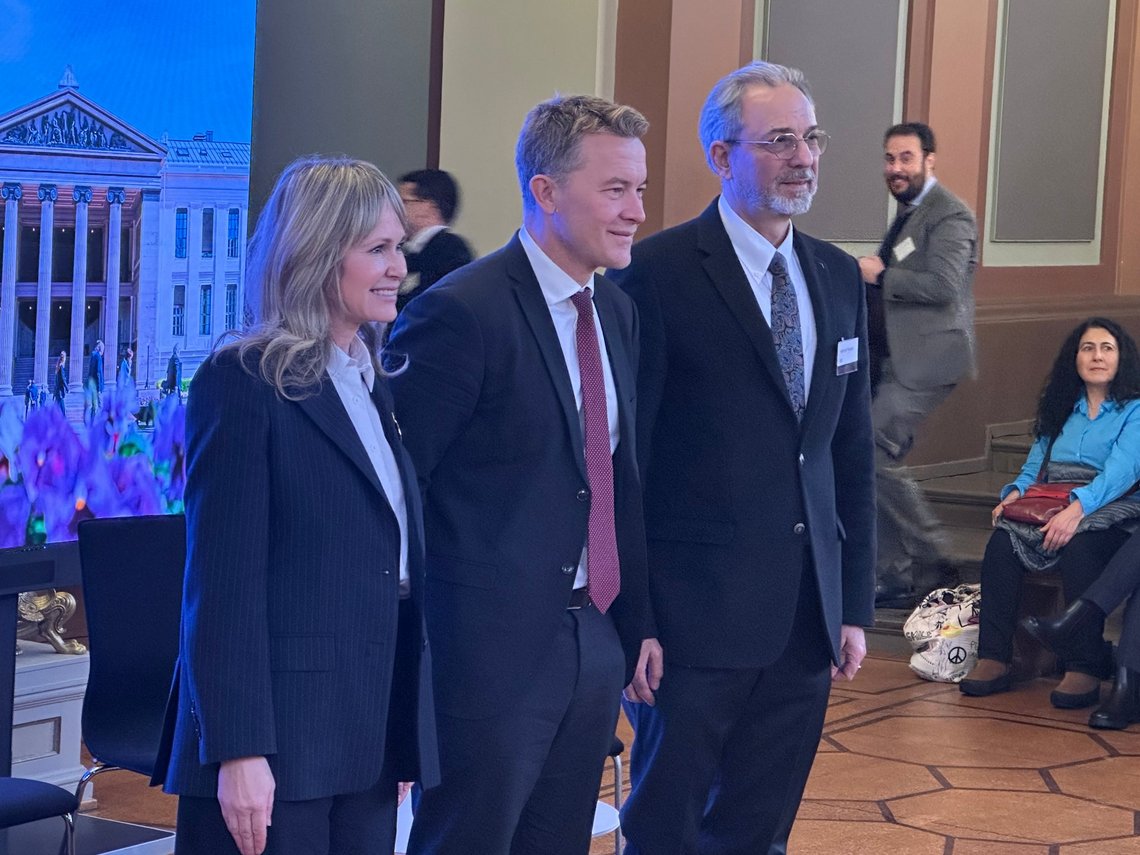


«In the face of war and unrest, Norway needs more diplomacy, not less», writes State Secretary in the Ministry of Foreign Affairs (UD) Andreas Motzfeldt Kravik in Aftenposten, 21 April.
That is not difficult to agree with. «A wise foreign policy requires an updated understanding of how the world functions», he continues. Nor is that difficult to agree with. It is important to understand our surroundings.
Motzfeldt Kravik points out that we live in a time with a historically high number of armed conflicts, that even conflicts far away affect us directly, and that international politics is becoming increasingly centralised. True enough.
But what he does not say is far more important than his attempt to justify thirty years of failed Norwegian peace mediation in the Middle East, and his attempt to stem the criticism that has arisen in the wake of the Epstein revelations with regard to the Ministry of Foreign Affairs’ scandalous handling of Norwegian taxpayers’ money for aid and peace mediation.
He refers to the troubled times and highlights that the Government is now implementing a historic defence investment and strengthening our security policy alliances with countries in Europe.
He avoids mentioning that the party to which he himself belongs bears a principal responsibility for having dismantled 85 per cent of the Armed Forces, at the same time as the Government of which he is a member, for all practical purposes, is already at war with our great-power neighbour in the east.
Nor does he touch upon the fact that the Government is dragging its feet with regard to implementing the recommendations of the Defence Commission, that it will take at least 12 years to rebuild the Armed Forces, and that by then it may long since be too late.
Nor does he mention that repeated Labour Party governments have evidently not understood how the world functions, and that it is power that ultimately regulates relations between the great powers.
And like his party colleagues, he has evidently not understood that while the security landscape can change virtually overnight, defence structures are slow-moving structures that can take decades to build up.
He refers to alliance-building with Europe, but does not point out that the European NATO countries, like Norway, have to a large extent dismantled their own defences. They have very little to offer in order to enhance Norwegian security.
And he does not mention that, as a consequence of the irresponsible defence and security policy pursued over three decades, Norwegian security in the foreseeable future will be totally dependent on the USA.
At the same time, he describes the American President in highly undiplomatic terms. That is unwise.
… international politics is becoming increasingly dynastic and centralised. The development is particularly marked in the USA, where President Trump, supported by a small circle of advisers, makes most decisions himself.
He simply fails to grasp that the weakened Euro-Atlantic relations are primarily caused by the fact that Norway and the European NATO countries have not fulfilled their obligations within NATO, and have not contributed to maintaining their own defence, but have allowed the USA to bear the main burden for Norwegian and European security.
Kravik draws the conclusion that this development entails that our peace and conflict diplomacy is among our most important foreign policy tools.
That is a remarkable misjudgement, and it stands in stark contrast to the lack of results of Norwegian peace diplomacy, as well as to the revelations that have thus far emerged from the publication of the Epstein documents.
Kravik curiously cites the ongoing Norwegian peace diplomacy in South Sudan as a prime example, but does not mention the catastrophe it led to in 2013. Former Minister of Development Hilde Frafjord Johnson was central. It did indeed lead to a peace agreement and South Sudan’s independence in 2011. But the peace lasted only barely two years.
In 2013, a brutal civil war broke out. Hundreds of thousands were killed, millions displaced, and it led to widespread famine in Sudan. Hilde Frafjord Johnson was chased out of South Sudan, which since then has been regarded as a failed state.
Kravik justifies the continued Norwegian engagement in South Sudan by arguing that it is in Norway’s interest to help prevent the emergence of extremism and migration flows, which he believes will affect Norway’s security and economy.
He is entirely correct that migration from the MENA countries affects Norway’s security and economy negatively, and is consequently not in Norway’s interest. But with that recognition, the Labour Party should have contributed to reducing the asylum flow, not maintaining it. A large proportion of this immigration is economic welfare migration.
There are few or no examples of Norwegian peace mediation having contributed to reducing migration flows. Norwegian foreign policy under the Labour Party has rather contributed to increasing them, cf. when Norway bombed Libya back to the Stone Age in 2011, as well as the Norwegian engagement in Iraq in 2003.
Compare also the Norwegian peace mediation in Afghanistan and the fact that Norwegian forces remained there for almost 20 years without achieving anything whatsoever other than that 10 Norwegian soldiers were killed, NOK 40 billion disappeared to no avail, and 35,000 Afghans immigrated to Norway. Annually, they cost Norwegian taxpayers billions.
Norway scatters aid money and good intentions, but has neither the diplomatic nor military weight necessary to force lasting peace solutions. Only the great powers can do that.
The best we can do from the Norwegian side is to contribute humanitarian aid and emergency assistance, not peace mediation without diplomatic weight. Such efforts rather contribute to prolonging conflicts and worsening humanitarian suffering, as we have seen in South Sudan, in Sri Lanka and during the thirty-year-long failed Norwegian peace engagement in the Middle East, led by the duo Terje Rød-Larsen and Mona Juul.
Kravik’s assertion that criticism of Norwegian peace mediation «bears witness to an outdated concept of Norwegian interests and a lack of understanding of how modern diplomacy functions» is nothing more than empty words from someone who has built his own career in the Ministry of Foreign Affairs on peace mediation and the party membership book of the Labour Party.
When Kravik furthermore attempts to make himself more important than he and the Ministry of Foreign Affairs are, and writes that «it is well known that Norway has been involved in talks between the USA and Iran to prevent the conflict from escalating», it begins to verge on the embarrassing.
As if the Trump administration cares a jot about the megalomaniac ambitions of Norwegian peace mediators. Nor, for that matter, do the leaders of the Revolutionary Guard or the mullahs in Tehran, except insofar as it provides opportunities to tap into the large Norwegian aid purse.
The best we can do from the Norwegian side is to recognise that Norway is a small country in the world, and to keep well away from peace processes for which we lack the prerequisites to contribute, such as in Iran, in the Middle East and in all manner of other places.
Kravik assures us in conclusion that «Norwegian peace diplomacy shall of course take place within democratic and cost-effective frameworks». Well, I never! The Epstein revelations tell quite a different story about Norwegian peace diplomacy.
The stated purpose behind the peace diplomacy and the so-called engagement policy was that it should build Norway’s reputation as a humanitarian great power.
The Epstein case has, however, exposed the opposite. Abroad, Norway now appears as a corrupt small oil state with a peace diplomacy consisting of hidden networks, gross conflicts of interest, unrestrained spending, lack of control routines, corruption and security breaches.
The three institutions that matter most for Norway’s reputation abroad – the Ministry of Foreign Affairs, the Nobel Committee and the Royal House – have all been dragged through the mud. Rebuilding Norway’s reputation to a decent level will take many years. For the time being, international news media are wondering what is actually going on in the «peace nation» Norway.
That Kravik and the Ministry of Foreign Affairs are still unable to take this on board is hardly surprising. The arrogance and lack of self-awareness have long been a hallmark of the Labour Party.
If I were in Kravik’s shoes, I would tread more carefully. I would in fact consider whether there might be something to the criticism of thirty years of failed Norwegian peace diplomacy. I would at the very least await the conclusions of the Epstein investigation commission.
It will probably conclude that Andreas Motzfeldt Kravik should find something else to do.


