




Recent figures from the Ministry of Finance (Finansdepartementet) show why an increasing number of non-Western immigrants are raising the use of oil revenues and the tax burden for the rest of the population. Immigrants from Africa pay less than half as much in tax as persons without an immigrant background. And second-generation immigrants pull the average down, which suggests that integration is proceeding poorly.
Norway’s population in the age group 25–62 numbers just over 2.8 million people. This age interval carries the greater part of the burden of financing the Norwegian welfare state. This group has largely completed its education and has not yet begun to retire early.
Recent figures from the Ministry of Finance show that the average person in this age interval contributed assessed tax (utlignet skatt) of NOK 192,000 in 2024.
In total, personal taxation amounted to NOK 543 billion and corresponded to 35 per cent of the state’s revenues excluding petroleum activities.
Large differences – Norwegians at the top
However, the differences between the various population groups are considerable. The following table shows the different population categories, with numbers, sorted by average assessed tax per person.
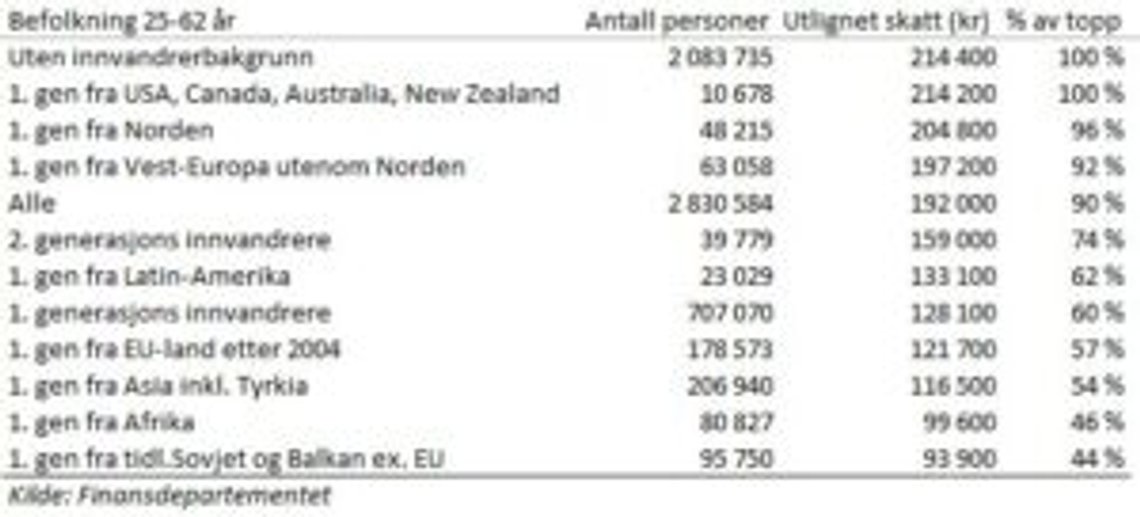
At the top of the table stands the majority population without an immigrant background. At approximately the same level we find immigrants from the United States, Canada, Australia and New Zealand. Unfortunately, there are only just under 11,000 of these in Norway.
First-generation immigrants from the Nordic countries and other Western European countries also rank above the average, with assessed tax of NOK 204,800 and NOK 197,200 respectively.
Non-Western at the bottom
At the very bottom we find the immigrant category from the former Soviet Union and the Balkans outside the EU. This group is dominated by war refugees from Ukraine with low labour market participation.
In the article “The population is being replaced at a blood price” (“Befolkningen skiftes ut til blodpris”), we nevertheless substantiated that the low labour market participation among Ukrainians is not persistent. The reasoning is that Ukrainians in Norway with longer residence periods are at the top of the employment statistics.
By contrast, the statistics show that immigrants from Africa and Asia have persistently low labour participation in Norwegian society. These also have a disproportionately high consumption of tax-financed benefits and services.
The figures from the Ministry of Finance show that African immigrants in Norway are only just above war refugees from Ukraine in assessed tax per person. The financial contribution from an average African immigrant through the tax system amounts to only 46 per cent of the contribution from an average person without an immigrant background. The largest African immigrant group is from Somalia.
Category number three from the bottom is immigrants from Asia, where immigrants from the Middle East leave their sombre mark. This is demonstrated in the article “Concealing facts by pointing to the ageing wave” (“Gjemmer bort fakta ved å peke på eldrebølgen”).
The children of immigrants pull down
Even Norwegian-born persons with immigrant parents contribute significantly less than the average, at only 74 per cent of a person without an immigrant background.
In the figures from the Ministry of Finance, this group is not divided according to the region from which the parents have immigrated.
The markedly lower contribution through the tax system is a typical sign that this group, in aggregate, is not sufficiently integrated into Norwegian society. This group should therefore be divided according to country of origin and examined more closely.
Low contribution and high welfare consumption increase taxes and the use of oil revenues
In the current year’s state budget, expenditures amount to NOK 2,165 billion, while revenues excluding petroleum revenues (tax from oil companies, direct revenues through state ownership and dividends from Equinor) are estimated at only NOK 1,712 billion. The deficit in the state budget before it is balanced through the use of oil revenues is NOK 452 billion – the oil-adjusted deficit.
In the article “We spend all the money on non-Western immigrants” (“Vi bruker alle pengene på ikke-vestlige innvandrere”), we substantiate that the net fiscal burdens related to the non-Western immigrant population correspond to this deficit.
In 2024, the oil-adjusted deficit was NOK 346 billion. The estimate for 2025 is NOK 475 billion. An update of the current year’s state budget will be provided in the revised national budget in May.


