


Many with high housing debt have experienced reduced real income from 2021 to 2023, according to a recent report from Statistics Norway (Statistisk sentralbyrå, SSB). That ought perhaps to have been something for the newspapers to highlight, and perhaps also to confront the government with?
Unfortunately, that is not how it functions when the deep state encompasses both the government apparatus, the institutions, and the largest media, and the state prefers to keep ordinary people down.
On page 49 of the report “Economic Analyses 2/2026: Outlook for the Norwegian Economy 2025”, which SSB has recently published, it is stated in black and white:
When we take into account that interest expenses reduce disposable income, we find that a large group of homeowners with high debt have experienced reduced real incomes from 2021 to 2023.
Well, fancy that? This comes as no surprise to anyone, and everyone who does not live in a closed prosperity bubble knows that many Norwegians have had less to live on in recent years.
So what happens to this information when NTB produces a piece about the report? It disappears: “SSB report: People do not have less to live on – even if it feels that way”, reads the headline. And Aftenposten gives the NTB piece prominent visibility on the front page. You have been deceived by your loan, you fool:
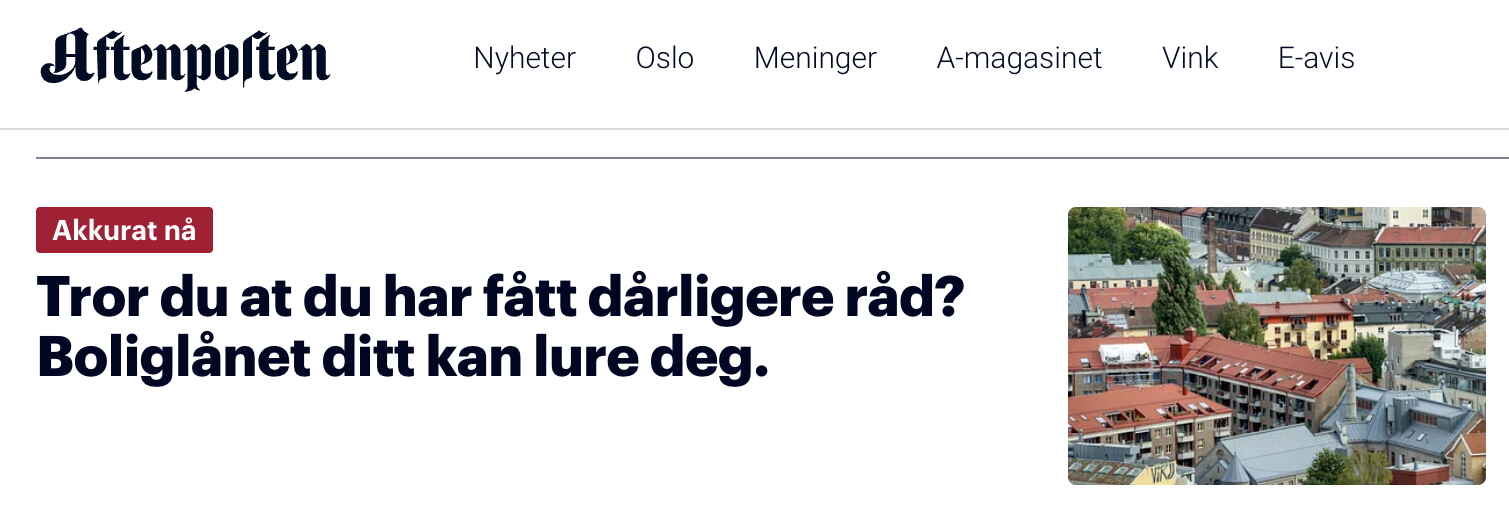 Norway’s supposedly conservative newspaper Aftenposten claims: “Think you’ve got less money? Your mortgage might be fooling you.” Screenshot: aftenposten.no
It varies somewhat how “Over-Norway” reacts when that troublesome population complains of its distress. DNB chief Kjerstin Braathen sat in Davos in 2022 and said that “we” must accept that the energy transition will entail pain, energy scarcity, and inflationary pressure. She might perhaps have mentioned immigration and the Norwegian state’s criminal wastefulness, but never mind—now we have received a foretaste of the pain.
But the Støre regime cannot be seen to acknowledge this, so we are to be convinced that they are engaged in “safe governance”. Then it is good to receive a helping hand from NTB.
The ingress is slightly less bombastic than the headline:
Are Norwegians steadily getting less to live on? That is a perception which is not entirely in line with developments in Norway in recent years, according to an SSB report.
One is tempted to wonder what that “not entirely” means, and reads on.
On Tuesday, Statistics Norway (SSB) presented the report “Outlook for the Norwegian Economy 2025”.
There, SSB’s researchers have, inter alia, taken a closer look at the concept of high cost of living and whether people have in fact had less to live on in recent years. The researchers state that it is not entirely correct that people in Norway have had poor finances over the past five years.
Not entirely, indeed—thank you very much. So what is the solution to this riddle?
SSB researcher Audun Langørgen is among those who have worked on the extensive report:
– Income developments in recent years have been sufficient to compensate for the increased inflation. This means that many households have experienced increased real incomes, but in the same period many report that they have had less to live on. There appears to be a discrepancy between developments in objective and subjective economic indicators, says Langørgen to NRK.
Exactly what a “subjective economic indicator” is, is left as an exercise to the reader. Does anyone believe that, for example, NOK 4,000 appears on the electricity bill when it is in fact NOK 2,000?
No, it is presumably people’s perceptions:
He says that it is particularly homeowners who report that they have had less to live on.
– When more of them experience having less to live on, this may be due to the increased interest expenses.
Well, would you look at that? Do people also have loans? Then they may well deserve it. Though how does one obtain ownership of the roof over one’s head in the Kingdom of Norway without taking out an enormously high bank loan, if one is so unfortunate as not to belong to the wealthiest third of the population who can surf on family wealth? But we note that the payment of interest and instalments is to be regarded merely as perceptions; it is not something real.
The researcher suggests that the disadvantages are offset by the advantages:
But at the same time it may indicate that homeowners underestimate the inflation gains they have on their loan, he says.
And otherwise there is much imagination at work:
He believes there are many reasons why people have a perception that they have had less to live on, while in reality the situation is not quite so bad.
– People fixate on the price of very visible goods that they purchase often and that they notice a great deal. This can also drive the perception that everything is becoming more expensive and that one has less to live on, says Langørgen to NRK.
Yes, is it not foolish that people fixate on the fact that, for example, bread costs much more than a few years ago? Those simpletons should in fact not eat so much bread. But if they cannot afford to reduce carbohydrates in favour of appealing fresh goods from the meat, vegetable, or fish counter, could they not instead eat cake?
In any case: many have indeed had less to live on, and this is evident from SSB’s own documents. But our overlords are fortunate that the official consumer price index (CPI, KPI) has become a kind of preferred measure of inflation, and it does not take into account more expensive housing loans. SSB writes this itself:
Since interest expenses are not counted as consumption expenses in the CPI, the measured inflation does not take into account that it has become more expensive to service loans.
But then one must also not use “the measured inflation” blindly to conclude that people have “good finances”. One can have poor finances in many ways, not least because the state has devised many ways of being unpleasant towards people.
“How to Lie with Statistics” is the title of a classic by Darrell Huff from 1954. It is no coincidence that the title of the first chapter is “The Sample with the Built-in Bias”—that is, a situation in which the data one collects has an inherent skew.
The art of making a truth appear as a lie, or a lie appear as a truth, has a large statistical arsenal at its disposal, and one of the better tricks is to look only at the data that supports the desired conclusion and—forgive the expression—ignore those that do not.
The principle applies both to the definition of indices and to the presentation of findings.
You have thus had less to live on, but the deep state gaslights you: it is not true. Keep quiet! And be grateful that the boot’s pressure is only verbal.


