

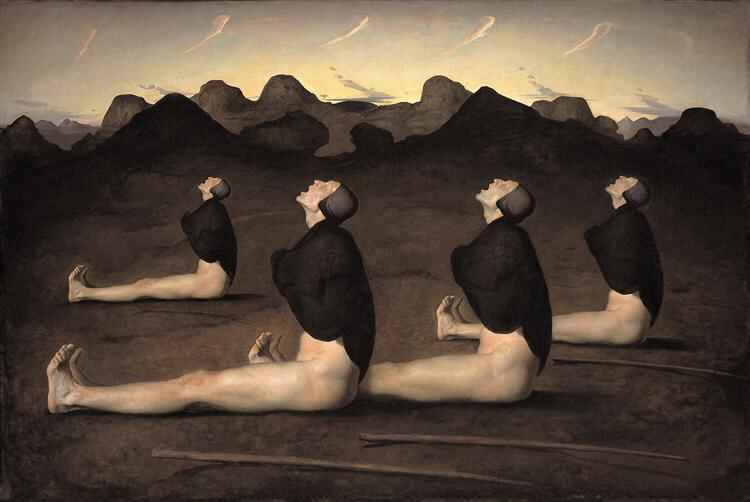
 Odd Nerdrum, “Dawn” (1990)
DR is currently showing a documentary series about the Norwegian painter Odd Nerdrum. It is a good opportunity to take a closer look at this masterly painter. Why is he so controversial? And why is he so good?
Odd Nerdrum is an anomaly. At a time when art prefers to be concept and communication, he stands at the easel and paints, as though the old masters still lived. In that sense, he can be compared with the equally outstanding Danish painter Thomas Kluge.
Like Kluge, Nerdrum has also been accused of painting kitsch. Nerdrum has even himself chosen the word “kitsch” for his project. It is not meant ironically. It should rather be understood as a declaration of war against a culture that wishes to explain everything and therefore no longer sees anything.
They do not at all see how anti-modern Nerdrum’s project is, in a positive sense. It is untimely art in Nietzsche’s sense: art that the age lacks, but has need of.
Strauss on Nerdrum
In literature we find a spiritual affinity in the German poet and cultural critic Botho Strauss, and it is precisely Strauss who has written a profound and original essay on Nerdrum.
Strauss sees in Nerdrum an artist who has created a closed counter-world to modern visual art.
Whereas contemporary art concerns itself with ideas, institutions, and critical strategy, Nerdrum’s canvases show another order altogether: epiphanic images that strike like a shock. A mythical intensity that cannot be translated into theory.
Nerdrum is a painter for everything that our age would most like to explain away. Truth appears as sudden revelations, as pictorial shocks that cannot be explained, but only endured; as mythical scenes and an almost unbearable intensity that lies far beyond the reach of enlightened, rational discourse.
Nerdrum’s images show that man is embedded in an order he has not himself created. Instead of staging identity and the liberal individual’s sovereign self-mastery, he shows human beings as entities that stand before something older and more impenetrable than themselves: earth, heaven, time, guilt, fate, tragedy.
The landscapes are timeless, the costumes enigmatically without history, and the figures do not live in a recognisable “now”, but in a kind of permanent aftermath. In the fundamental tone of the works themselves there likewise lies an attachment to the pre-modern: a mistrust of belief in progress, a deep knowledge of the inevitability of tragedy, and an intuition that dignity arises in the manner in which one bears one’s misfortune.
Where modern consciousness rushes towards the next solution, Nerdrum halts time and allows us to see what it means to be bound to fate, inheritance, and a world that was there before us and will be there after us.
The anti-modern in Nerdrum
The anti-modern also manifests itself in Nerdrum’s rejection of the ideal of self-creation. The world of the figures is not plastic, but marked by inevitability: they do not enter an open future, but find themselves in situations where the outcome already appears inscribed in the scene.
This is expressed in the way the bodies are positioned—as if they respond to forces that run counter to their own intentions—and in a pictorial economy where everything superfluous has been cut away, so that only the inevitable remains.
Nerdrum’s relation to style and technique is also anti-modern: he insists on a slow, craft-based labour and a resumption of a figurative tradition that modern art has officially left behind.
Why do Nerdrum—and Thomas Kluge—do this?
Because the fundamental situation of man—vulnerability, guilt, longing for meaning—is best safeguarded by forms that have already demonstrated their durability through centuries. In a culture that celebrates rupture and novelty, Nerdrum responds with continuity and weight.
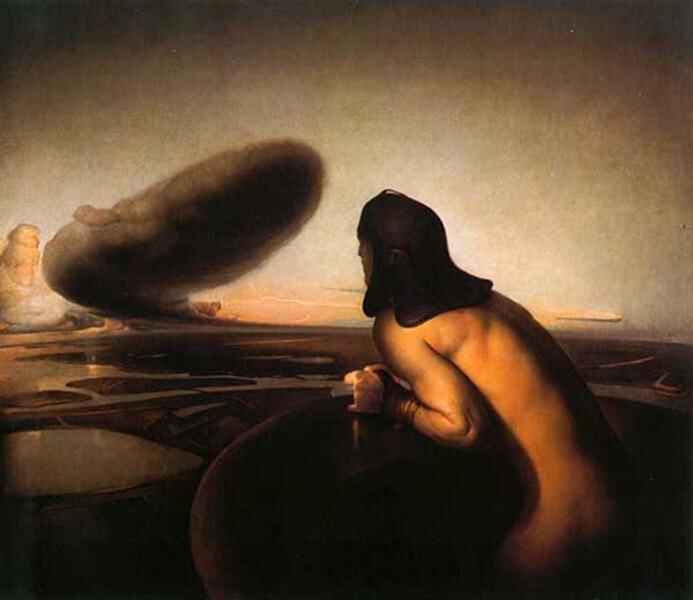 Odd Nerdrum, “The Cloud” (1985)
In Nerdrum, everything that the dominant, optimistic reason hopes to be able to resolve through conversation and argumentation is transferred into images that cannot respond. Where modern thinking understands man as a participant in an open dialogue, his paintings show a human being who stands before experiences that cannot be negotiated: death, loss, fate, grace.
Instead of illuminated transparency, we are given enigmatic condensation; instead of the ideal of domination-free communication, we are given figures who cannot even communicate with one another, but only with a dim horizon.
Nerdrum paints the residue of experience that remains when one has talked through everything and discovers that there still stands a naked body beneath a heavy sky.
Kitsch as counter-art
Back to the question of kitsch.
For Strauss, it is decisive that Nerdrum not only tolerates the label “kitsch”, but himself makes it into a programme, and that this is precisely his greatness. In an art world where kitsch is normally a term of abuse for sentimentality and technical skill in a spiritually empty imitation, one can reverse the perspective: in Nerdrum, kitsch is the form in which the banished seriousness can return.
That the paintings resemble something from a lost figurative tradition is a sign of resistance to a modernity that has lost contact with the tragic and the metaphysical. Kitsch here means: images that dare to be pathetic, narrative, “too much”, and which precisely for that reason can bear experiences of tragedy, fate, and grace that the loud, ironic contemporary art can no longer contain.
Nerdrum’s kitsch will not enter as an ironic commentary within the circulation of modern art; it is seriously meant, and that is precisely what makes it scandalous.
If Nerdrum painted in a modernist style, the works would sooner or later be absorbed and domesticated as a style within the modern canon and the modern art institution. Kitsch is deliberate anachronism, seriously intended pathos, uncompromising figurative narration across the rules of the modern art game.
Precisely for that reason, Nerdrum’s painting functions as counter-art, but not in the old avant-garde sense, where the new shatters the old, but the reverse: the old, banished language of form returns in order to shatter the self-evidences of the present from within.
Return of the Sun
Finally, let us look at the masterpiece “Return of the Sun” from 1986:
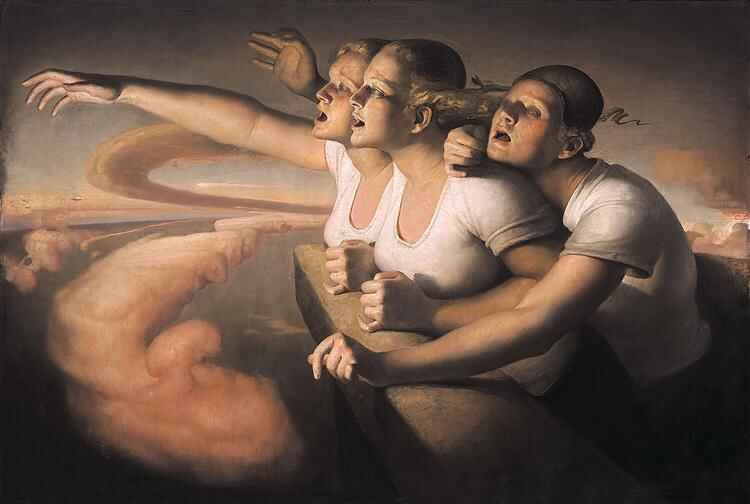
Three young women stand at the edge of the world and reach out towards a light we never see directly. Mouths and eyes are open, but the eyes are dull—blind, we must assume; they respond to a radiance they cannot see. The blindness shows precisely that the relation to the horizon is not enlightened insight, but a dim, mythical attraction: man stands here not as a seeing, modern subject who masters his perspective, but as a being that gropes towards a light on which he is both dependent and threatened. As if they both pray and cry out towards something they only sense.
Is the return of the sun salvation or downfall?
The image does not answer. The painting leaves us in unrest and holds us fast in a duality that modern consciousness would prefer to escape: that the horizon can be both beginning and end, both promise and judgement, grace and perdition.
That time may be in the process of running out, while something else is on its way in.
Man is a frail, partially blind being beneath a restless sky.
There are still truths that can only be sensed when the light suddenly falls upon a canvas.


