

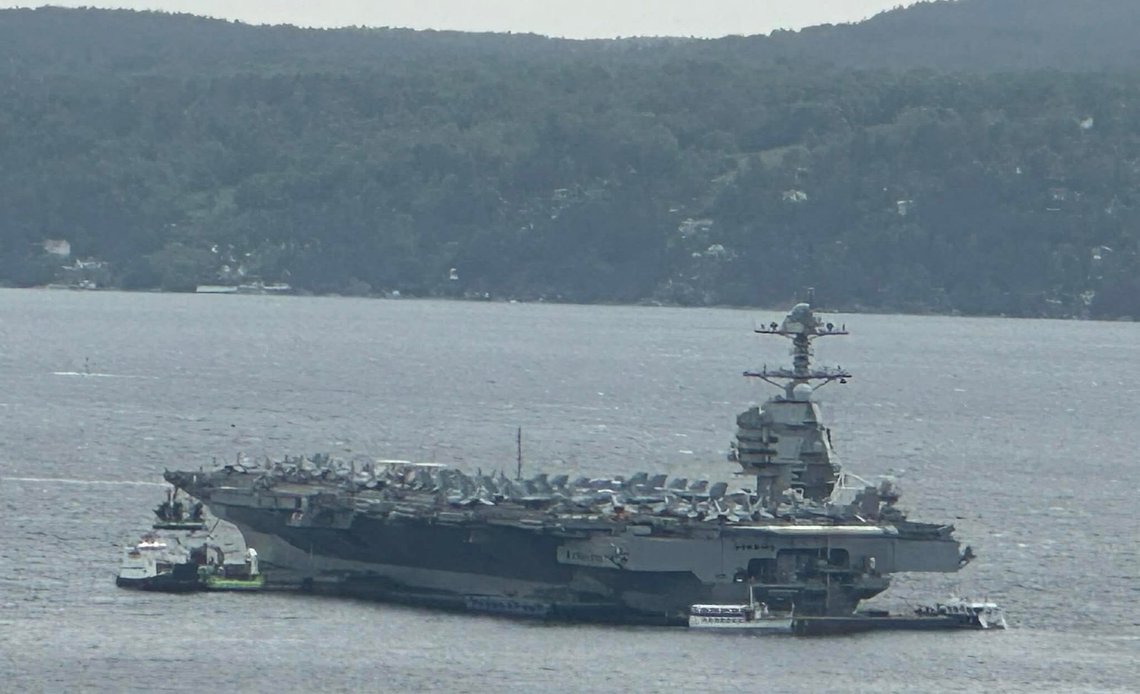
Trump is now doing what must be done in order to secure control over the Strait of Hormuz.
The United States has turned off the oil tap and Iran’s most important source of income in order to deprive it of the means to keep the war going. Iran threatens to attack the American naval task force, close the Strait of Hormuz to all shipping traffic, and thereby paralyse the world economy.
The question is not merely which side is militarily stronger: the American carrier strike group, with its superior conventional military capabilities, or Iran’s mosquito swarm of fast small craft with asymmetric capabilities?
It also concerns how the rest of the international community will react. While the totalitarian theocratic regime in Tehran has for several decades adapted itself to the Western sanctions regime, the world economy is already now struggling under the pressure of reduced oil supplies.
What will China, India, and the non-aligned countries do? What position will the United States’ Western allies take? Iran’s actions are clearly contrary to both the law of the sea and international law, but thus far the Western allies have given their diplomatic support to Iran and accused the United States of violating international law.
As the many wars that the United States and NATO have lost in the Middle East over the past thirty years bear witness, the answer is not given. War does not concern military capacity alone, but also economics, logistics, ideology, willingness to fight, domestic politics, alliance relations, and the global balance of power.
Great powers may lose wars, not because they are militarily weak, but because they underestimate how rapidly economic shocks, the reluctance of allies, domestic political opposition, and the adversary’s asymmetric instruments can turn victory in a battle into defeat in a war.
The war between the United States and Iran has consequences for us in Norway as well.
Whether the attack on Iran was contrary to international law or not, objectively speaking we share the interests of the United States and Israel in that the fanatical theocratic clerical regime in Tehran cannot be permitted to possess nuclear weapons. The Norwegian government ought already at an early stage to have made that clear.
The lack of support from the Norwegian side undermines the Euro-Atlantic relations, our relationship with the United States, and thereby long-term Norwegian security interests. To cling to the skirts of Ursula von der Leyen and an EU that has nothing to offer militarily is a poor alternative.
Furthermore, if the war increases the oil price and the revenues of the wealthy Norwegian state, it also increases petrol prices, food prices, mortgage interest, and rent for the relatively poor Norwegian households. The government can afford to compensate for that itself, even if it is reluctant to do so.
The naval war in the Gulf also negatively affects Norwegian shipping. Norway is the world’s fifth-largest shipping nation and has every interest in keeping the Strait of Hormuz open, and in preventing Iran’s attempt to control the Gulf from creating a precedent for shipping in other parts of the world.
The government ought to support the United States diplomatically and send one or two Norwegian minesweepers to the Gulf in support of the United States, which itself has limited minesweeping capacity. Instead, Støre slavishly follows the heads of government of the EU, who evidently suffer from a collective Trump Derangement Syndrome.
Last but not least, the experiences of any naval war in the Gulf have implications in relation to the ongoing modernisation of our own navy. The six advanced and super-fast stealth corvettes of the Skjold class, the world’s fastest warships, are to be replaced with 12 simple but slow standard ships as part of the close coastal defence.
The experiences from the land and air war in Ukraine, with precision-guided missiles, cheap mass-produced drones, and AI-controlled drone swarms, are areas in which Ukraine and Iran have advanced further than the United States and the NATO countries.
If the fanatic Revolutionary Guard’s “mosquito navy” should dare to launch a swarm attack against the American carrier strike group, it would represent something entirely new in naval warfare.
That would, inter alia, have transfer value with regard to the twelve new ships with traditional hulls that are to replace the super-fast Skjold class for defence in our coastal waters. These make barely 20 knots.
Here we shall take a closer look at the relationship between the parties’ military capabilities: the conventionally superior American carrier strike group versus Iran’s dangerous and mobile “mosquito fleet”. The danger of American economic and political “overstretch” has been discussed by us previously.
The Americans are deploying a significant conventional naval force.
Based on USNI News Fleet, Marine Tracker, and CENTCOM reports, two American Arleigh Burke-class missile destroyers are already now in the Gulf of Oman. They passed through Hormuz on 11 April in order to prepare mine-clearing together with USS “Canberra”. Two additional minesweepers are on their way to the Gulf.
Further out in the Western Indian Ocean lies the carrier strike group Abraham Lincoln Carrier Strike Group with USS “Abraham Lincoln” together with 8–10 destroyers and 3 landing ships with the 31st Marine Expeditionary Unit.
The carrier strike group “Gerald R. Ford” is in the Red Sea and is ensuring that the Houthis in Yemen do not close the Bab el-Mandeb Strait. The Houthis have threatened to close the strait, but have so far kept quiet. The Americans obviously have a clear plan; there should be no doubt about that.
The American air power force in the Gulf consists of 70–90 aircraft as well as helicopters aboard USS “Abraham Lincoln”. They come in addition to the land-based American air force in Bahrain and Qatar, as well as an unknown, but probably smaller, number of drones for aerial surveillance and a few underwater drones for mine-clearing.
Aboard each of the carrier strike groups there are 5,000–6,000 personnel as well as 2,200 US Marines for any landing operations. On land in Bahrain there are approximately 8,300 sailors in the US 5th Fleet, in total by estimate just over 15,000 men.
In addition, a further carrier strike group, USS “George H.W. Bush” and associated warships with an additional 6,000 personnel, as well as 4,200 soldiers from Boxer Amphibious Ready Group, is on its way.
The Boxer group is an amphibious ship group consisting of USS “Boxer”, USS “Portland”, and USS “Comstock”. The group’s associated marine infantry unit is the 11th Marine Expeditionary Unit. They are obviously heading for Kharg Island.
On paper, the United States has assembled more than enough capacity for air superiority, surface control, and to control traffic through the Strait of Hormuz. Mine-clearing is more challenging. The old Avenger minesweepers have long since been condemned. At the time of writing, the United States has turned back 13 ships from Iran.
Iran’s navy has a wholly different structure and orientation.
Most of the regular Iranian navy and the conventional surface fleet were destroyed already during the first five days of the opening phase of the war. According to CENTCOM chief Adm. Brad Cooper, more than 60 Iranian ships are said to have been sunk or destroyed.
What remains is the Revolutionary Guard’s mosquito navy (IRGCN). It is based on an entirely different combat concept and a mass of fast small boats with missile platforms that can operate in swarms.
During the tanker war between Iran and Iraq from 1980 to 1988, Iran did not have much with which to confront Iraq’s French Mirage fighter aircraft with Exocet missiles. They had 50–60 fast Swedish Boghammar boats (13–14 metres long) equipped with 12.7 mm machine guns and American Sidewinder missiles with short range and limited explosive force.
The situation today, almost 40 years later, is entirely different. The Revolutionary Guard still uses some of the original Swedish Boghammar boats, but has since built up a large fleet of thousands of fast small boats, which attack simultaneously in swarms from several directions in order to overwhelm and attack a superior enemy, for example an American carrier strike group.
The IRGCN has an estimated 1,000–5,000 such small boats, all of which are produced in Iran, and new ones are continually being produced. One hundred and ten were launched in 2021, as well as 340 in 2024. Many are based on civilian racing boats or copies of foreign designs. These boats will be central to Iran’s asymmetric warfare against the American naval force.
Whereas the Boghammar boats could make up to 46 knots, the new boat types can make up to 80–90 knots. By comparison, the far larger Norwegian stealth corvettes of the Skjold class make close to 70 knots. They are the world’s fastest warships. The Iranians have copied speed and mobility, but distributed the capacity across far more and far smaller platforms.
The Iranian Serjai 1 class is a copy of the British racing boat Bladerunner 51. It can make up to 75 knots and is armed with a 12.7 mm machine gun and 107 mm 12-tube rocket launchers.
The Zolfaghar class is a 17-metre missile boat armed with anti-ship missiles with a range of 35–40 km and can make 52 knots. Some variants also have torpedoes and short-range air-defence missiles.
The Ashura class and the older Peykaap class are also equipped with 107 mm rocket launchers and are used to lay mines. They can also fire torpedoes. Newer models have radar-reducing stealth hulls, better engines, and are integrated with drones.
Unlike the situation in the 1980s, when Sidewinder missiles were used from improvised platforms, today’s missiles are dedicated anti-ship weapons with active radar guidance. The boats are fast and difficult to hit in large swarms, and they are cheap and easy to produce in large quantities.
This is the IRGCN’s “mosquito fleet”. It is not intended to win major naval battles, but to create chaos, threaten oil tankers, and deter larger naval vessels in narrow waters such as the Strait of Hormuz. In addition there are mobile missile and drone batteries concealed on land along the whole of Iran’s 1,600-kilometre coastline on the eastern side of the Gulf.
American gunboat diplomacy in the Gulf is not without risk.
With its air superiority, the American carrier strike group has the capacity to take out large parts of the IRGCN’s fleet, but probably not all the vessels and all the missiles and drones with which they are equipped. And that is the core of the asymmetric Iranian naval strategy.
Some in the swarm will probably penetrate the American missile defence, just as we have already seen Iranian missiles penetrate missile defences in Israel and in the Gulf states. It takes only a small number of hits for Iran to be able to keep the Strait of Hormuz closed.
The United States’ conventional power projection capability is challenged by new technology, Iran’s asymmetric military naval strategy, and Iran’s willingness and ability to endure losses. It is not sufficient to defeat the superior American sea power. But it may be enough to keep the Strait of Hormuz closed. That remains to be seen, but Trump is probably somewhat overly optimistic when he already now claims that “The war is close to over”.
Should one or more of the ships in the American carrier strike group be damaged or even sunk, this will have major consequences both domestically in the United States, for the United States’ global power projection capability, and for the oil price and thus for the world economy.
It is herein that the danger of American overstretch lies above all, together with difficult Western allies who in part work against the endeavours of the Trump administration to neutralise the Iranian regime.
Trump has time against him, whereas Iran has it on its side. The American blockade will stop oil revenues. At the time of writing, CENTCOM reports that the United States has turned back 9 oil tankers from Iran, without confrontation.
But Iran has an enormous black economy, a hardened population with long training in enduring difficult conditions, as well as a fanatical religious leadership and a Revolutionary Guard that thinks asymmetrically. The Revolutionary Guard’s willingness to fight is the X factor in the equation.
The government is undermining the Euro-Atlantic relations
That Norway and the European NATO countries are so openly working against the Trump administration both diplomatically and through a lack of military support does not make the task easier.
Nor does it contribute to repairing the Euro-Atlantic links upon which our own security is so dependent.
The government’s policy is short-sightedly opportunistic in relation to the EU, and antagonistic in relation to the Trump administration and the United States. It is not in accordance with Norway’s long-term security interests.


