

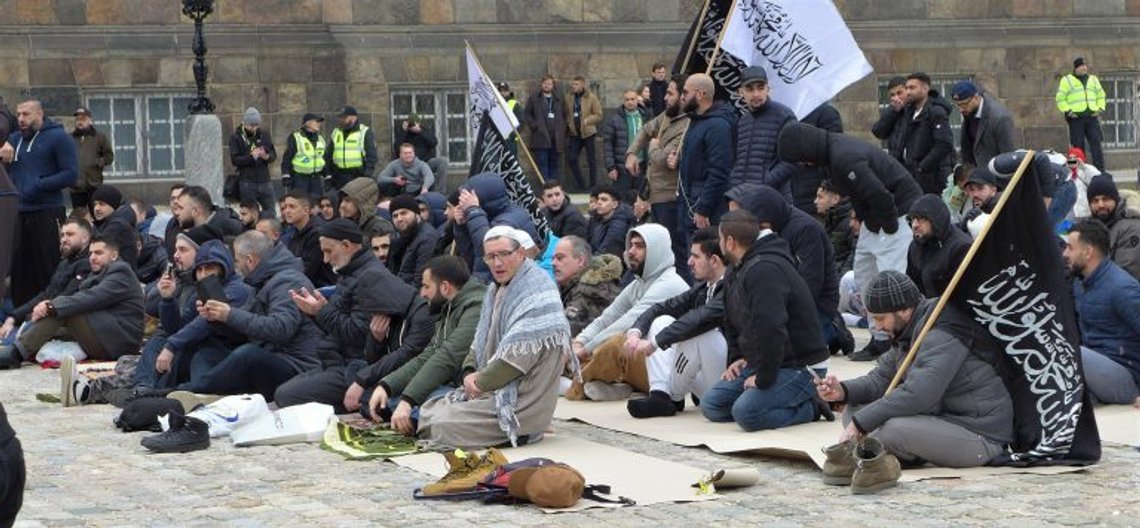
We do not need artificial intelligence. It is enough to switch on French television.
An interviewer asks: “Is this neighbourhood in Marseille calm?”
A left-wing woman replies: “Yes, it is peaceful and diverse, we live in peace.”
Suddenly, a man appears who threatens a Frenchman because he is smoking during Ramadan, and says that “it is haram and provocative”.
Such an incident on live television is not something one can stage.
Who would have believed that? Even George Soros’ Open Society once established that “30 per cent of the population of Marseille are Muslims” (the report is from 2011, so the figures are already outdated and must be increased).
To the usual fits of laughter from commentators and Twitter users, Donald Trump caused scandal among the right-thinking when, ten years ago, he claimed that “no-go zones” were in the process of emerging in Europe. No-go zones? Surely that was just another of Trump’s lies.
David Ignatius had already used the term in the New York Times, where he explained that certain areas in Paris had become “no-go zones”. Later, Michael Nazir-Ali, the Bishop of Rochester, spoke of “no-go zones” in England. Since then, it has been an open secret, and even Angela Merkel has admitted that this is a reality in Europe, while France’s former socialist president François Hollande has said: “How can we avoid separation? For that is what is happening: separation.”
This happens when one believes that cultures are as interchangeable as clothes. And separation prevails over the “narrative”.
When one reads these figures, one understands that Marion Maréchal is not so daring when she says that France may soon become “a new Muslim country”. For my own part, I would add that it is no coincidence that the first European vessel the Iranians allowed through the Strait of Hormuz was French.
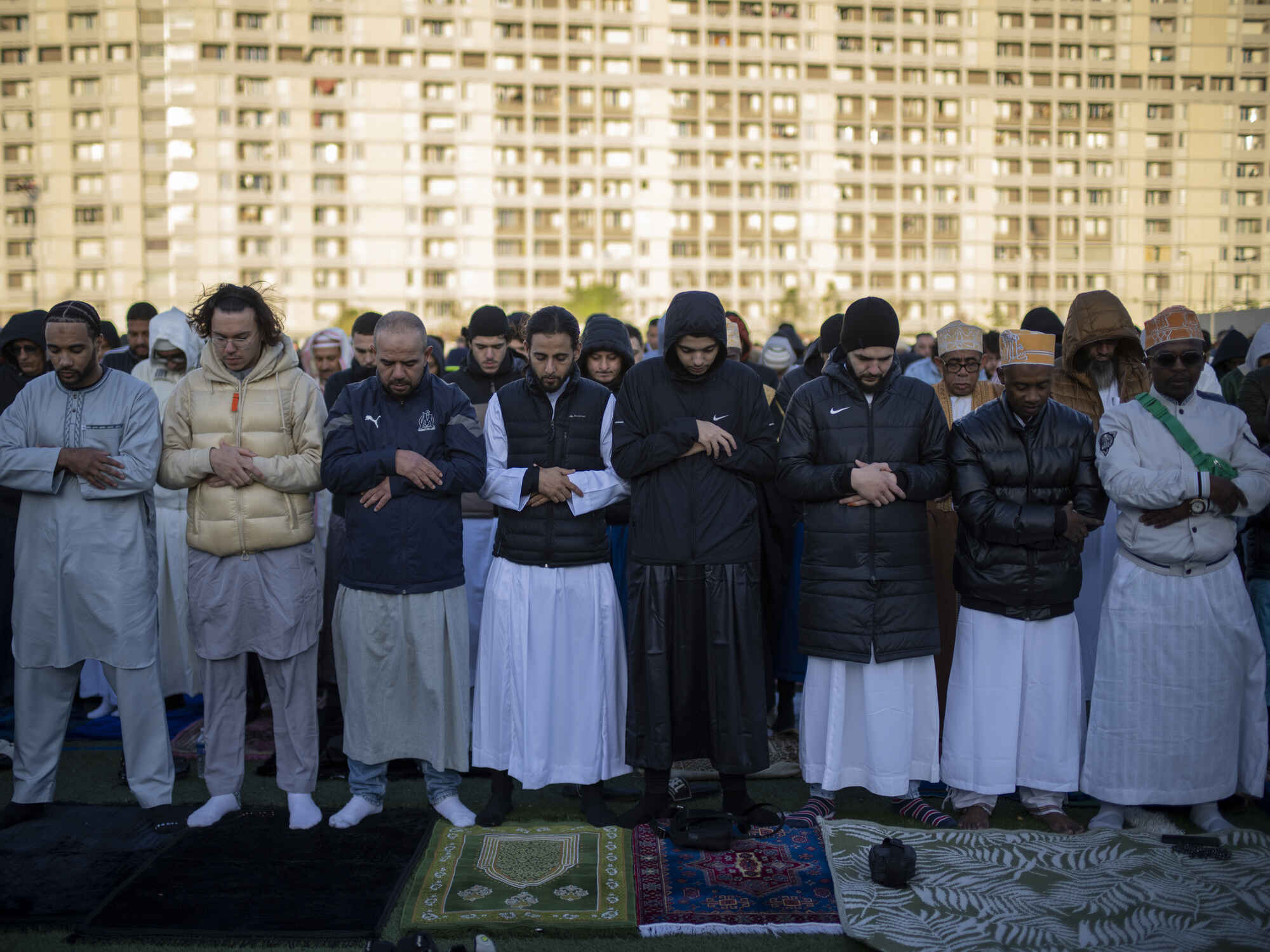 Muslims take part in Eid al-Fitr prayers marking the end of the fasting month of Ramadan at the Malpasse football stadium in Marseille on 10 April 2024. Photo: Daniel Cole / AP / NTB.
In the areas where they were recently elected, the mayors from La France Insoumise (LFI) are already making themselves noticed. The use of violence and sectarianism presents a disturbing picture of a France in the hands of the far left.
In Saint-Denis, Mayor Bally Bagayoko – who is of Malian origin and was elected already in the first round – now leads a city of more than 150,000 inhabitants. The handover to the new administrations did not take place in a calm manner. In the hours following the victory of LFI and their allies, images circulated showing violence, insults and pushing directed at the outgoing mayors, and it provoked indignation.
In some cases, the outgoing mayors were even escorted away by police: the socialist Hélène Geoffroy, who was defeated by just 104 votes by the LFI candidate Abdelkader Lahmar in Vaulx-en-Velin outside Lyon, was humiliated by residents present when the results were announced. Sophie Dhoury-Lehner, who was defeated by Omar Yaqoob in Creil in the department of Oise, has also complained of insults and threats against her team.
After Saint-Denis and Creil, Mantes-La-Jolie and Le Blanc-Mesnil, the list has grown long of cities where outgoing mayors have been escorted out amid threats and mockery in a toxic atmosphere. This gives the impression that the new mayors are celebrating a territorial conquest rather than an electoral victory.
In Saint-Denis, Bagayoko has announced that he intends gradually to disarm the local police, which concerns police officers. According to police sources cited by Europe 1, nearly half of the city’s 140 police officers are already considering requesting transfer.
Disarming the police in already tense situations is not progressive naivety, but a clear political signal: the state is relinquishing enforcement of its rules in certain neighbourhoods. The security barrier surrounding the police is weakened.
Moreover, Fabrice Leggeri, the former head of the EU’s migrant agency Frontex, is under investigation in France for “crimes against humanity”, an empty legal concept now also used to target those who have attempted to stop illegal immigration.
There are up to a thousand “no-go zones” across Europe, and thousands of other “sensitive neighbourhoods”, as a result of decades of mass immigration policy and the failures of multiculturalism.
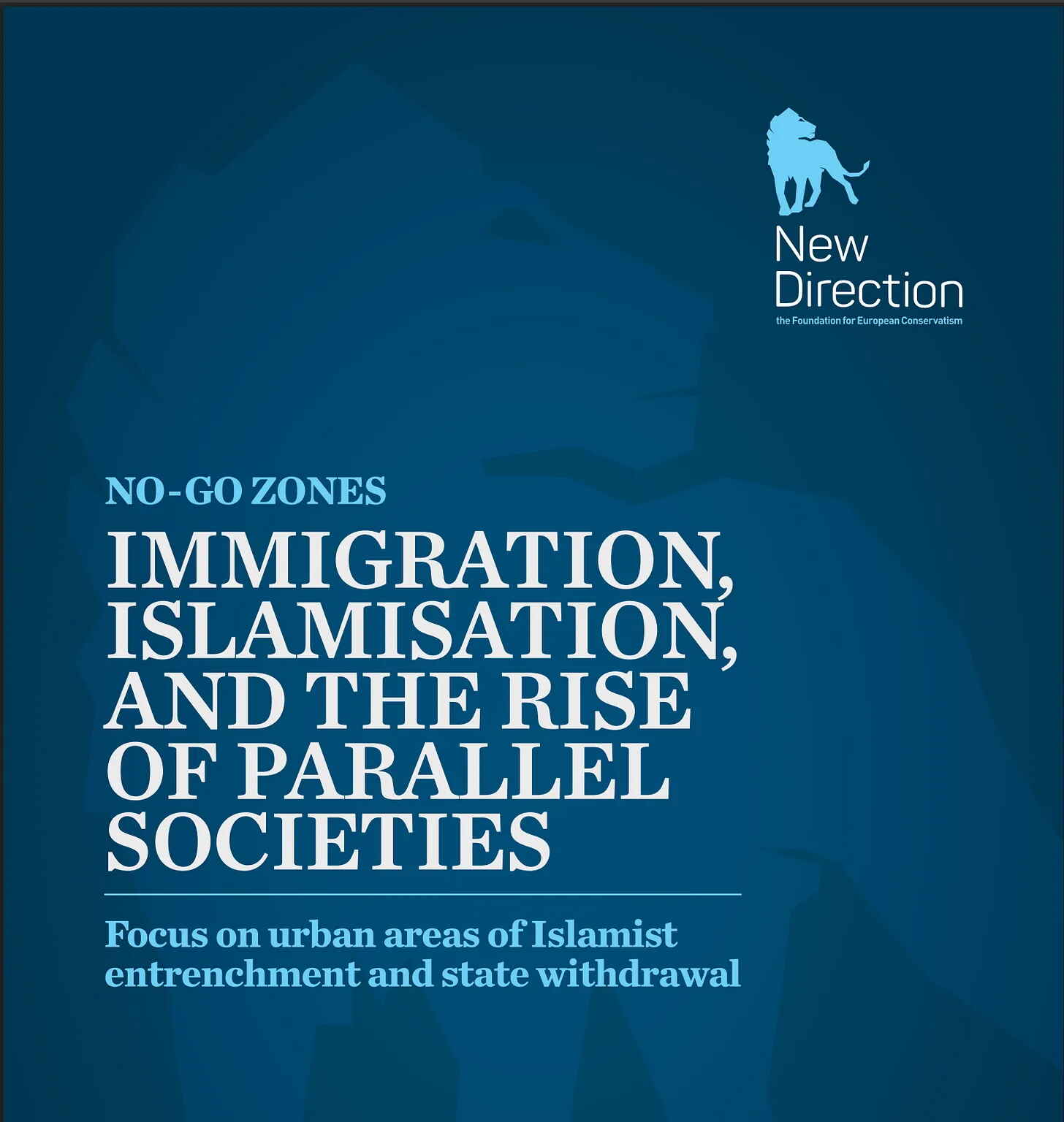
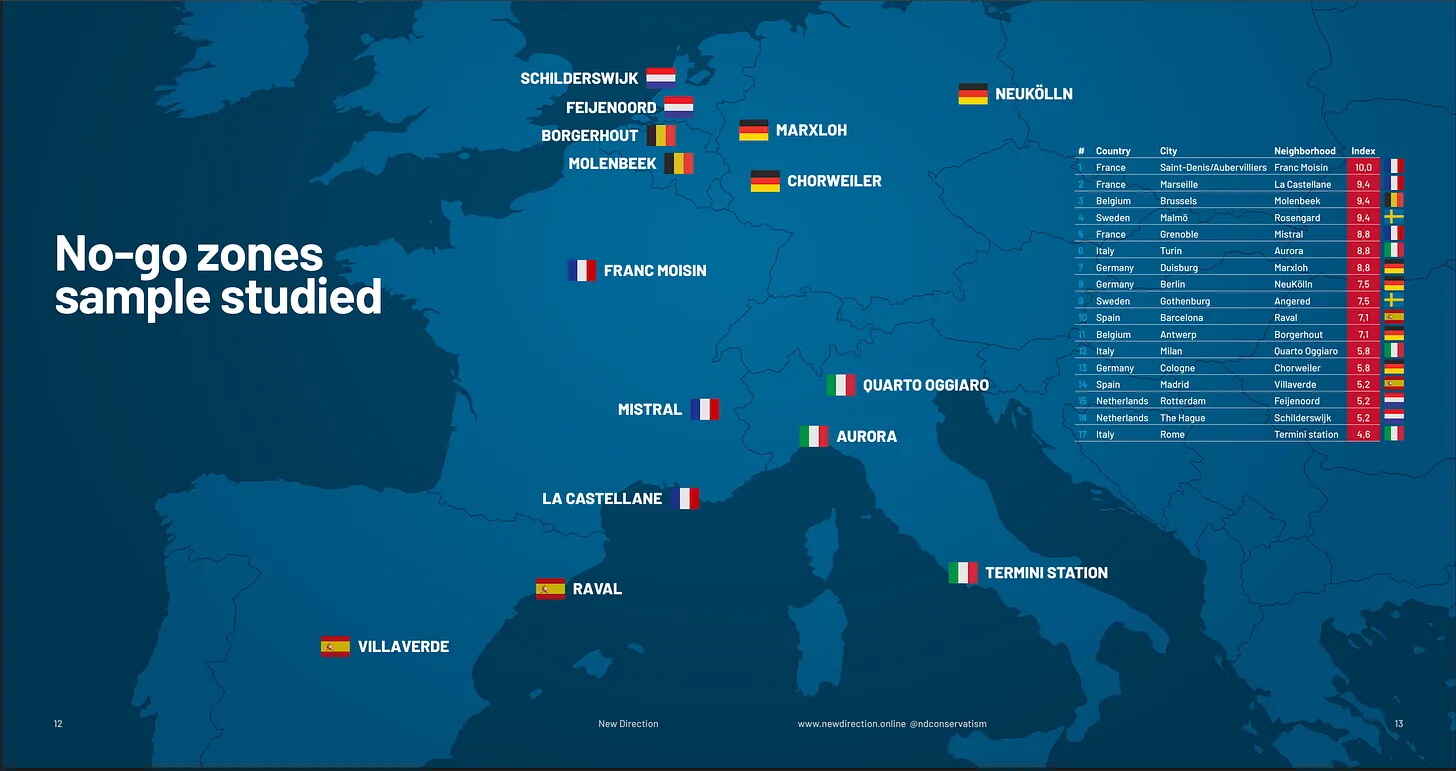
A report entitled “No-Go Zones, Immigration and the Rise of Parallel Societies”, prepared by the think tank New Direction Foundation for European Reform, estimates that there are between 900 and 1,000 urban areas that can be regarded as “no-go zones”, characterised by high crime, social disintegration and weakening of state authority.
In Italy, three risk zones have been identified: Termini in Rome, Quarto Oggiaro in Milan and the Aurora area in Turin, home to the autonomous house Askatasuna.
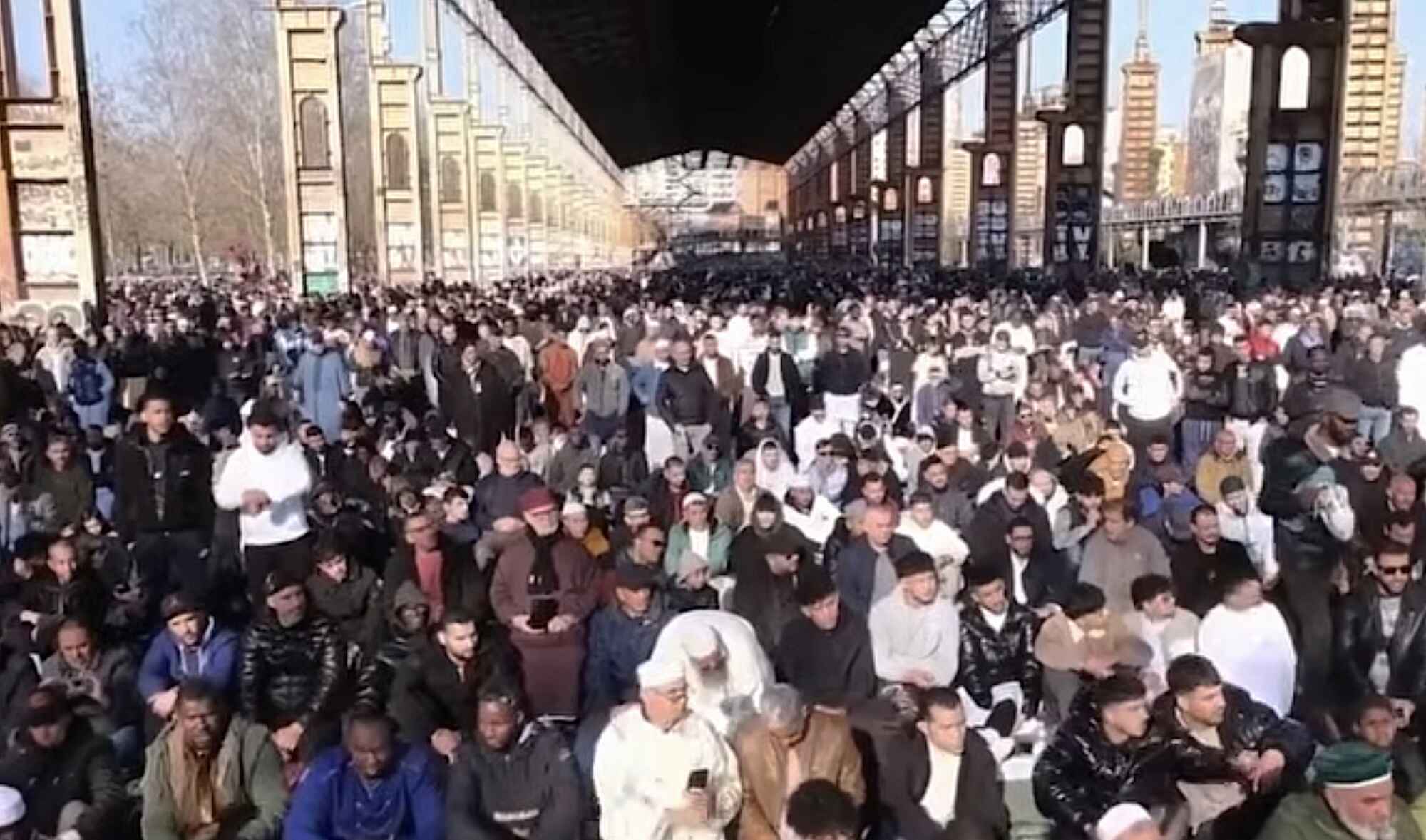 Muslims gathered for prayer at the end of Ramadan in Turin on Friday 20 March 2026. Still image: ANSA / QuotidianoNationale / YouTube.
The analysis is based on data from official reports, media and academic sources, such as Eurostat, the EU drugs agency, OECD, the Pew Center and estimates of the black economy by Friedrich Schneider. The presence of gangs, attacks on police and cases of antisemitism are among the factors taken into account.
The document, prepared by Maxime Hemery-Aymar from the Observatory for Immigration and Demography (OID) in France, draws a direct line from policies of mass immigration and open borders to areas of high crime, weakening of social norms and even support for Islamist terrorism. The think tank has in fact found that 63 per cent of the Islamist terrorist attacks that took place in Europe between 2010 and 2025 had a “confirmed link” to an identified no-go area. The document has moreover found a “strong correlation between demographic composition and spatial dysfunction”, and states that the identified no-go zones have on average a foreign-born population of 40 per cent, compared with the EU average of 20 per cent, while the EU average for cities is 30 per cent.
These areas extend from La Castellane in Marseille to Neukölln in Berlin, from Chorweiler in Cologne to Raval in Barcelona, from Rosengård in Malmö to Feijenoord in Rotterdam.
In North Rhine-Westphalia, Germany’s most populous state and the one with the country’s largest Muslim population, there are 44 no-go zones.
While some governments have tacitly acknowledged the existence of no-go zones, often by disguising them with euphemistic terminology, traditional media have sought to deny their existence, often by reacting with disbelief to a literal interpretation that they themselves have created.
The Migration Research Institute in Budapest, affiliated with the prestigious Mathias Corvinus Collegium, had already estimated that there were 900 areas outside control across Europe.
What do they look like? In these areas, the police, social workers and ambulances do not enter, or they must be protected. High birth rates ensure longevity and expansion. These are places where a woman in broad daylight can be openly harassed and abused for how she chooses to dress. The journalist Jean-Paul Brighelli, who is of Italian origin but lives and has taught in Marseille, tells Le Point: “Here the police are reluctant to patrol certain parts of the city. The problem is not limited to the northern districts of a sick city: it is a gangrene that affects a limb before reaching the rest of the organism.”
These areas are security threats because of the risk of crime, riots and terrorism. Yet this triad is not even discussed. Ultimately, sharia – de facto, not de jure – is respected by people on the ground. Over time, all slaughterhouses become halal, mixed hair salons disappear, and women are pressured to live according to Islamic law. It goes without saying that Jews and homosexuals must not show themselves. The leading German weekly Die Zeit reports on “forbidden zones” for Jews in Germany.
The other day, a Jewish restaurant was ransacked in Munich. The Islamists’ Kristallnacht.
The leader of the Jewish community in Marseille, Zvi Ammar, has asked his co-religionists not to wear Jewish symbols outside the home. A synagogue in Rue Saint-Dominique has been purchased by Muslims to be converted into a mosque.
“In Sweden there are 60 ‘risk areas’,” writes The Spectator. These are areas such as Alby, a suburb of Stockholm known as “little Baghdad”. Here only one in ten residents is Swedish. Swedish ambulance personnel are calling for gas masks and bulletproof vests to protect themselves against a growing number of attacks – “equipment similar to that used by those working in war zones”.
In Stockholm, an Iraqi Christian refugee was killed during a live broadcast on social media because he had burned the Quran.
The Netherlands has mapped 40 areas. The most well known is Schilderswijk in The Hague, where the census already in 2012 showed that ethnic Dutch people constitute just under ten per cent of the population, and where ethnic violence frequently erupts. They call it “sharia wijk”, the sharia district.
Twenty years ago we were concerned with building democracy in the Islamic desert in the spirit of “democracy, whiskey, sexy”, and now we sit here with sharia.
France’s domestic intelligence and security service (DGSI) has mapped 150 districts that are “in the possession of Islamists”. Neighbourhoods, districts and enclaves that are now in the hands of fundamentalists, and which they shape according to their ideology of submission. According to the former deputy head of the foreign service (DGSE) Alain Chouet, who has published the book “Sept pas vers l’enfer” (Seven Steps Towards Hell), “these areas exist in 859 cities, and 4 million people live in them, that is to say 6 per cent of the entire population of France”.
“Clinical psychology teaches us that when a compulsion is blocked, the impulse shifts,” writes Doron Goldberg. “When the situation in the Jewish state deteriorates, extremists may turn to easier targets.” Which ones? Europe.
As Eric Delbecque, former head of France’s National Institute for Advanced Studies in Security and Justice (INHESJ), explains to L’Express, the situation is that “the state has not even set itself up to regain control of these neighbourhoods, and once it begins, it may take up to ten years”.
The problem is that many European governments appear to have concluded that it is too late to prevent an Islamised Europe, and that all that can be done is to mitigate the effects in the present moment and hope that the damage remains confined to the so-called “no-go zones”, preferably not their own.
We do not need to be atom-bombed. We are our own suicide bomb.


