


An average immigrant of working age receives 10 times as much social assistance as an average member of the remaining population. If one focuses solely on non-Western immigrants, the ratio increases to 16. And the trend is now that their Norwegian-born descendants are a rapidly growing group of social assistance recipients.
In the question of what non-Western immigration costs Norway, it is important to illuminate not only what they contribute on average through taxation, but also what they consume in terms of tax-funded public goods.
As shown in this article, the Ministry of Finance has calculated that non-Western immigrants contribute slightly less than half as much through taxation compared with the remaining population, in the age interval 25–62.
https://www.document.news/editorials/2026/04/all-of-norways-oil-money-is-being-spent-on-non-western-immigrants
Pure mathematics dictates that if a non-Western immigrant consumes 2–3 times more tax-funded welfare goods than a member of the remaining population, this explains the entirety of the oil-adjusted deficit on the state budget. This deficit is, as is well known, covered through the use of oil revenues.
In the following, we examine how financial social assistance is distributed between immigrants and the remaining population.
NOK 11.9 billion in social assistance
In 2024, NOK 11.9 billion in financial social assistance was paid out to just over 166,000 persons in Norway. Ref. Statistics Norway’s “statistics on Financial Social Assistance” published 24 June 2025.
In the article “More than half of newly arrived refugees receive social assistance”, published 16 January this year, Statistics Norway writes: “In 2024, 74 per cent of the total disbursements went to immigrants”.
Social assistance is a benefit granted to persons who cannot cover expenses for subsistence. In the Statistics Norway publication of 16 January, Statistics Norway conducted an analysis of who receives this social assistance in the age group 18 to 66 years.
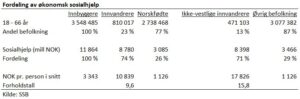
In 2024, there were 3.5 million inhabitants in Norway in the age group 18–66 years. 23 per cent of these were immigrants. Norwegian-born descendants in this age interval are included in the remaining population.
When 810,000 immigrants in this age interval receive 74 per cent of the social assistance, this means that they received well over NOK 10,800 on average per capita. The Norwegian-born population, numbering well over 2.7 million, received on average just over NOK 1,100 per capita.
Ergo, an average immigrant received almost ten times as much financial social assistance as an average Norwegian-born person in the age interval 18–66 years. See attached table.
Non-Western: 16-fold
However, it is natural to separate Western immigrants, from the EU/EFTA/United Kingdom, North America and Australia/New Zealand, from the non-Western, as Western immigrants have a high employment rate. They are labour immigrants and not typically recipients of financial social assistance.
Non-Western immigrants constituted 13 per cent of the population in the age interval. If we assume that Western immigrants in the age group 18–66 years received social assistance per capita equivalent to a Norwegian-born person, this means that an average non-Western immigrant received over NOK 17,800 in social benefits.
In that case, an average non-Western immigrant received 16 times as much financial social assistance as an average member of the remaining population in the age interval 18–66 years.
Note that in the article linked above, reference is made to ratios of 13-fold and 26-fold respectively. This is due to the fact that no selection was made in the population within the same age interval. The ratios of 10 and 16 are thus correct.
The conclusion is that financial social assistance is a factor that significantly increases the ratio between non-Western immigrants and the remaining population with regard to the consumption of tax-funded goods that explains the oil-adjusted deficit on the state budget.
A sentence indicating that the development is moving in the wrong direction is when Statistics Norway writes: “Another group of social assistance recipients that has experienced greater growth in disbursements is Norwegian-born persons with immigrant parents. This group is quite small, but growing.” Furthermore, Statistics Norway writes that their share of total expenditure doubled from 2014 to 2024, from 1% to 2%.
Document will review additional budget items where information is available on how the consumption of public goods is distributed between inhabitants with and without an immigrant background.


