

Europeans are being fed propaganda against the United States and Israel. It is not without reason that Benjamin Netanyahu and Yoav Gallant have been indicted and are wanted for war crimes. Had the International Criminal Court (ICC) dared, they would also have indicted Trump and Hegseth. When one sets this moral outrage against what Europeans are engaged in in Ukraine, the picture becomes entirely different.
Europeans are conducting large-scale testing of lethal drones in Ukraine. This applies both to the destruction of infrastructure and of human beings. Norway has invested 12 billion in this lethal industry.
We are now hearing, among others from EU President António Costa, that the bombing of bridges and other infrastructure in Iran may constitute war crimes. This is how EU leaders speak about the superpower upon which they are entirely dependent, both for the defence of Ukraine and of their own territory. EU leaders have an inferiority complex and an antipathy towards Trump’s United States that may prove fateful. Anyone who saw the press conference Trump held at the White House on Monday saw that Europe’s refusal to allow the Americans to use bases and airspace is something everyone is talking about.
Trump has made it clear that unpredictability is part of his tactic to confuse the opponent. But European media and politicians use this to portray Trump as irrational. This is not done because they are naive like children, even if one may sometimes get that impression, but out of sheer malice.
In Ukraine, Europeans have unleashed their appetite for war, even though it is Ukrainians who are doing the killing.
War is about killing, but Europeans speak as though they are above the dirty work. They are better.
Yet on the battlefield they are developing new drone technology, and it is Russians and Ukrainians who are paying the price.
The so-called kill zone on both sides of the front is steadily expanding.
European companies are cooperating with Ukrainians to develop drones to take out both people and structures.
A bridge over a tributary of the Dnipro had proved difficult to neutralise.
It was only when a Russian soldier published an image of the underside of the bridge that the Ukrainians/British saw how it was constructed and where its weak points lay. A regiment working with unmanned systems, led by an engineer known as Journalisten (the Journalist), used creative solutions.
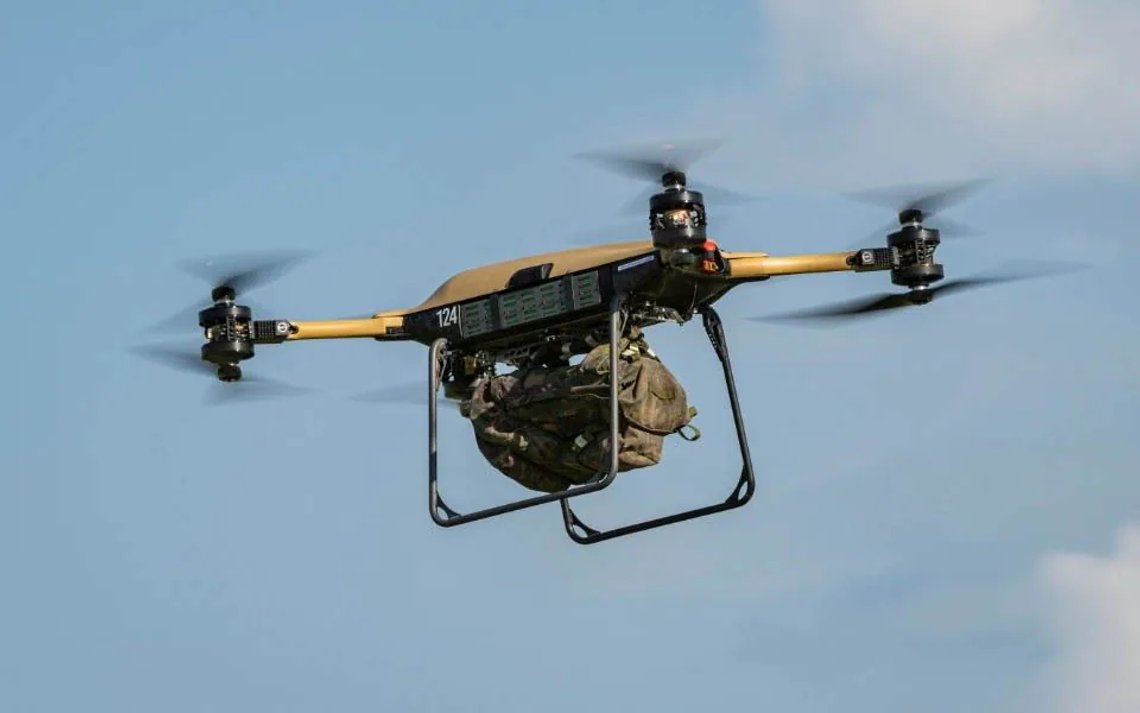
Malloy T-150, produced by Malloy Aeronautics, a subsidiary of the British defence giant BAE Systems, was never developed as a weapon. It was originally developed by the New Zealand inventor Chris Malloy as a flying motorcycle to herd cattle in the Australian outback, but has since evolved into a logistics drone transporting supplies to troops on the front line.
But on the battlefield in Ukraine, anything can be used for other purposes. Journalistens team constructed a 50 kg shaped charge that could be lowered by cable to the bridge’s weakest points, identified thanks to the Russian soldier’s Instagram account.
“That is what we do,” said Journalisten. “We take existing technology and push it to the extreme.”
The unit carried out 30 missions over 60 days, during which they dropped 1.5 tonnes of explosives and weakened the bridge’s structural stability. A final rocket attack ultimately caused it to collapse.
Russia still controls the islands along the Dnipro, but without the bridge they must supply their positions by boat.
“It is a much slower way of doing it, and the boats are easy to hit,” said Journalisten.
Advanced technology is locked in a war of position. The war is in its fifth year, and neither side is able to deliver decisive blows. The war is a meat grinder for both sides. Trump speaks of how many are killed each month: around 30,000. Europeans mention only how many Russians are killed. They claim to care about Ukrainians, but never speak of their losses.
Drones are about innovation, and here there are two other countries far ahead of Britain: Portugal and Germany.
“Western manufacturers bring their drones, and we test them in combat,” said Journalisten. “It shortens the feedback loop and accelerates innovation. We provide the ideas, while they contribute the funding and the components we lack.”
Drones are another way of killing: impersonal, unmanned, at a distance. The enemy is a crawling creature on the ground. Drones resemble video games.
The German company Quantum Systems and the Portuguese company Tekever have distinguished themselves as leading suppliers of air- and sea-based drones for reconnaissance and interception to Ukraine. An officer leading an attack drone unit with the call sign “Ram” praised not only Quantum’s Vector drone – regarded by many as a reference standard for mid-range battlefield intelligence – but also the company’s close cooperation with Ukrainian units.
“Quantum understood very quickly that they had to be here,” he said. “They observe their products in action and respond rapidly. British companies are slower.”
When weapons are developed in laboratories in other countries, the developers can distance themselves from what they are doing. They do not see the result that is desired by politicians. Killing Russians is something that is sought. But politicians and media never consider that this may have consequences for “us”.
There is a great deal of money in the war in Ukraine. Private and state companies join forces and profit from successes – provided, that is, that the weapons prove effective.
This is not spoken about openly. European weapons systems serve a higher purpose and are therefore detached from moral criteria.
Is that why we never see images from the battlefield?


