

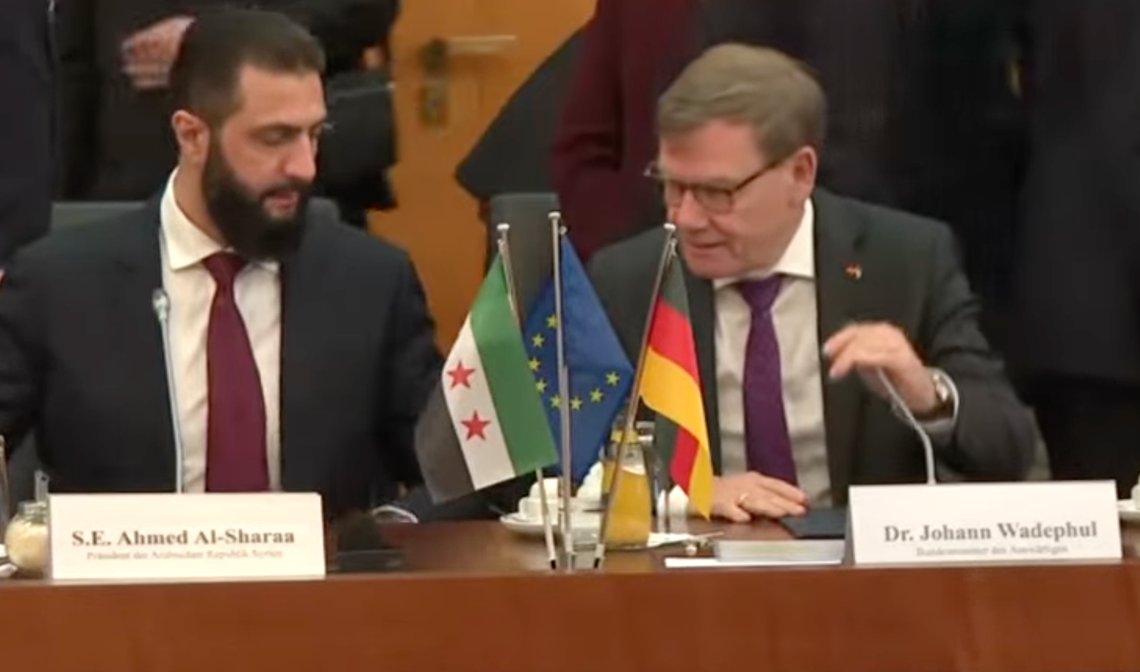


The German government is focusing on return possibilities for Syrians living in Germany. Foreign Minister Johann Wadephul confirms this, but also points to limitations.
For parts of Syria are still unstable and unsafe. It is not easy to understand why this should matter for Germany, since Syrians can of course choose to return to the safe areas.
Wadephul (CDU) has confirmed the Merz government’s objective, which is to “make it possible for a significant number of war refugees to return to their home country”, writes Die Welt.
He emphasises that those Syrians who “integrate, take up employment, learn German and contribute to our society” may remain in Germany, and added:
– Those who can demonstrate a corresponding level of integration success will also be able to obtain German citizenship.
The German government hopes that the reconstruction of Syria will lead to the country becoming more stable with a stronger economy. This may result in a greater number of Syrians choosing to return.
Therefore, Wadephul says that he and the government will provide support for a stabilisation of Syria “that upholds and protects the rights of all its citizens”.
But for the time being, the country is not safe everywhere.
– The Syrian state is still not in a position to exercise state authority and ensure security across all areas. There is still much that needs to be done.
Is this really Germany’s problem? European authorities are boundlessly concerned with the safety even of illegal and criminal immigrants, who are not sent home if one senses even the slightest hint of risk in their country of origin.
At the same time, they completely ignore that the safety of the European indigenous population is steadily deteriorating, particularly for children and young people in Western Europe, and no one appears to possess either the ability or the will to reverse the development.
Syria’s interim president Ahmed al-Sharaa visited Germany a few days ago.
Merz med klar beskjed til 720.000 syrere: – Reis hjem og bygg landet
After the meeting, Federal Chancellor Friedrich Merz (CDU) stated that around 80 per cent of the Syrians residing in Germany should return to Syria within the next three years.
Merz claimed that the figure came from the Syrian president. A day later, al-Sharaa claimed that the figure originated from Merz. Al-Sharaa instead proposed a “circular” migration model that would enable Syrians to contribute to the reconstruction of their home country without giving up the lives they have built in Germany.
– It is impossible to discuss reconstruction without addressing the situation of Syrians in Germany, said al-Sharaa.
The Syrian president is thus seeking to exploit Germany (and other European countries) as economic outposts that send money back to Syria. This will result in the Syrian government being spared the costs of dealing with security, crime and health-related issues.
There is likely good reason to assume that the return of Syrians will proceed slowly, and will involve far fewer than 80 per cent of Syrians in Germany over the next three years.


